

 12 min read
Choosing a software development outsourcing model affects more than cost. It determines who manages developers, who is accountable for delivery, and how much control your business retains. The wrong arrangement can turn an affordable proposal into an expensive management problem.
There are three decisions to make: engagement (how the external team works with you), pricing (how you pay), and location (where the team works). These choices can be combined. For example, you can hire a dedicated offshore team under a monthly capacity agreement.
This guide compares the models, explains their tradeoffs, and helps you choose an arrangement that fits your project, budget, and internal management capacity.
Not Sure Which Outsourcing Model Fits?
Discuss your project needs and find an engagement approach that fits your team, scope, and level of control.
Book a Free CallWhat Are Software Development Outsourcing Models?
Software development outsourcing models (also called software outsourcing models or software outsourcing business models) are arrangements for organizing external development work. They establish how teams collaborate, how services are billed, and where delivery takes place.
There are nine common types of software development outsourcing models across three categories: three engagement models (staff augmentation, dedicated team, and project-based), three pricing models (fixed price, time and materials, and monthly capacity), and three location models (onshore, nearshore, and offshore).
Category | Main decision | Common options |
|---|---|---|
Engagement | Who manages work and delivery? | Staff augmentation, dedicated team, project-based outsourcing |
Pricing | How are costs charged and controlled? | Fixed price, time and materials (T&M), monthly capacity |
Location | Where does the provider operate? | Onshore, nearshore, offshore |
Start with management responsibilities, then scope and pricing, and finally location. A low rate is not useful if your business lacks the people needed to direct the work.
Looking to Outsource Your IT Projects?
Enosis Outsourcing helps technology leaders scale their teams with expert offshore engineers. Get a free consultation today.
Get a Free ConsultationEngagement-Based Outsourcing Models: Who Manages the Work?
There are three engagement-based outsourcing models: staff augmentation, dedicated team, and project-based outsourcing. They define how your business works with external developers and who is responsible for managing delivery.
Staff Augmentation
Staff augmentation adds external specialists to an existing team. They follow your processes and receive direction from your managers. Your business remains responsible for priorities, architecture, progress, and delivery.
Best fit: An established engineering team needs extra capacity or a skill such as DevOps or AI integration for a limited period.
Advantages: Direct control, access to specialist skills, and flexibility to adjust staffing.
Limitations: Your managers must onboard, coordinate, and review the work. More developers will not fix weak internal processes.
For example, a SaaS company can use staff augmentation to add two external engineers while keeping sprint planning and technical decisions in-house.
Dedicated Development Team
A dedicated team provides a relatively stable group of developers and other specialists for ongoing work. The continuity helps people learn the product and adapt as priorities change. Some providers sell this arrangement as team as a service (TaaS). This model is easier to scale than project-based outsourcing. You can adjust team capacity without renegotiating project scope.
Best fit: A company needs recurring development capacity for a SaaS platform or a series of releases.
Advantages: Product knowledge, consistent collaboration, and the ability to change priorities.
Limitations: You commit to ongoing capacity and still need clear leadership and work priorities.
A dedicated team is not necessarily provider-managed. Some report to your technical lead; others include a provider-side delivery manager. Before signing, agree on who owns the backlog, how quality is reviewed, and what the provider is obligated to deliver. Paying for a team does not itself guarantee an outcome.
Project-Based Outsourcing
In project-based outsourcing, a provider takes responsibility for completing an agreed project or set of deliverables. It normally manages the delivery team and execution. Your business still approves requirements, supplies information, and accepts completed work.
Best fit: You have a defined objective, such as an inventory application, and want the provider to manage implementation.
Advantages: Less daily staff management and clearer delivery ownership.
Limitations: Unclear requirements can cause rework, disputes, and delays. Client decisions and approvals remain necessary.
Project-based outsourcing is an engagement model, not a synonym for fixed-price contracting. It can use fixed-price or T&M terms. Agree in advance how the contract handles change requests, acceptance, and ownership of the finished work.
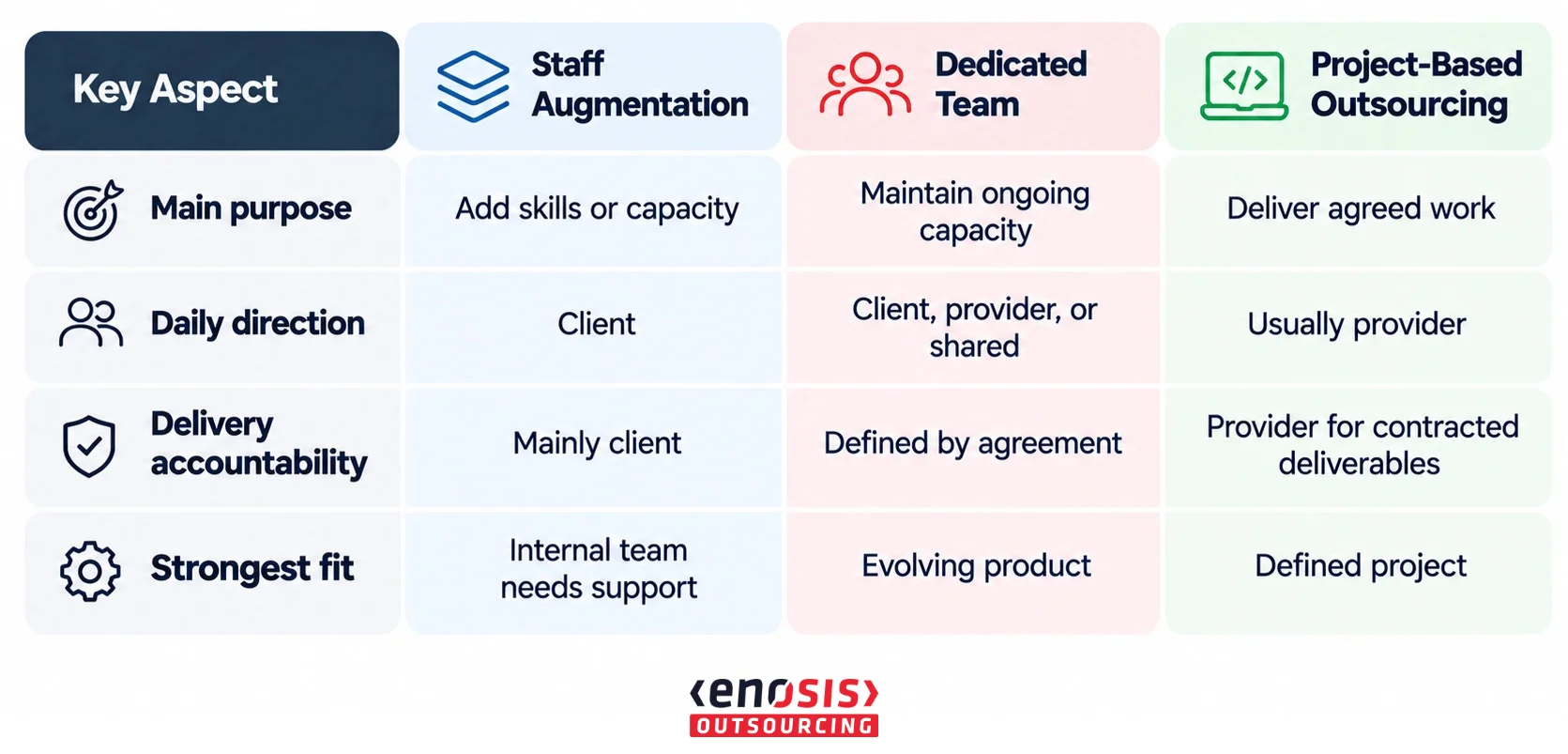
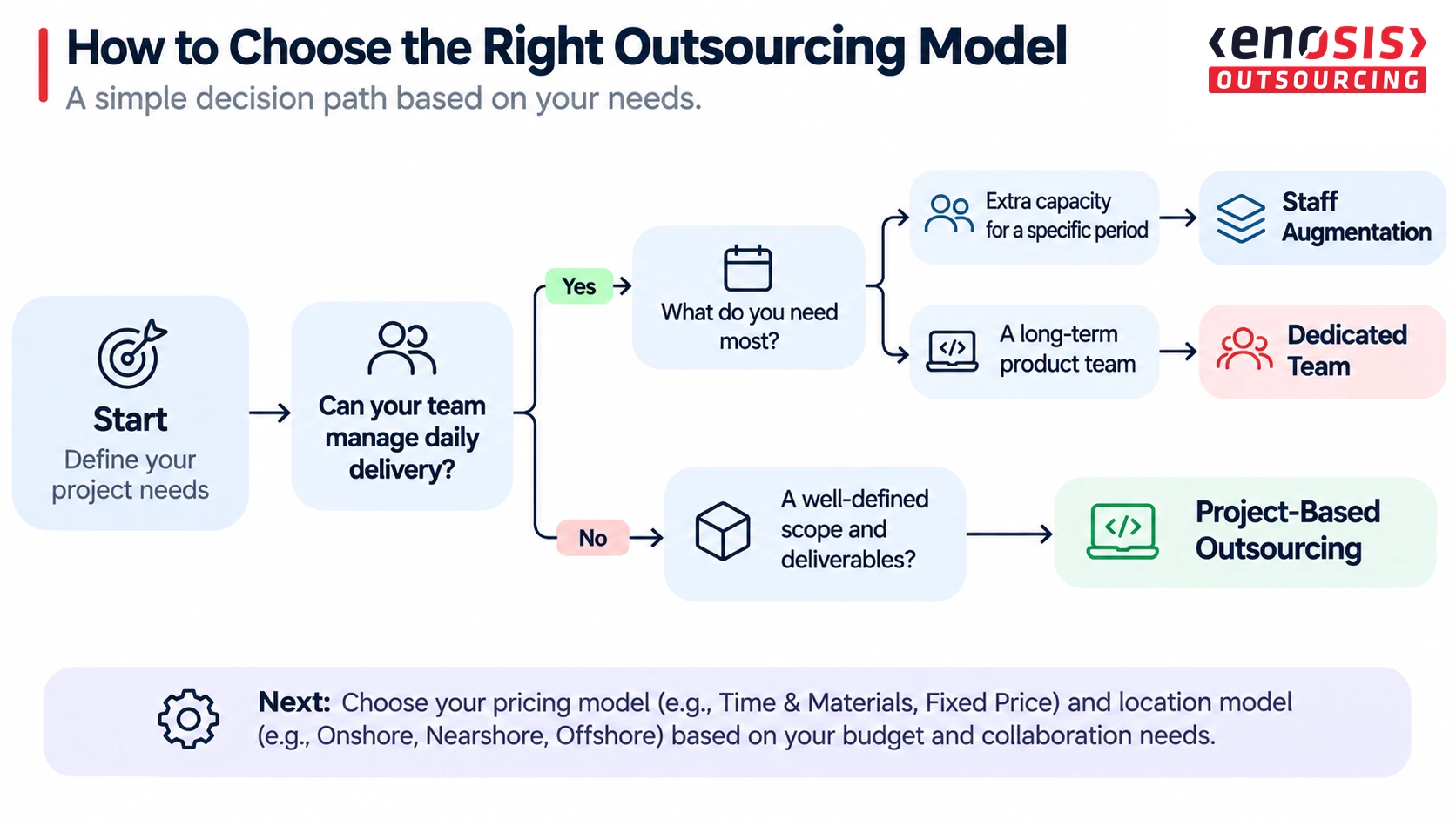
Decision rule: If your team can manage delivery, augmentation may be enough. If you need continuity, consider a dedicated team. If you want the provider to manage execution, consider project-based delivery.
Managed services are another provider-led option for ongoing functions such as application maintenance or cloud operations. Unlike staff augmentation, the provider takes responsibility for agreed services and performance levels.
Cost-Based Pricing Models: How Do You Pay for Delivery?
The three main pricing models are fixed price, time and materials (T&M), and monthly capacity. Each changes how costs are controlled and financial risk is shared. The right choice depends on how clearly you can define the work and how often priorities may change.
Fixed Price
Fixed-price outsourcing is a pricing arrangement where you and the provider agree on one fee for defined deliverables, often with milestones and acceptance criteria. This works well when requirements are stable and outcomes can be specified.
The advantage is cost predictability for the agreed scope. The tradeoff is that changes can require new estimates, fees, or deadlines. A fixed fee does not guarantee quality or eliminate oversight. Before signing, check exclusions, change requests, and how acceptance will be demonstrated.
Time and Materials (T&M)
Time and materials (T&M) is a pricing model where you pay for actual work, usually at agreed hourly or daily rates plus authorized expenses. T&M suits projects where scope evolves during development.
It offers flexibility but makes total spending less certain. Set budget review points, require useful progress reports, and agree on approval thresholds. Ask the provider to show completed work alongside hours billed, so spending discussions focus on progress rather than activity alone. If the budget runs out before the work is done, review the priorities and scope. Do not let spending continue without approval.
Monthly Capacity-Based Pricing
Monthly capacity pricing is a recurring fee for agreed capacity, such as specified team roles or available development hours. It suits ongoing work with relatively steady staffing needs.
Spending on capacity is predictable, but completed features are not guaranteed. Confirm availability, holidays, replacement provisions, unused capacity, and notice periods.
Pricing model | Best when | Main cost risk | Control to use |
|---|---|---|---|
Fixed price | Scope is stable | Change requests | Clear deliverables and acceptance |
T&M | Requirements evolve | Effort exceeds estimate | Reports and spending limits |
Monthly capacity | Work is continuous | Unused capacity | Staffing and utilization reviews |
No method is automatically cheapest. Compare the likely total cost, including your management time and potential rework. AI-assisted tools can change project estimates, although their effect varies by task and contract. These changes also influence how software outsourcing services are priced.
Once the pricing arrangement fits your project's scope and budget, consider where the development team should operate. Location affects collaboration, access to talent, and coordination costs, but it should not determine who manages delivery.
Location-Based Outsourcing Models: Where Should Your Team Work?
Location-based models include onshore (same country), nearshore (nearby country), and offshore (more distant country). Location affects collaboration, travel, talent access, and some costs. It does not determine who manages the team or whether the provider is capable or compliant.
Onshore Outsourcing
An onshore provider operates in the same country as your business. A U.S. company hiring a firm in another U.S. state is outsourcing onshore. Onshore does not mean onsite: the team may work remotely.
Best fit: You need familiar working hours, domestic stakeholder coordination, or frequent in-person sessions. Travel may be easier, although domestic rates can be higher in some markets. Being in the same country does not automatically establish GDPR, HIPAA, or other compliance.
Nearshore Outsourcing
Nearshore providers work in nearby countries or regions. U.S. companies may use teams in Mexico or Costa Rica for convenient working-hour overlap.
Best fit: You need frequent live discussions while expanding your talent options internationally. Costs and communication quality differ across firms. Compare actual schedules, language skills, and data-handling arrangements rather than assuming proximity solves everything.
Offshore Outsourcing
Offshore delivery involves a more distant country, such as a U.S. buyer working with developers in India, Bangladesh, Pakistan, or Vietnam. It may provide broader talent access and competitive costs.
Best fit: You can coordinate remote work and have clear requirements, documentation, and review routines. Time differences can slow urgent decisions unless overlapping hours and escalation procedures are arranged. Offshore does not automatically mean low quality or low control.
Hybrid and Multishore Delivery
A business can combine domestic product leadership, a nearshore delivery lead, and offshore engineering capacity. This may balance collaboration and costs, but only when decision rights and handoffs are clear.
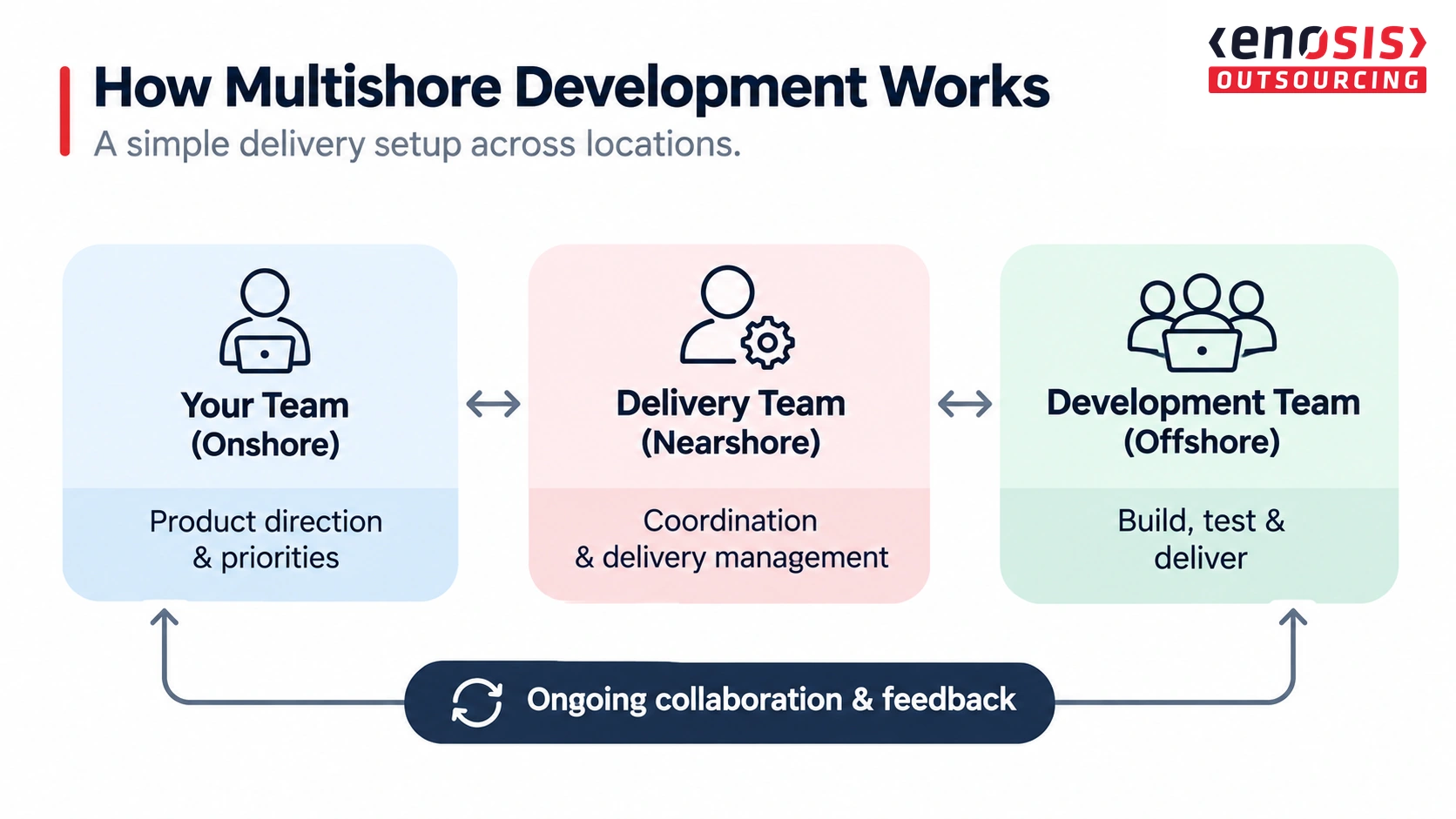
Factor | Onshore | Nearshore | Offshore |
|---|---|---|---|
Location | Same country | Nearby country or region | More distant country |
Working-hour overlap | Often high | Often substantial | Varies; sometimes limited |
In-person access | Generally easier | Often practical | Longer travel may be needed |
Cost potential | Can be higher | Varies | Can be lower |
Priority to verify | Skills and domestic coordination | Real overlap and communication | Handoffs and delivery governance |
Location should support the engagement and pricing decisions, not override them. With all three categories understood, the next step is to evaluate them against your project's requirements and your team's management capacity.
Need Help Choosing the Right Outsourcing Partner?
Tell us what you need, and we’ll help you identify companies that fit your project requirements.
Schedule Your Free CallHow to Choose the Right Software Development Outsourcing Model
Start with the responsibilities your business can manage, then match the contract and location to the work.
1. Assess Your Internal Management Capacity
If your engineering leaders can assign work, review code, and resolve blockers, staff augmentation may fit. If they cannot manage daily delivery, look for a provider-led arrangement. For a dedicated team, confirm who supplies the technical lead.
2. Evaluate Scope and Pricing Flexibility
Stable requirements and testable deliverables can support fixed-price project work. Uncertain requirements call for discovery, change control, or flexible pricing. A detailed software development scope of work should define those boundaries.
3. Assign Decision Rights and Budget Controls
Define who approves priorities, architecture, additional spending, and completed work. Compare the full cost of each option, including your own management time, onboarding, testing, and possible rework.
4. Check Collaboration and Security Needs
Confirm working-hour overlap, access restrictions, and applicable data requirements. When choosing a software development company, check evidence from comparable projects rather than relying only on rates.
Project condition | Starting arrangement | What to verify |
|---|---|---|
Internal team needs additional skills | Staff augmentation + T&M | Internal leader has capacity |
Ongoing product with changing priorities | Dedicated team + capacity pricing | Product ownership and team continuity |
Defined deliverables; provider manages work | Project-based + fixed price | Acceptance and change process |
Uncertain scope; provider leads discovery | Project-based + controlled T&M | Spending checkpoints and decision rights |
Use this table as a starting point, not a formula. Location can be combined with any arrangement. Before comparing proposals, share the same project brief and ask providers to identify their assumptions and the work your team must still perform.
Which Outsourcing Model Fits Different Project Scenarios?
Real projects often reveal a constraint that changes the first recommendation.
An Evolving SaaS Product Without a Product Owner
A dedicated team with recurring capacity pricing suits changing features, but developers still need someone to set priorities. If you lack a product owner, the provider may need to supply one. The agreement should clarify who makes business decisions. Hiring more developers alone will not solve the gap.
An Inventory Dashboard With Uncertain Integrations
A retailer may initially prefer a fixed-price project. But if the quality of its existing data and APIs is unknown, pricing the entire build upfront creates dispute risk. A short discovery phase can establish integration requirements and acceptance tests before the parties agree on the implementation price.
Application Maintenance With Urgent Support Needs
A recurring team can handle bug fixes and planned enhancements. Yet critical incidents may require response coverage outside normal development hours. Define response times, escalation ownership, and what counts as extra work. Expected software maintenance costs should reflect that support obligation, not just developer capacity.
These examples show why the engagement model, price, and location are only part of the decision. The responsibilities written into the agreement determine whether the arrangement will work.
Emerging Trends in Software Development Outsourcing Models
The market is still growing, but buyers are changing how they structure and pay for outsourced development. Mordor Intelligence estimates the software development outsourcing market at $618.4 billion in 2026 and projects about $977 billion by 2031, a 9.6% annual growth rate. Other research firms publish different totals because they define the market differently, so treat any single figure as directional.
Four shifts affect which model you choose:
Pricing is moving toward outcomes. Forrester's State of Technology Services 2026 report identifies AI and outcome-based pricing as the leading themes in technology services. Expect more proposals that combine capacity fees with milestone payments or performance incentives. These terms only work when outcomes can be measured and agreed in advance.
AI-assisted delivery is changing estimates. Providers using AI coding tools may quote fewer hours for some tasks. Ask how they use AI, who reviews AI-generated code, and whether productivity gains are reflected in the price.
Nearshore is growing fastest. Offshore delivery held 51.85% of the market in 2025, but Mordor projects nearshore to grow 13.95% a year through 2031, faster than the market overall.
Software budgets are outpacing services. Gartner's July 2026 forecast puts 2026 software spending growth at 15.5%, against 5.3% for services. That gap puts pressure on providers to show value per contract rather than headcount.
None of these trends changes the core decision: settle responsibilities first, then pricing, then location.
What Should You Control After Outsourcing?
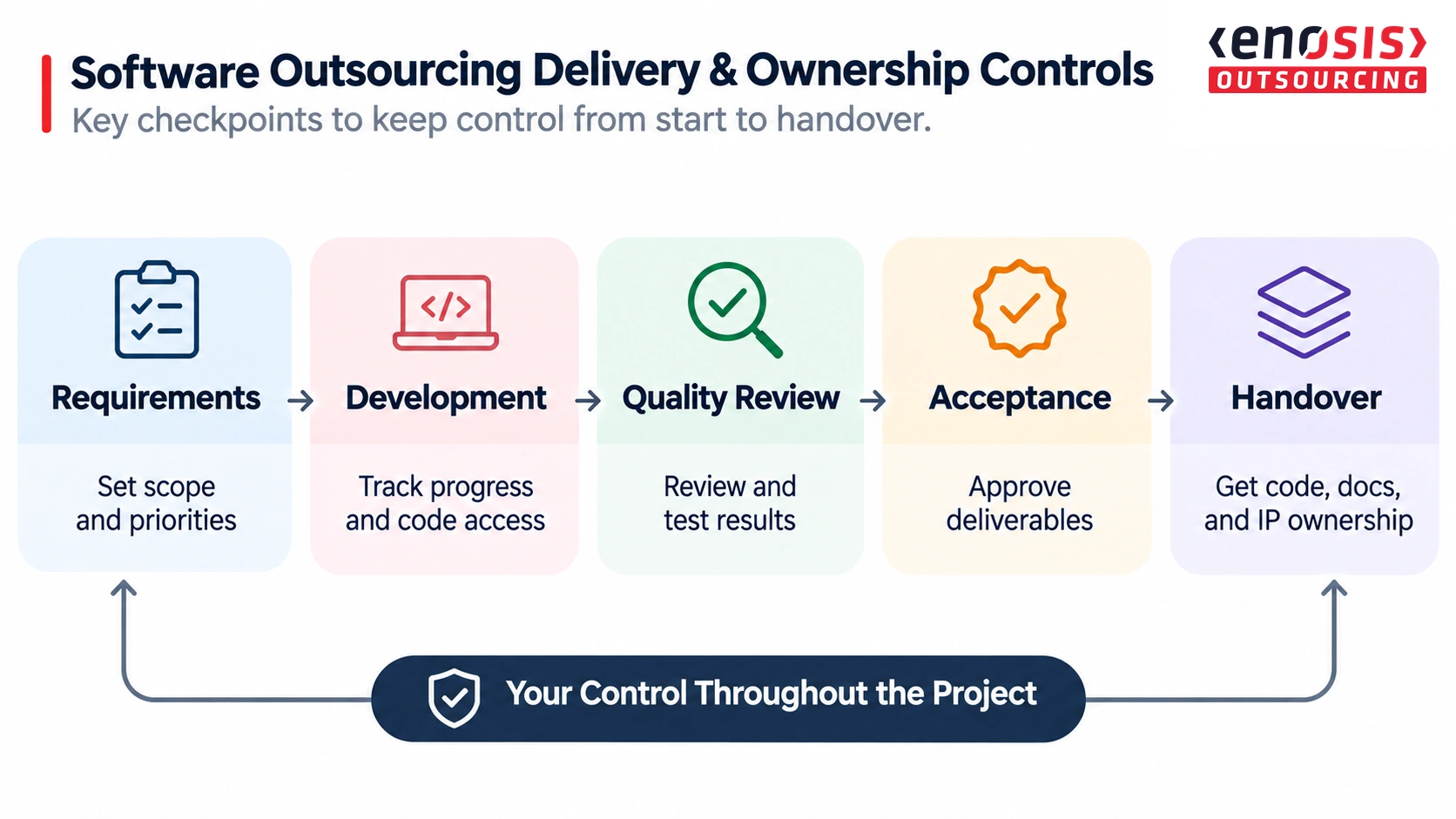
Outsourcing development does not mean giving up control of the results. Keep clear decision rights, reviewable quality evidence, and access to the assets you need after the engagement ends.
Roles and Decision Rights
Identify who approves features, architecture changes, additional spending, and final deliverables. The provider may make routine implementation decisions, but your company should retain authority over business priorities. Set a clear escalation path when teams disagree.
Quality and Acceptance
Write testable acceptance criteria before work begins. Require appropriate code reviews, testing evidence, defect tracking, and security checks. Depending on risk, a code quality assessment may help validate delivered software. Do not assume that payment or a completed sprint means acceptance.
IP, Documentation, and Exit
Specify ownership and usage rights for source code, designs, and documentation. Define access to repositories, environments, and accounts. Require handovers during development, not only at the end, so another team can continue the work if needed.
Area | Question your agreement must answer |
|---|---|
Decisions | Who approves scope, architecture, and budget changes? |
Quality | What tests and evidence are required for acceptance? |
Security | Who controls access and reports incidents? |
Ownership | What rights and deliverables transfer to the client? |
Exit | How are code, credentials, and knowledge handed over? |
The goal is not to approve every task. It is to retain control over decisions that affect cost, risk, and long-term ownership.
Looking for Companies With the Right Expertise?
Explore software development companies by service and narrow your options around what your project requires.
Find Relevant CompaniesCommon Mistakes When Choosing an Outsourcing Model
Starting with the cheapest location. Define delivery responsibilities first. A low rate can be offset by delays and added management effort.
Treating dedicated capacity as guaranteed delivery. A dedicated team provides people; the contract must specify any outcome commitments.
Fixing a price before defining the work. Uncertain scope creates change requests and disputes. Use discovery or a flexible pricing structure when needed.
Augmenting a team that cannot manage more people. Extra engineers still need direction, reviews, and integration with existing processes.
Ignoring handover and ownership. Agree on code access, documentation, IP rights, and exit procedures early. These are practical IT outsourcing risks to manage, regardless of model.
Final Takeaway
Choose your outsourcing model by deciding what your business can manage and what the provider must deliver. Staff augmentation fills skill gaps, dedicated teams provide continuity, and project-based outsourcing supports defined delivery responsibilities. Pricing should fit scope uncertainty; location should support collaboration.
Before signing, confirm accountability, budget controls, acceptance criteria, ownership, and exit arrangements. The best model is the one whose responsibilities, costs, and risks your business can manage in practice.