

 6 min read
Mexico’s rise from 13th to 11th on the Kearney Global Services Location Index (GSLI) reflects more than an incremental ranking shift. It signals a structural change in how global companies evaluate outsourcing destinations. IT outsourcing in Mexico is no longer framed purely as a cost-saving measure. It is increasingly viewed as a way to expand innovation capacity, scale delivery teams, and improve operational resilience.
IT outsourcing in Mexico now sits within a broader move toward nearshoring in North America, as companies place greater value on proximity, faster collaboration, and tighter operational alignment alongside cost efficiency. For organizations across the United States and Europe, Mexico offers a combination that is difficult to replicate elsewhere: time zone compatibility, cultural familiarity, competitive development rates, and a technology ecosystem that has matured steadily over two decades.
Strategic Recap: IT Outsourcing in Mexico's Innovation
This recap highlights Mexico’s growing prominence in global IT delivery models.
i. Key Benefits
Time zone compatibility with the US and Canada for real-time collaboration and agile workflows.
Large and growing tech talent pool, supported by strong STEM graduates and a maturing tech education system.
Competitive labor costs with high delivery quality, offering optimal cost efficiency for outsourcing software development.
The Mexican government is fueling IT sector growth through initiatives like “500 Startups LATAM”, over 20 tech parks, and the “Fondo Nacional Emprendedor.”
ii. Key Challenges
Talent shortage in niche skill areas due to increasing global demand.
Geopolitical instability in certain regions requires careful vendor location selection.
Varying levels of English proficiency among software developers can affect communication skills.
Looking to Outsource Your IT Projects?
Enosis Outsourcing helps technology leaders scale their teams with expert offshore engineers. Get a free consultation today.
Get a Free ConsultationTech Ecosystem
IT outsourcing in Mexico’s capacity is anchored in cities like Mexico City, Guadalajara, and Monterrey, with emerging hubs such as Querétaro and Tijuana drawing attention for lower outsourcing costs and expanding developer networks.
The tech education system produces over 200,000 engineering and technology graduates annually, making Mexico one of Latin America’s largest producers of STEM talent. Institutions like Tecnológico de Monterrey and Universidad Nacional Autónoma de México (UNAM) play a pivotal role in advancing software engineering, data analytics, and AI development capabilities. This north american country has 300,000 tech specialists according to 2024 data. For US based companies, nearshore destinations such as Mexico offer a strategic advantage thanks to their close time zone proximity, typically just one to three hours apart. This alignment enables seamless real-time communication and enhances workflow coordination, resulting in more efficient and collaborative operations.
Innovation thrives in clusters like Guadalajara’s Digital Creative City and Mexico City’s startup accelerators, fostering R&D centers, DevOps services, and AI-driven personalization projects for global clients.
Boom of the IT Industry
Mexico’s technology sector did not grow overnight. Its current position as a nearshore IT destination is the result of two decades of policy decisions, infrastructure investment, and steady demand from global markets.
Early 2000s: NAFTA-era reforms sparked a major shift in Mexico’s tech scene. As trade barriers fell, global companies began setting up engineering and software hubs in Guadalajara, earning it the nickname “Silicon Valley of Mexico.” This transition moved the country beyond low-cost manufacturing into high-value IT services and business process outsourcing.
2010–2018: The government’s National Digital Strategy, including the “Internet for All” initiative, laid the groundwork for improved digital access and cloud adoption. These efforts expanded internet infrastructure, boosting digital inclusion across both urban and rural regions.
2019–2023: Surge in offshore development and nearshore outsourcing fueled by U.S. demand for software solutions and project management expertise.
2024–2025: Momentum in innovation continues to build. Microsoft announced a $1.3 billion investment to enhance cloud computing and AI infrastructure in Mexico, focusing on connectivity and accelerating AI adoption among small and medium-sized businesses.
Also, Mexico has also been ahead of the curve when it comes to AI policy. In 2018, it became the first country in Latin America, and one of the first ten globally to launch a national AI strategy. This early move highlights Mexico’s commitment to responsible AI development and long-term innovation planning.
Looking for Companies With the Right Expertise?
Explore software development companies by service and narrow your options around what your project requires.
Find Relevant CompaniesOutsourcing Operations and Models
Mexico’s IT outsourcing sector provides flexible software outsourcing models that balance cost, control, and scalability, helping businesses align with their digital transformation goals.
Staff Augmentation Model integrates Mexican software engineers, QA specialists, and project engineering talent directly into an existing in-house team. Ideal for filling skill gaps or scaling up quickly for specific sprints, it enables organizations to tap into Mexico’s diverse programming languages expertise without the long-term overhead of full-time hires.
Dedicated Teams Model involves outsourcing firms building full, client-focused units, complete with leads, managers, and developers, to deliver long-term software solutions with consistent quality, backed by Mexico’s solid legal and IP protections.
Project-Based Development Model is best for fixed-scope initiatives like Minimum Viable Products (MVPs), mobile app development, or cloud solutions. This model delivers defined outcomes within set budgets and timelines.
Hybrid Models combine nearshore outsourcing from Mexico with in-house strategic direction. These models maximize cost optimization while preserving tight control over technical requirements and core IP. This approach is often chosen for high-complexity projects that require real-time collaboration, along with agile iteration cycles.
Top IT Outsourcing Companies in Mexico
The following companies represent a cross-section of established IT outsourcing providers in Mexico, evaluated based on delivery scale, pricing benchmarks, and areas of technical specialization.
Company | Clutch Rating | Hourly Rate | Team Size | Specializations |
|---|---|---|---|---|
Sonatafy Technology | 5 | $50–$99/hr | 130+ | Custom software, cloud solutions, nearshore outsourcing, healthcare & fintech solutions, strong English proficiency |
ClickIT | 5 | $25–$49/hr | 70+ | DevOps services, software engineering, AWS/Azure/Google Cloud, software quality assurance |
Unosquare | 5 | $25–$49/hr | 500+ | Agile software development, software quality assurance, nearshore collaboration, project management, data engineering |
Definity First | 5 | $50–$99/hr | 200+ | Software engineering, project management, AI-driven personalization, IT services, digital transformation |
Why Global Companies Choose Mexico
What draws global organizations to Mexico is not a single advantage, but a set of conditions that work well together in day-to-day delivery.
Time Zone Advantage: Overlaps with US Central and Pacific Time zones enable same day communication, real-time sprint reviews, and faster iteration cycles, accelerating delivery without extending working hours.
Cultural Compatibility: Shared collaboration styles and business norms reduce onboarding friction, improving project management efficiency and strengthening nearshore outsourcing relationships.
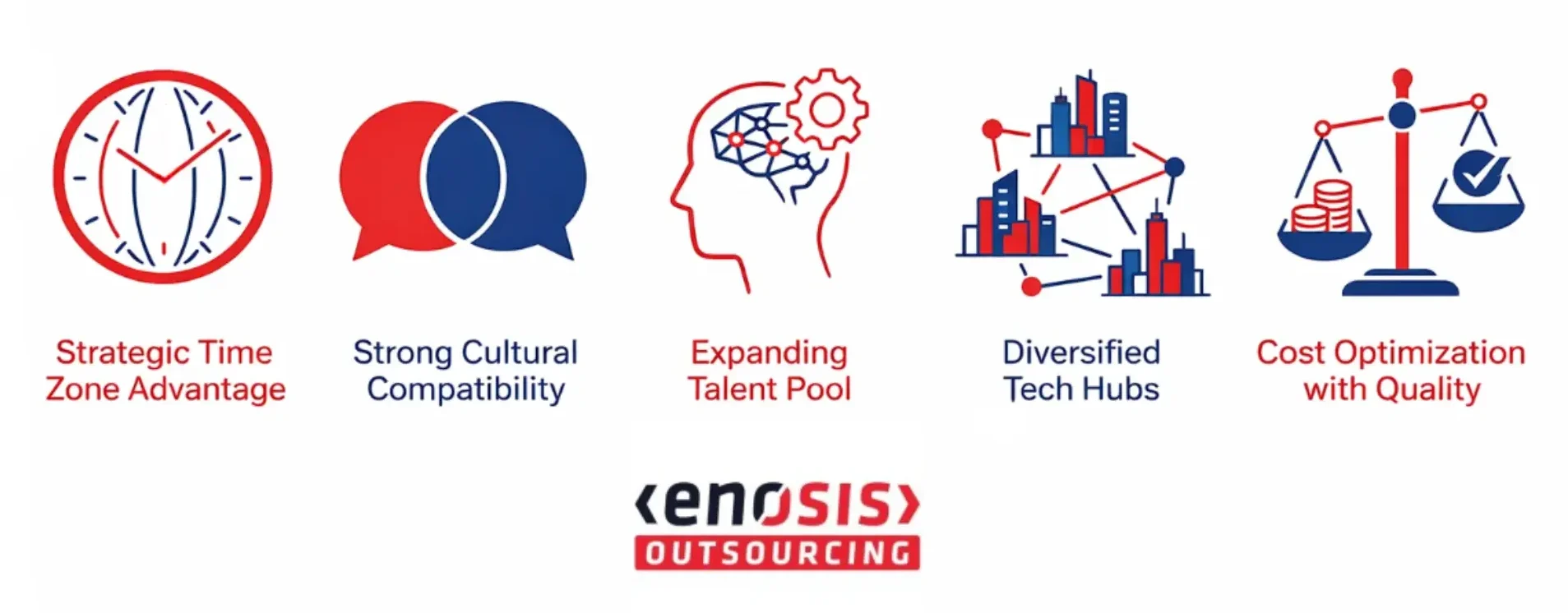
Expanding Talent Pool: A steady pipeline of STEM graduates and specialized software engineers supports demand in custom software, AI development, cloud computing, and data engineering.
Diversified Tech Hubs: In addition to Guadalajara and Monterrey, emerging cities like Querétaro and Tijuana are building competitive IT outsourcing ecosystems with lower labor costs and strong retention rates.
Cost Optimization with Quality: Software development rates remain 40–50% lower than in the US, while robust quality assurance standards and legal frameworks ensure secure, high quality delivery.
Want to See What a Vendor Has Actually Delivered?
Explore real project experience to understand a company’s capabilities before adding it to your shortlist.
Explore ProjectsReturn on Innovation
Mexico’s outsourcing benefits extend beyond cost efficiency:
Retention: Nearshore locations reduce attrition with long-term project engagement.
Iteration Speed: Shorter feedback cycles accelerate software engineering sprints.
Delivery Efficiency: Mature project management frameworks ensure high quality standards and consistent timelines.
Risk Considerations
Mexico remains a strong nearshore option, but execution quality depends on how a few common risks are managed at the outset.
English Proficiency Variance: Vet for bilingual project managers and customer support staff.
Regional Security Concerns: Choose vendors in stable, tech-focused cities with low risk.
Talent Shortage in Emerging Tech: Partner with firms offering strong technical education pipelines.
IP Protection: Ensure contracts follow international Intellectual Property and data privacy compliance.
Vendor Selection Checklist
Select vendors with:
Industry specific expertise (e.g., healthcare, fintech);
Proven global delivery and international track records;
Agile processes and robust IP security protocols;
Scalability to handle growing project demands over time;
Adequate team size to ensure resource depth;
Positive client feedback and case studies demonstrating impact;
Multi-time-zone support for seamless distributed team coordination;
Transparent pricing models with clear cost breakdowns.
Need Help Building Your Vendor Shortlist?
Tell us what you're looking for and get help identifying companies relevant to your requirements.
Get a Free ConsultationFinal Takeaway
Mexico’s rise as a nearshore outsourcing leader comes down to four key strengths: a fast-growing pool of tech talent, close time zone alignment with North America, competitive yet sustainable development rates, and a stable business climate. These advantages are backed by continued investment in digital infrastructure, STEM education, and innovation hubs in cities like Guadalajara and Monterrey.
For companies looking to speed up digital transformation without compromising on quality or blowing their budget, Mexico offers a rare balance, scalability, cultural alignment, and the technical expertise to support long-term software innovation.