

 20 min read
In July 2024, a faulty CrowdStrike update brought down 8.5 million Windows devices across airlines, hospitals, banks, and emergency services. Systems stopped at once. The economic impact reached an estimated $5.4 billion within hours.
The failure was not just technical. It exposed concentration risk. Organizations that had placed endpoint security with a single vendor, without an independent fallback, had no way to respond on their own. That incident reframed the discussion. IT outsourcing risk is not a checklist item. It is a strategic exposure that belongs at the executive level.
IT outsourcing risks refer to the operational, financial, legal, and reputational threats that arise when a company delegates technology functions to an external vendor. IBM’s 2024 Cost of a Data Breach Report puts the average cost of a third party breach at $4.88 million, around 17% higher than breaches managed internally.
This guide covers: 12 Critical IT Outsourcing Risks | Vendor Risk Scoring Model | Pre-Contract Due Diligence Checklist | Real Case Studies of Outsourcing Failures | The CLEAR Mitigation Framework | Vendor Evaluation and Monitoring | Enosis Free Consultation for Vendor Shortlisting | FAQ
Why IT Outsourcing Risk Has Changed in 2026
IT outsourcing risk does not look the same as it did a decade ago. The model has scaled, and with that scale, the exposure has changed.
The global IT outsourcing market is projected to exceed $650 billion in 2026, with steady growth above 5%. At that size, the structure shifts. More vendors operate in the market. More subcontracting layers exist. More client data moves across more jurisdictions than before. Each additional layer increases complexity. Complexity is where most risk hides.
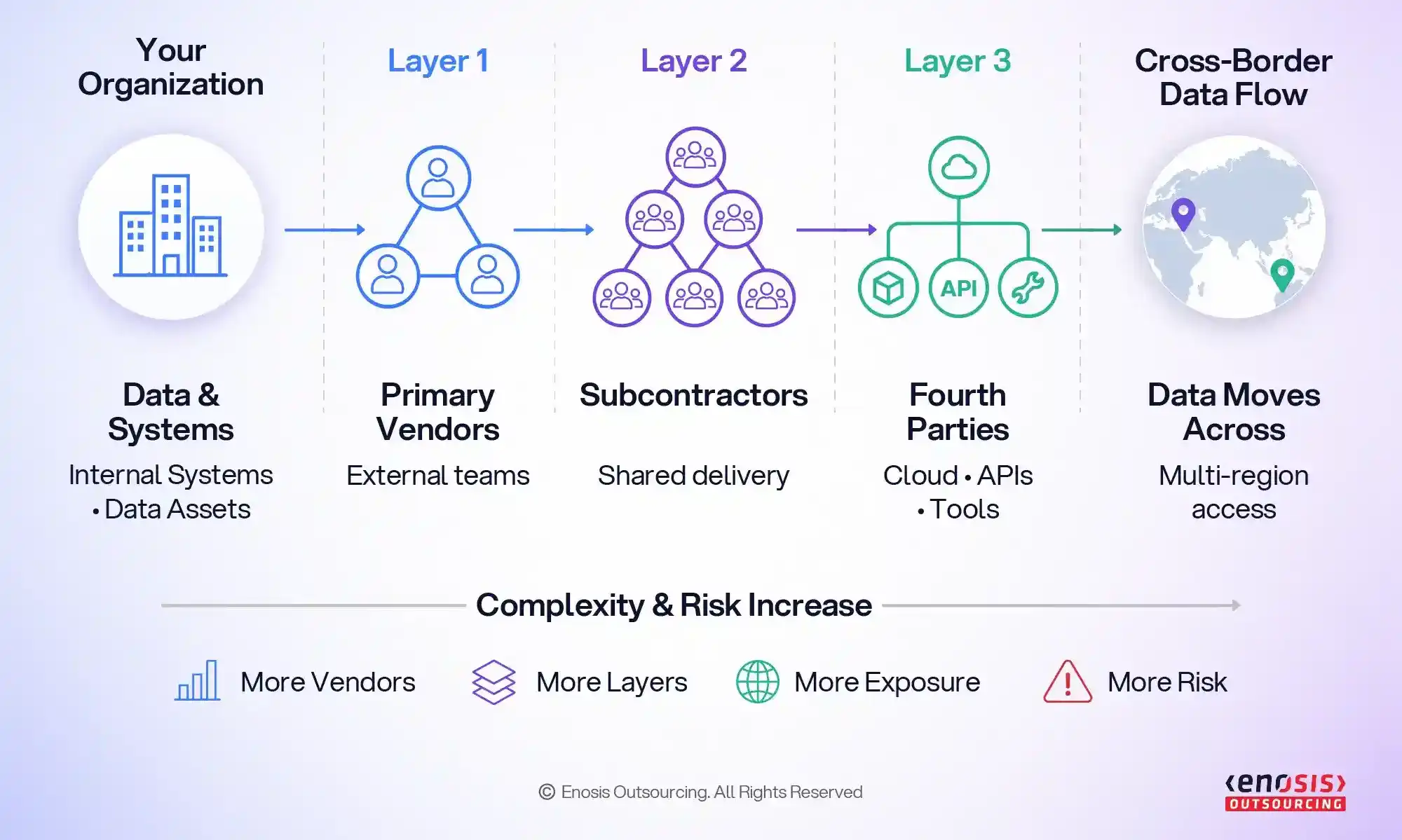
Three shifts in particular have made outsourcing risk harder to control.
The first is the talent market. The shortage of experienced engineers has shifted leverage toward vendors. When hiring is difficult, clients compromise. Exit clauses become weaker. SLA definitions lose precision. Audit rights get negotiated down. The ManpowerGroup 2024 Talent Shortage Report found that 77% of employers globally struggle to fill roles. Vendors are aware of that imbalance, and it shows up in contract terms.
The second is AI adoption inside delivery teams. Tools like GitHub Copilot and ChatGPT are now part of everyday development workflows. Code is written faster, but it is also exposed in new ways. Whether your vendor agreement defines how these tools can be used is often unclear. In many cases, it is not addressed at all.
The third is regulatory pressure. The EU’s Digital Operational Resilience Act (DORA), effective from January 2025, requires financial entities to assess ICT third party risk, maintain vendor registers, and meet strict incident reporting timelines. Similar expectations exist under GDPR Article 28 and SOC 2 Type II requirements in the US. Informal outsourcing arrangements are no longer viable under these conditions.
Need Help Choosing the Right Outsourcing Partner?
Tell us what you need, and we’ll help you identify companies that fit your project requirements.
Schedule Your Free CallThe 12 IT Outsourcing Risks Every Executive Must Evaluate
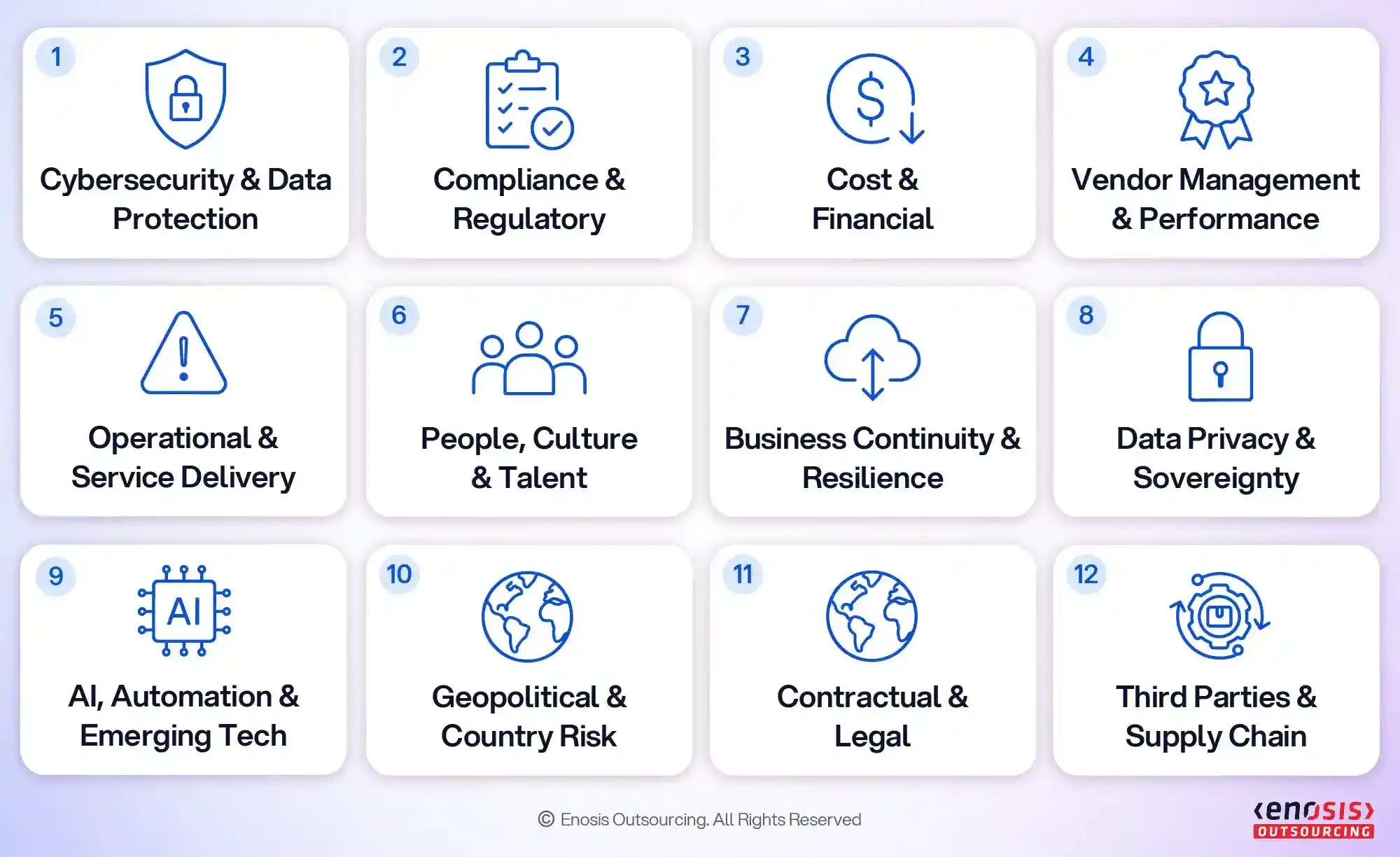
What are the biggest risks in IT outsourcing? They tend to cluster into 12 categories: data exposure, operational control, cost unpredictability, regulatory liability, and geopolitical factors. Each one carries a different level of impact. Each one can be managed, but not without visibility.
The relevance of these risks depends on how your software development outsourcing model is structured. Project based engagements, dedicated teams, and staff augmentation do not carry the same exposure. The model shapes the risk.
Risk 1: Data Security and Third Party Breach Exposure
Severity: Critical
When a vendor has access to production systems, customer data, or financial records, a breach on their side becomes yours. There is no separation at that point.
IBM’s 2024 estimate of $4.88 million per breach reflects the full impact: detection, response, legal handling, and long term reputational cost. Third party incidents tend to be more expensive. They are harder to detect and slower to contain, because the affected environment is outside your direct control.
A less visible layer sits behind this: fourth party exposure. When a vendor subcontracts work, your data can move to organizations you have never assessed and cannot audit. The contract you signed may not cover that path at all.
Mitigation preview: Require SOC 2 Type II certification and regular penetration testing. Include a clause that mandates disclosure of all subcontractors with access to your data, along with explicit approval rights.
Risk 2: Regulatory and Compliance Exposure
Severity: High
Regulatory risk has moved from a background concern to an active constraint.
DORA is now in force for EU financial entities. It requires organizations to register critical ICT vendors, test the resilience of outsourced functions, and meet strict incident reporting timelines. Failure to comply is not just a financial issue. It can carry direct accountability for executives.
GDPR Article 28 adds another layer. Any vendor acting as a data processor must be covered by specific contractual clauses. Referencing compliance in policy documents is not enough. The language must exist in the signed agreement.
For US operations, SOC 2 Type II has become the baseline. It confirms that a vendor’s controls have been tested over time, not just documented. A Type I report provides a snapshot. It does not confirm how those controls perform in practice.
Mitigation preview: Map applicable regulations before contract signature. Then reflect them directly in contract language, using a structured compliance clause matrix.
Risk 3: Hidden and Escalating Costs
Severity: Medium-High
The initial quote rarely reflects the full cost.
Over time, the gap shows up in predictable places. Scope expands. Integration work takes longer than expected. Infrastructure costs sit outside the original estimate. Currency fluctuations affect time and materials contracts. Transition costs appear at the end.
A realistic cost model looks different. It includes base engineering cost, onboarding time with reduced productivity, internal management overhead, and eventual transition effort. That is the actual cost of ownership.
Comparing vendors on hourly rate alone gives a distorted picture.
Mitigation preview: Request a multi year cost projection during evaluation. Define scope boundaries clearly in the SOW and require formal approval for any work outside that scope.
Risk 4: Loss of Operational Control and Institutional Knowledge
Severity: High
Control loss shows up in two ways.
The visible side is execution. Are you seeing what is being built, when it is delivered, and how quality is measured? The less visible side is knowledge.
Over time, system understanding shifts toward the vendor team. Architecture decisions, edge cases, and business logic sit with people who are not part of your organization. When those people leave or rotate out, the knowledge goes with them.
Turnover rates in offshore teams can exceed 20% annually. Each transition creates friction. Re-onboarding slows delivery. Documentation rarely fills the gap fully.
Mitigation preview: Formalize knowledge retention. Require architecture decision records, maintained documentation, and structured handover periods before key personnel changes.
Looking for Companies With the Right Expertise?
Explore software development companies by service and narrow your options around what your project requires.
Find Relevant CompaniesRisk 5: Quality Control Degradation
Severity: Medium
Quality issues rarely appear all at once. They build gradually. Test coverage drops slightly. Code reviews become less thorough. Documentation is delayed. Over several sprints, those small changes compound.
There is also an allocation effect. Vendors serving multiple clients prioritize where attention is most required. Projects with less oversight can receive less scrutiny over time. The result is not immediate failure. It is slow erosion.
Mitigation preview: Keep quality oversight independent from delivery. Track metrics such as test coverage, defect escape rate, and technical debt on a regular basis.
Risk 6: Communication, Cultural, and Timezone Failures
Severity: Medium
Communication risk is often reduced to language. That misses the real issue.
Differences in how teams raise concerns, question assumptions, or define completion create gaps that are not immediately visible. A feature marked as “done” by one team may not meet the expectations of another.
Timezone separation adds delay. A question raised late in one working day may not be addressed until the next. Over time, that latency affects delivery speed.
Nearshore software outsourcing reduces part of this problem by increasing overlap, but it does not remove the need for a clear communication structure.
Mitigation preview: Define completion criteria in detail before work begins. Establish overlapping working hours and maintain shared visibility through a common project management system.
Risk 7: Business Continuity and Disaster Recovery Failures
Severity: High
A documented plan is not the same as a tested one. Business continuity and disaster recovery plans often look complete on paper. The real question is whether they have been exercised under realistic conditions.
If a vendor’s infrastructure fails or key personnel become unavailable, recovery time depends on what has actually been tested. An RTO written in a document is not evidence of readiness. Shared infrastructure increases the impact. A disruption affecting a vendor’s cloud environment can affect multiple clients at once.
Mitigation preview: Request BCP/DRP documentation from any vendor managing critical functions. Ask specifically when it was last tested, what the test scenario was, and what the actual recovery time was compared to the documented RTO.
Risk 8: Intellectual Property Theft and NDA Jurisdiction Gaps
Severity: High
Legal protection does not always travel across borders.
An NDA signed in one jurisdiction may not hold in another. If your vendor operates across multiple countries, enforcing that agreement can become complex. In some cases, it becomes impractical.
The more critical issue is IP ownership. Work-for-hire assumptions do not automatically apply in cross-border outsourcing. Without an explicit IP assignment clause, ownership can remain ambiguous. Payment alone does not guarantee transfer of rights.
Mitigation preview: Use jurisdiction specific legal review for cross-border contracts. Include a clear IP assignment clause that transfers all work product upon delivery under your chosen governing law.
Risk 9: AI Vendor Data Exposure and Shadow AI
Severity: Critical
This risk is recent, and most contracts have not caught up.
Developers working on outsourced projects now rely on AI-assisted tools such as GitHub Copilot, ChatGPT, and Gemini. These tools process code as part of their operation. Depending on configuration, that code may be stored, reused, or exposed beyond the immediate session.
The more immediate issue is unapproved usage. A developer copying part of your code into an external tool to solve a problem may unintentionally move that code outside any controlled boundary. That is shadow AI. It often happens without visibility.
IBM’s 2025 data on AI related incidents shows a consistent pattern: most organizations affected did not have defined controls in place.
Mitigation preview: Define an explicit AI usage policy in the contract. Specify approved tools, restrict unapproved ones, and require periodic compliance confirmation.
Risk 10: Geopolitical and Country Specific Risks
Severity: High
The impact of Russia’s 2022 invasion of Ukraine made that visible. Companies with development centres in Ukraine, or teams built around Ukrainian engineers, faced immediate disruption. Work paused. Teams relocated. Delivery timelines shifted. Nearby countries such as Poland and Lithuania saw demand rise as companies moved quickly to stabilise operations.
A separate layer sits in data sovereignty, and it is often underestimated. China’s National Security Law allows authorities to access data held within its jurisdiction, including data processed by foreign companies through local vendors. A detailed look at IT outsourcing in China outlines the opportunities and the specific legal framework risks that buyers need to assess.
Sanctions introduce a third dimension. Engaging vendors connected to OFAC-sanctioned territories can create direct legal consequences for US companies. The nature of the work does not change that exposure.
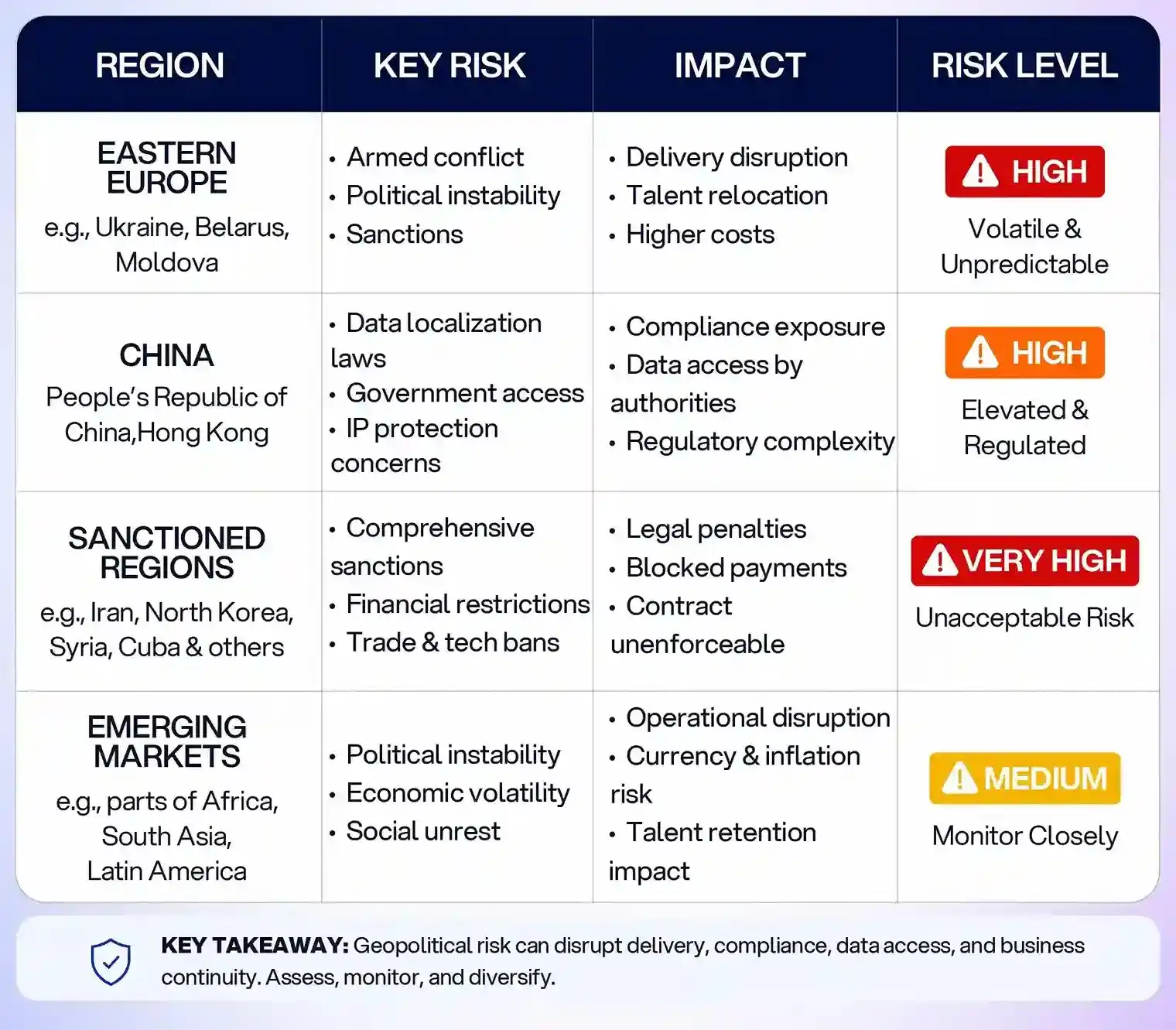
Mitigation preview: Assess geographic concentration as part of vendor evaluation. For any function considered critical, distribute delivery across regions to avoid dependence on a single location.
Risk 11: Vendor Lock In and Exit Complexity
Severity: High
Vendor lock in is not theoretical. It is built into how systems evolve.
A partner that uses proprietary frameworks, undocumented configurations, or third party tools under their own control makes exit difficult. In practice, switching vendors becomes a separate project with its own timeline and cost.
BaFin analysis indicates that more than half of organizations cannot rebuild outsourced capabilities quickly if a relationship ends unexpectedly. That is not a rare edge case. It is common.
The engagement model matters. The staff augmentation model generally reduces lock in because engineers work within your systems. Dedicated teams can increase dependency over time if governance is weak.
Mitigation preview: Require a technology neutral stack, clear IP ownership, access to source code, and a defined transition period of at least 90 to 180 days.
Risk 12: Concentration Risk and Single Vendor Dependency
Severity: High
The CrowdStrike incident is a clear example. When one vendor controls a critical function, failure is not contained. It spreads. An organization that relies on a single provider for a core system, without a fallback, does not have redundancy. It has a dependency.
This applies beyond security. Any critical IT function handled by one external party carries the same exposure. There is also a geographic layer. Concentrating delivery in a single region introduces additional risk. Infrastructure failures, connectivity issues, or geopolitical events can affect the entire operation at once.
Mitigation preview: Identify single points of failure across all critical functions. Maintain partial internal capability or a secondary vendor option where continuity matters.
Need Help Building Your Vendor Shortlist?
Tell us what you're looking for and get help identifying companies relevant to your requirements.
Get a Free ConsultationHow to Score Your Vendor Before Signing: An IT Outsourcing Risk Rubric
There is no widely used scoring model for outsourcing risk. Most vendor decisions still rely on proposals, references, and internal judgment. That approach works to a point, but it leaves gaps.
The table below provides a more structured way to evaluate risk before committing. Score each dimension from 1 to 10 and apply the weighting. Vendors falling below 65 weighted points should not be considered for critical functions without clear remediation.
For organizations new to cross-border outsourcing, an IT outsourcing consultant can add clarity during vendor evaluation, particularly where risk is not immediately visible.
Evaluation Dimension | Score 1–4 (Poor) | Score 5–7 (Acceptable) | Score 8–10 (Strong) | Weight |
|---|---|---|---|---|
Data Security Posture (ISO 27001, SOC 2 Type II, penetration testing) | No certifications, no recent testing | ISO 27001 only, annual testing | SOC 2 Type II + ISO + quarterly penetration testing + SIEM monitoring | x3 |
Financial Stability and Business Continuity | No audited financials, no cyber insurance | 3 years of audited financials, basic BCP | Publicly audited, tested BCP, active cyber insurance | x2 |
Regulatory Compliance (GDPR, DORA, CCPA) | No compliance programme | GDPR clauses present, basic compliance | DPA in place, DORA ready, dedicated compliance function | x2 |
Exit Provision and Technology Portability | No exit clause, proprietary lock in, no source code transfer | 90 day notice, basic knowledge transfer | 180 day transition, tech-agnostic stack, full IP assignment | x1.5 |
Geographic and Geopolitical Risk Profile | Single country, high risk, or sanctioned zone | Multi-country, moderate risk | Multi-region distribution, politically stable, no sanctions exposure | |
AI Tool Governance | No AI usage policy | Basic restrictions | Approved tool list, quarterly certification, and audit rights | x2 |
How Relevant Is a Vendor’s Past Experience?
See how Project Capability Score helps you assess whether a company has completed work relevant to your requirements.
See How PCS WorksThe Pre-Contract Due Diligence Checklist
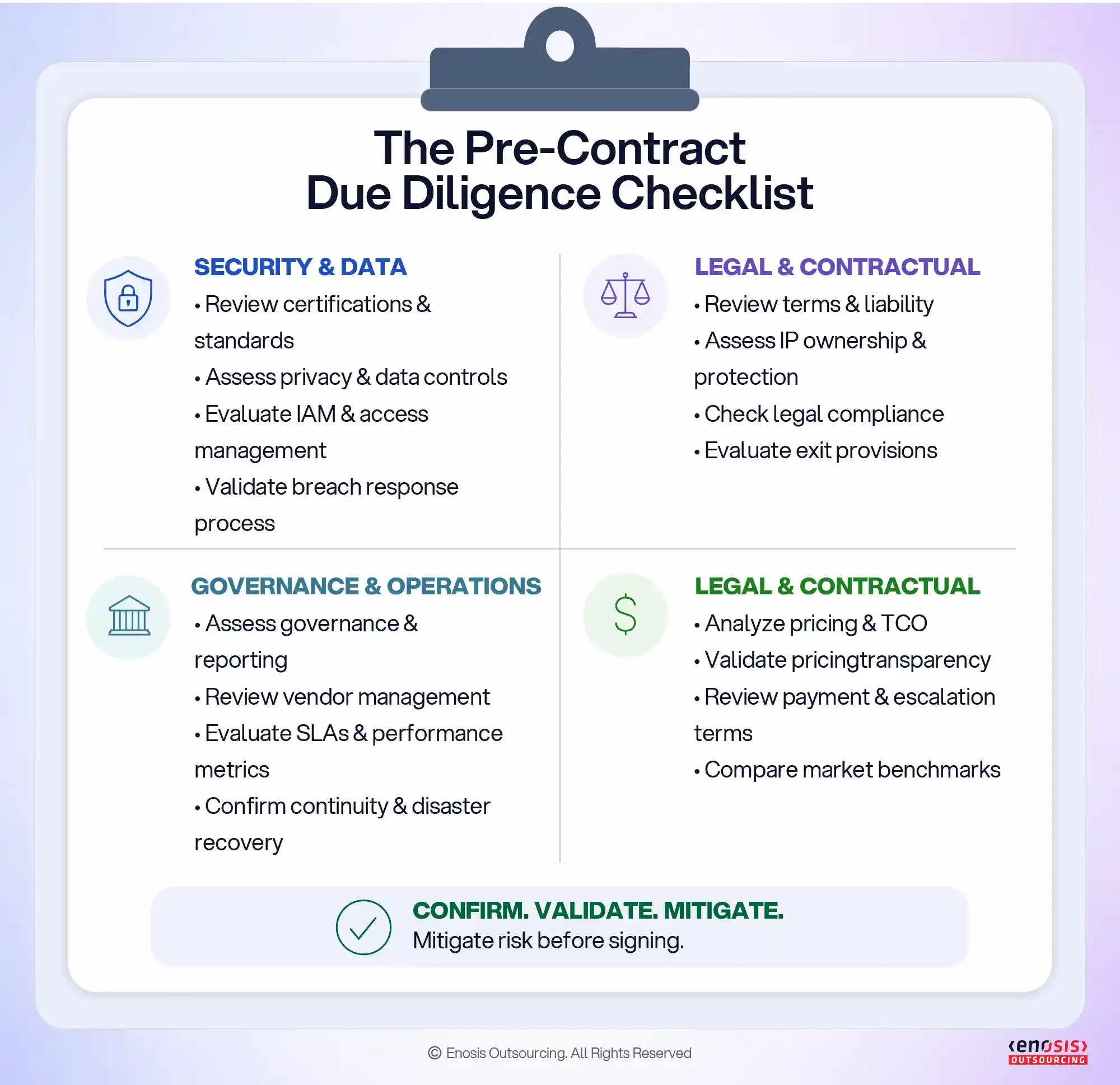
Before signing any IT outsourcing contract, you need clear, written answers to a defined set of questions. Verbal assurances are not enough. Missing or vague responses should be treated as risk signals, not minor gaps.
Use these 20 point checklist during vendor evaluation:
Is the vendor SOC 2 Type II certified? Request the latest audit report and confirm the coverage period.
What is the vendor’s policy on AI tool usage? Clarify whether tools like GitHub Copilot or ChatGPT are permitted on your codebase.
Does the contract include a right to audit clause? Your team should be able to review security practices when needed.
Who owns the intellectual property created during the engagement? Confirm there is an explicit IP assignment clause transferring ownership to you upon delivery.
Which subcontractors will access your data or code? All fourth party vendors should be disclosed and approved in advance.
What is the SLA incident notification timeline? GDPR sets a 72-hour requirement for breaches. Your contract should meet or exceed this.
Is there a termination for convenience clause? Check for a defined transition period and knowledge transfer obligations.
Where will your data physically reside? Verify alignment with your data sovereignty requirements.
Has the vendor tested its BCP and DRP in the last 12 months? Ask what scenario was tested and what recovery time was achieved.
Does the vendor carry cyber liability insurance? Confirm coverage limits and whether third party exposure is included.
What is the staff turnover rate for your assigned team? Understand how the vendor replaces key engineers.
How are scope changes handled? There should be a written change request process with approval before work begins.
What does the governance structure look like? Identify escalation points beyond the delivery team.
Does the vendor serve direct competitors? If yes, review how data is isolated across environments.
Which development methodology is used? Agile software development outsourcing frameworks can reduce delivery risk, but only when clearly documented and enforced.
How are security vulnerabilities handled during development? Ask about disclosure timelines and remediation practices.
What is the dispute resolution mechanism? Confirm governing law and jurisdiction.
Are SLA performance benchmarks tied to financial consequences? Weak enforcement reduces accountability.
What delivery metrics are reported? Check whether reporting is automated, consistent, and shared regularly.
What happens to your data at the end of the engagement? Ensure there is a documented process for deletion or return.
When Outsourcing Risk Became Reality: Three Case Studies
Outsourcing risk is easier to understand when it is tied to real incidents. The cases below are well documented, publicly reported, and directly relevant to how outsourcing decisions are made.
CrowdStrike Falcon Outage, July 2024
A faulty configuration update in CrowdStrike’s Falcon sensor triggered Blue Screen of Death errors across roughly 8.5 million Windows devices within hours. Airlines grounded flights. Hospitals diverted patients. Banks paused operations. Estimated losses exceeded $5 billion across affected industries.
The issue was not just a technical failure. It exposed concentration risk. Organizations that relied entirely on CrowdStrike for endpoint security had no independent fallback. They could not isolate systems or restore operations without vendor involvement. Recovery often required manual fixes on individual machines, which extended downtime for days in some cases.
Lesson: Critical IT functions should not depend entirely on a single external vendor without a tested recovery process that your team can run independently.
Want to See What a Vendor Has Actually Delivered?
Explore real project experience to understand a company’s capabilities before adding it to your shortlist.
Explore ProjectsTarget Data Breach, November 2013
Attackers accessed around 40 million payment card records from Target’s systems. The entry point was not Target’s infrastructure. It was stolen credentials from Fazio Mechanical Services, an HVAC contractor with remote access to store systems.
This case highlights fourth party exposure. Fazio was not a core IT vendor, yet it had network access. Security expectations applied to primary vendors were not extended to this contractor. There was no enforced baseline, and no audit had verified their controls.
Lesson: Any entity with access to your systems or data becomes part of your risk surface, regardless of its role or how indirectly it was engaged.
British Airways GDPR Penalty, 2020
Between August and September 2018, attackers injected a data skimming script into British Airways’ website through a third party JavaScript library. The script captured payment details from about 500,000 customers. The breach went undetected for over two months. The UK Information Commissioner’s Office later fined British Airways £20 million under GDPR.
This incident reflects a supply chain security risk. The compromised code was not developed or controlled directly by British Airways. Even so, responsibility for customer data remained with them. GDPR makes that clear. Accountability does not shift when execution is outsourced.
Lesson: Every external component in your technology stack increases your risk surface. Maintain an inventory of third party code and review it regularly with security controls in place.
The CLEAR Framework: A Five Pillar Approach to Ongoing Risk Mitigation
Managing IT outsourcing risk does not stop at contract signing. It continues through the entire engagement. The CLEAR framework breaks that responsibility into five practical areas that can be monitored and adjusted over time.
C: Contract Architecture
Risk control starts with the contract. If key terms are missing at this stage, they are difficult to enforce later.
Focus on five clauses that should not be left vague: explicit IP assignment, a right-to-audit provision, clear boundaries on AI tool usage, full disclosure of any subcontractors, and a defined exit process with knowledge transfer built in.
L: Layered Security
Security oversight should never sit with a single party. If the same vendor manages your systems and validates their own controls, blind spots are inevitable.
Separating security operations from independent testing removes that conflict. It also gives you a second view on how your systems are actually performing under stress.
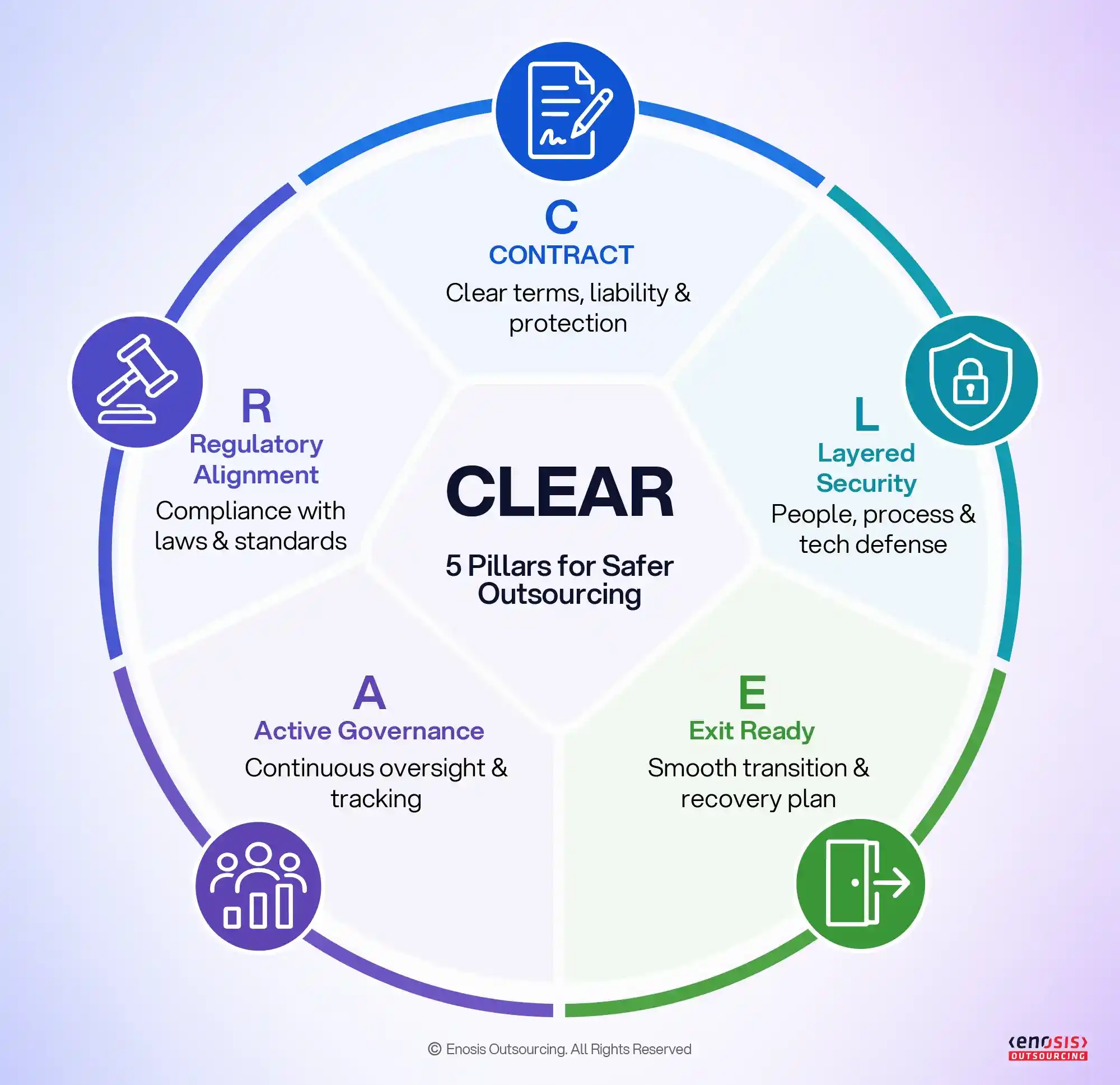
E: Exit Ready Operations
Vendor relationships end through disagreement, acquisition, financial failure, or strategic change. Maintaining internal capability registers, architectural documentation, and at least one pre-vetted alternative vendor for every critical function is operational hygiene, not contingency planning. Companies that outsource custom software development should ensure code ownership, documentation, and environment access are fully client-controlled at all times.
A: Active Governance
Governance only works when it is routine. Set a clear cadence. Quarterly SLA reviews, regular security assessments, and scheduled BCP testing create visibility before problems escalate. Waiting until something breaks turns governance into damage control.
R: Regulatory Alignment
Regulatory requirements shape what “acceptable risk” looks like. Each outsourcing engagement should be mapped to the rules that apply to your business and your data.
For example, DORA applies to EU financial entities, GDPR Article 28 governs data processors, and SOC 2 Type II is expected for many US SaaS vendors. These are not abstract obligations. They directly influence contract terms, audit rights, and vendor selection.
Looking for Companies With the Right Expertise?
Explore software development companies by service and narrow your options around what your project requires.
Find Relevant CompaniesMaking an Informed Outsourcing Decision
The risks outlined in this guide are not reasons to avoid IT outsourcing. They are the exposures that need to be understood, addressed, and actively managed.
What separates successful outsourcing from failed engagements is rarely the initial vendor choice. It comes down to the structure behind it: how the contract is written, how governance is maintained, how security is enforced, and how exit scenarios are planned.
For companies with engineering teams in the 20 to 100 range, the most effective starting point is not a broad vendor search. It is a structured evaluation process that filters out poor fits early. For organizations already working with external vendors, the priority shifts. Existing contracts should be reviewed against current regulatory requirements, especially where personal data or financial systems are involved.
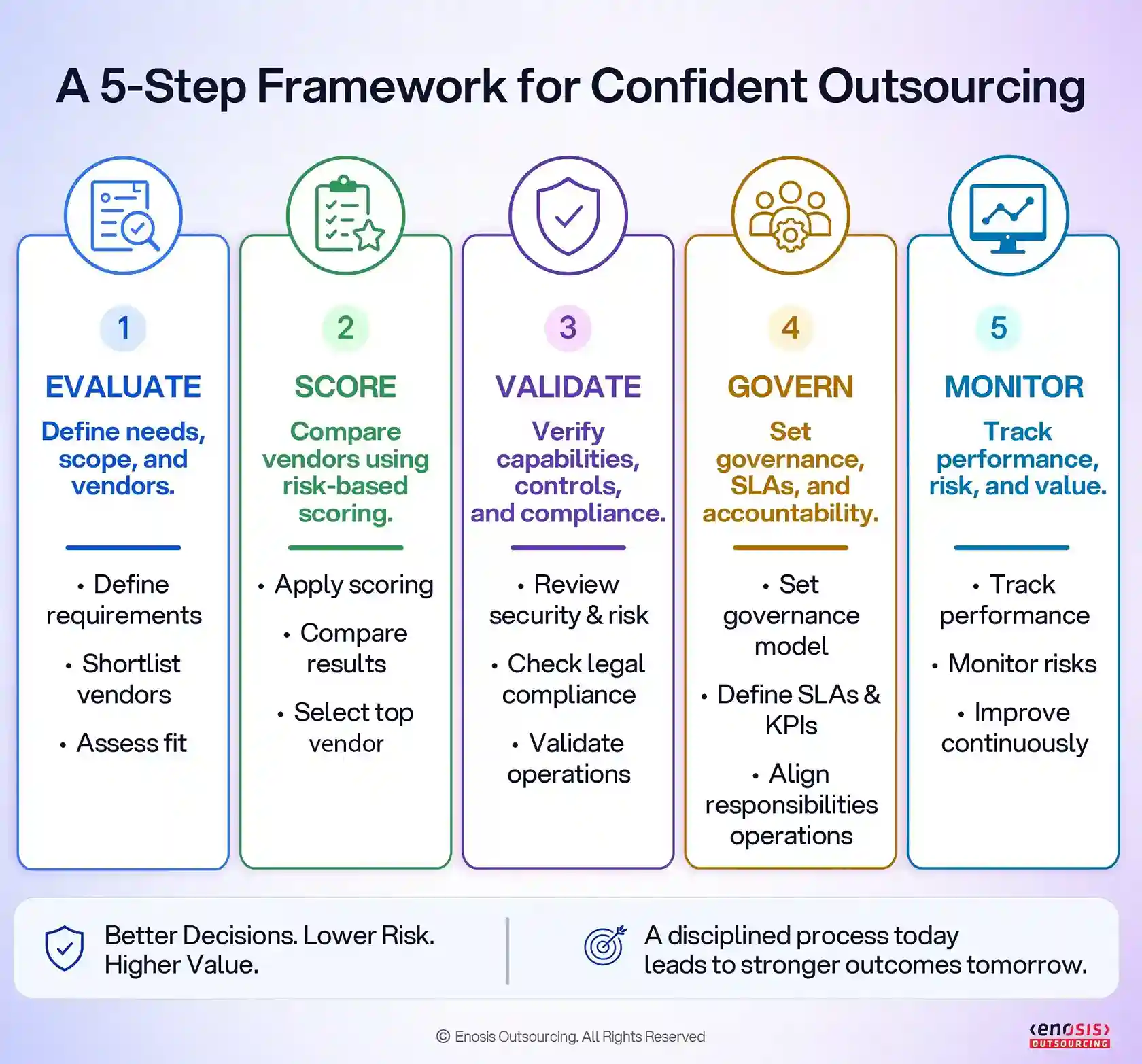
The checklist and scoring rubric in this guide are meant to be used, not just read. Applied consistently, they help surface the risks that matter before they turn into operational or financial problems.
Where Enosis Outsourcing Fits in Vendor Evaluation Decisions
Not every organization needs external input during vendor evaluation. Some do.
If this is your first meaningful outsourcing engagement, or if your current setup has not been reviewed against recent security, regulatory, or operational expectations, an outside perspective can reveal gaps that internal teams tend to overlook. Most stakeholders are focused on delivery. Vendor evaluation requires a different lens.
Enosis Outsourcing offers a free consultation built around that need. The session is structured, not exploratory. It focuses on your situation: what you are building, your constraints, and the assumptions shaping your current approach.
Instead of starting from a broad marketplace, their team maps your requirements against a curated pool of more than 6,000 pre vetted development partners. These vendors have been assessed over time across delivery consistency, technical depth, pricing patterns, and client feedback.
The value of the session is direction. You do not begin with a long list that needs filtering. You begin with a narrower set of options that already align with your scope and engagement model. The evaluation process still applies. What changes is the starting point.
If you already have a shortlist, the same session can be used to test your assumptions. Gaps in areas like security controls, governance structure, and long term maintainability tend to surface quickly under external review.
For teams that prefer to start independently, Enosis maintains a structured catalogue of all companies organized by service type, engagement model, and industry. It serves as a cleaner starting point than an unfiltered directory.
External input does not replace internal responsibility. Vendor selection, contract design, and ongoing governance remain with your team. The consultation helps you move faster with clearer assumptions, but the decisions stay yours.
Need Help Building Your Vendor Shortlist?
Tell us what you're looking for and get help identifying companies relevant to your requirements.
Get a Free Consultation