

 24 min read
Hiring skilled engineers is no longer just a recruitment problem. It slows delivery. Average hiring cycles take around 35 days, and senior engineering roles can take 80+ days. During that gap, roadmaps slip, product opportunities stall, and internal teams absorb more pressure.
Staff augmentation gives companies a faster way to add reliable capacity without committing to permanent headcount. External engineers join the existing team, report to internal managers, follow the same sprint process, and fill specific skill gaps without the overhead of full time hiring.
The model works best when the issue is velocity, not ownership. You still manage the work, but you avoid months of recruiting and onboarding delay. The same decision logic applies when teams use a broader framework for outsourcing software development to separate internal ownership from external execution.
This guide covers: How the Model Works in Real Delivery Environments | Types and Benefits of Staff Augmentation | Risks and Failure Points | Staff Augmentation vs Other Engagement Models | When Staff Augmentation Makes Sense and When It Does Not | Cost Structure and Pricing Realities | How to Choose the Right Staff Augmentation Partner
What Is the Staff Augmentation Model
Staff augmentation is a delivery model in which a company hires remote software engineers from an external provider and integrates them directly into its internal teams for a defined period. The augmented staff work under the company’s management, participate in its processes, and contribute to its projects.
In many organizations, this sits under IT staff augmentation or staff augmentation services, and it is often described as a team extension model because the engineers operate inside your delivery system.
Core Characteristics
The staff augmentation model differs fundamentally from traditional outsourcing in several key ways.
First, the hiring company retains complete control over day to day work. Project managers, tech leads, and senior engineers on the client side direct the work, assign tasks, and monitor progress. The augmented staff do not work autonomously toward a fixed deliverable; they execute work as defined by the internal team.
Second, the relationship is skill based rather than project based. You are not paying a vendor to deliver a finished feature or module. Instead, you are paying for access to individual engineers with specific skills for a specific duration. The client company retains full ownership of IP, decisions, and outcomes.
Third, integration is direct. Augmented staff attend stand ups, participate in sprint planning, attend team meetings, and use the same tools and processes as internal developers. They are not managed remotely by the vendor. They are managed by the client’s engineering leadership. Communication happens in real time through the client’s Slack, Jira, GitHub, or other systems.
Finally, the model is temporary and flexible. While some augmentation engagements last 12 months or longer, the usual duration is 3 to 6 months. There is no expectation of permanent employment. If business needs change, the engagement can end with 2 to 4 weeks’ notice, depending on the contract terms.
Why Companies Choose Staff Augmentation
Teams usually choose staff augmentation when the hiring timeline is the constraint, not just the budget. In practice, the biggest advantage is hiring velocity, how quickly you can add reliable capacity without lowering standards. It can also reduce cost per hire by shortening recruiting cycles and shifting replacement risk through a vendor replacement guarantee, while still keeping delivery control inside your team. In a market where engineering hiring is a persistent constraint, staff augmentation becomes a talent shortage solution that preserves internal control.
Unlike outsourcing vendors, staff augmentation partners do not promise project outcomes. They promise access to vetted engineers who can be productive within your team immediately. The success or failure of the work remains the responsibility of the internal organization.
Looking for Companies With the Right Expertise?
Explore software development companies by service and narrow your options around what your project requires.
Find Relevant CompaniesHow the Staff Augmentation Model Works
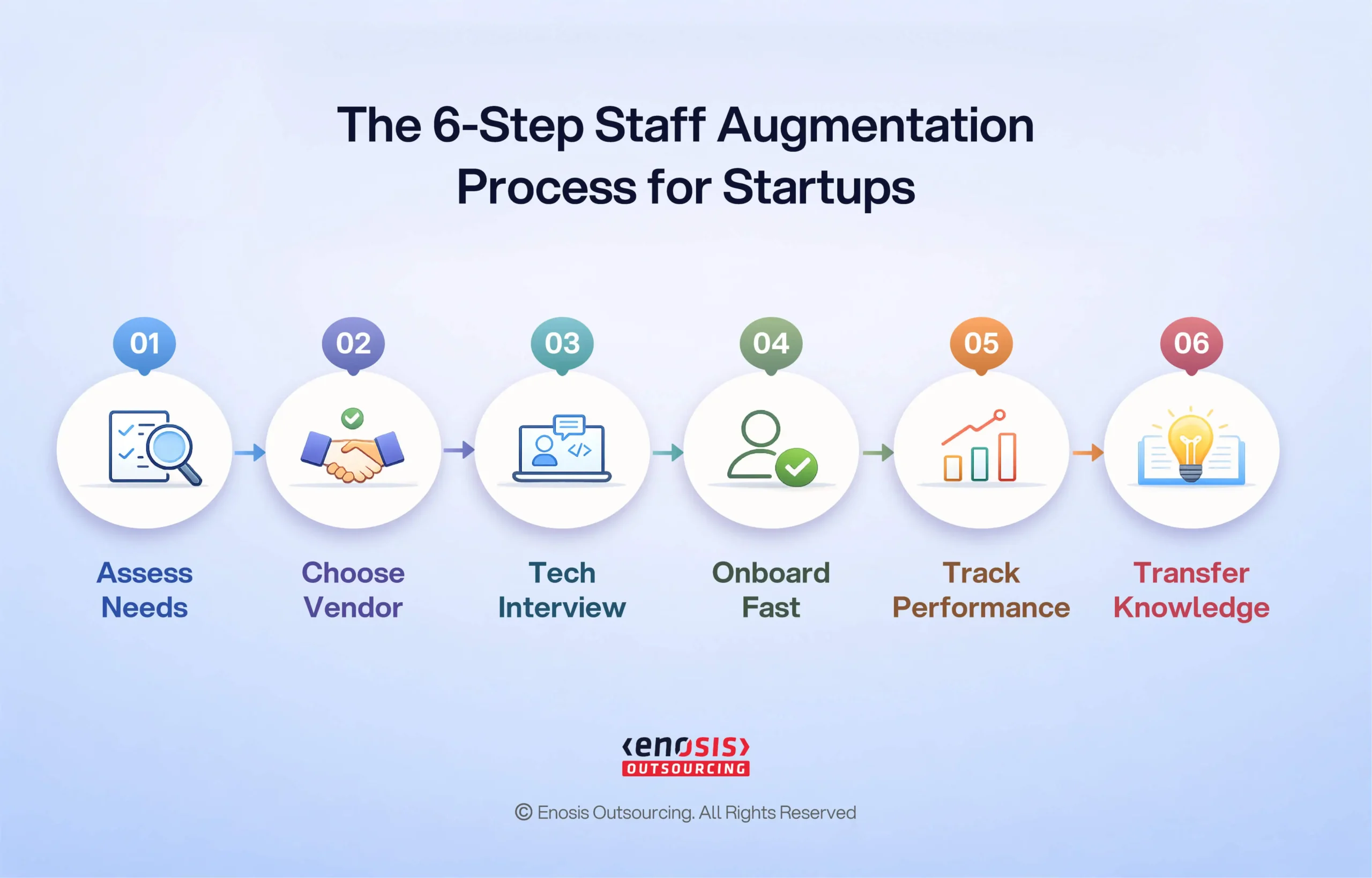
The staff augmentation process begins with an honest assessment of what you need. Before approaching any vendor, your team should articulate the specific skill gap, the seniority level required, the duration of the engagement, and how the role fits into your existing structure. Teams that treat onboarding as part of remote team building usually see faster build up and fewer coordination issues later.
Phase 1: Skills and Capacity Assessment
Define the role clearly. Is this a backend engineer who specializes in cloud infrastructure? A full stack developer focused on React and Node.js? A QA engineer with test automation expertise? The more specific the requirement, the faster the sourcing process moves. You should also determine whether this is a capacity play (you need more hands to complete the work your team has scoped) or a skill play (you need expertise your team does not possess).
Establish the seniority level. Are you looking for a senior engineer who can drive architectural decisions independently, or a mid level developer who can execute tasks under supervision? This distinction affects both the cost and the timeline.
Define the engagement duration. Is this a three month spike, a six month project, or potentially a one year engagement with the option to extend? Be realistic about this estimate. Engagements that are expected to be short often extend, and those expected to be long sometimes conclude early as business needs shift.
Phase 2: Vendor Selection and Candidate Screening
Partner with a staff augmentation provider that maintains a vetted bench of engineers. Ideally, the provider has already conducted technical screening, verified credentials, and confirmed communication skills. This shortens the hiring cycle significantly.
Provide the vendor with a detailed job description and technical requirements. Include the specific technologies, any domain expertise needed (e.g., SaaS, fintech, healthcare), and the expected team structure. The more clarity you provide, the better the match.
Request a small slate of candidates, typically three to five. Most reputable providers conduct their own technical assessments before presenting candidates to you. Review their experience, ask for technical references, and review their portfolios or GitHub profiles if available.
Phase 3: Technical Interview and Selection
Conduct a technical interview with your lead engineer or architect. This interview should assess not only technical competency but also communication clarity and the ability to work in a team environment. Staff augmentation requires strong soft skills because the engineer is integrating into an established team and culture.
Use practical assessment methods. Ask the candidate to solve a real problem from your codebase, or ask them to explain how they would approach a technical challenge relevant to your project. Avoid abstract puzzle questions.
Reference checks are important. Ask previous clients about responsiveness, code quality, ability to work without close supervision, and whether the engineer asked good questions about requirements. This is where many teams underestimate the effort.
How Relevant Is a Vendor’s Past Experience?
See how Project Capability Score helps you assess whether a company has completed work relevant to your requirements.
See How PCS WorksPhase 4: Onboarding and Integration
Once you select a candidate, the onboarding phase often takes one to two weeks. During this time, the engineer should set up their development environment, gain access to your systems, and understand your architecture and processes.
Assign a primary contact within your engineering team to mentor the new hire. This person should answer questions about your codebase, organizational norms, and team dynamics. Clear communication at this stage prevents weeks of downstream confusion.
Run the augmented engineer through your standard onboarding, including security training, compliance requirements, code review standards, and architectural documentation. Do not skip these steps even if they seem tedious; they set the foundation for productivity. If you skip onboarding, you usually pay for it later in code review and rework.
Assign initial work that is well scoped and clear. The first week or two should include tasks that the new engineer can complete with reasonable confidence, allowing them to build credibility and understanding simultaneously. Avoid complex architectural work during week one
Phase 5: Performance Monitoring and Optimization
Once the engineer is productive, establish clear feedback loops. Include them in sprint planning, retrospectives, and code reviews. Use your standard performance metrics: pull request turnaround, code review feedback, sprint velocity contribution, and quality metrics.
Have regular one-on-one conversations with your manager or team lead. Most problems show up in the first two weeks, which is good news because they are fixable early. These conversations should cover blockers, support needs, and whether the engagement is meeting expectations. Many augmentation relationships succeed because the hiring company invests in communication.
If performance issues emerge, address them quickly. If an engineer is not meeting your expectations after the first month, discuss it directly. If it is a skill mismatch, the vendor should provide a replacement. If it is a fit issue related to communication or work style, work with the vendor on a replacement as well.
Phase 6: Knowledge Transfer and Transition
As the engagement concludes, plan for knowledge continuity. This might mean the engineer documents their work, participates in code review of their contributions, or mentors another team member on the features they built.
If the engagement is successful and you want to extend, this is the time to discuss it with the vendor. Most augmentation providers can quickly extend engagements if both parties are satisfied.
If you decide not to extend, allow sufficient notice (typically two to four weeks) so the vendor has time to place the engineer elsewhere.
Types of Staff Augmentation
Staff augmentation takes different forms depending on your business needs and geographic constraints.
Skill Based Augmentation
You need a specific skill that your team does not possess. Examples include machine learning engineering, blockchain development, or Kubernetes expertise. You hire an engineer with that specialty for the duration of the project or initiative that requires it. Once the project concludes or the skill gap is filled by training internal staff, the engagement ends. This is the most common form of augmentation. Seniority choices affect the hiring timeline and the boost up curve.
Capacity Based Augmentation
You have the skills in house, but not enough people to deliver on your roadmap. You need additional hands to execute work that your internal team has designed and scoped. Capacity based augmentation is typically lower cost than skill based augmentation because the vendor is not sourcing specialized expertise, just experienced developers who can execute within your technical stack.
Short Term vs. Long Term Augmentation
Short term augmentation lasts three months or less and is typically driven by a specific event: a product launch, a deadline driven feature release, or a temporary staffing gap. Long term augmentation extends beyond six months and often transitions into semi permanent arrangements, where the augmented staff become part of the extended team.
The difference matters for onboarding, cost, and continuity planning. Short term augmentation requires a faster ramp up because the window is compressed. Long term augmentation requires deeper integration and clearer career development expectations.
Geographic Models: Onshore, Nearshore, and Offshore
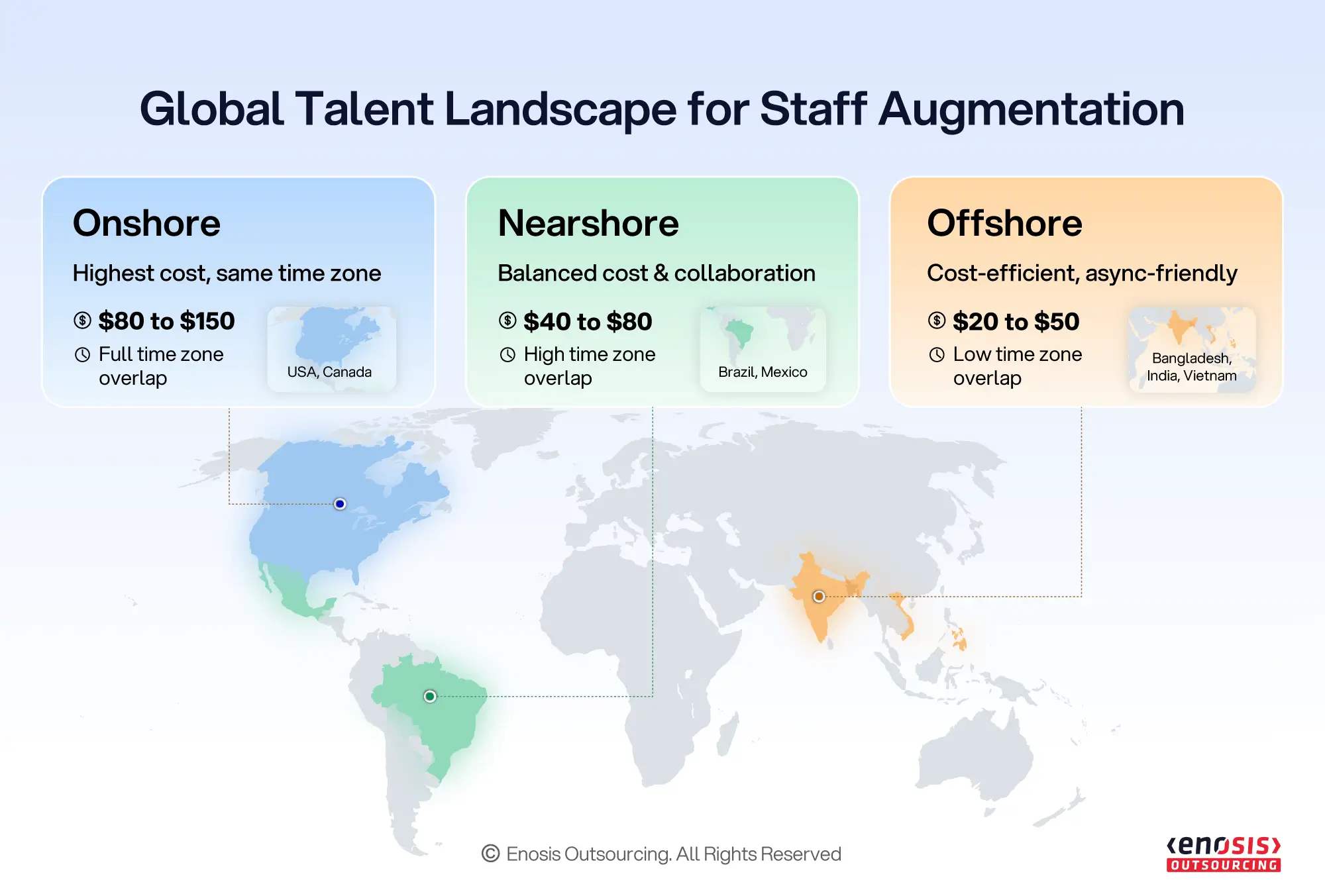
Onshore augmentation sources engineers from within the same country as your company. This typically means zero time zone difference, higher hourly rates ($80 to $150 per hour, depending on seniority), but faster communication and alignment.
Nearshore outsourcing sources engineers from countries in the same or adjacent time zones. For North American companies, this typically means Latin America, including Mexico, Colombia, and Argentina, or Eastern Europe. Hourly rates are moderate ($50 to $100 per hour), and there is substantial time zone overlap for collaboration.
Offshore augmentation sources engineers from regions with significant time zone differences, typically Bangladesh, India, or Asia Pacific based countries. Hourly rates are lowest ($20 to $50 per hour), but communication requires more careful planning due to time zone differences. Asynchronous communication and well documented tickets become essential.
Asynchronous work can run very well, but only if requirements are written clearly enough that engineers do not have to guess.
The choice of geographic model depends on the nature of the work, your communication style, and your budget constraints. High collaboration work is easier with onshore or nearshore. Work that is well scoped and can be assigned asynchronously is better suited to offshore. Most companies use a hybrid approach.
Team Structure and Roles in Staff Augmentation
Staff augmentation does not fundamentally change how delivery teams are structured, but it does require clear role definition and integration practices to function effectively.
Common Augmented Roles
Backend engineers are the most common augmentation role. Companies need additional backend capacity for API development, microservices architecture, database optimization, and infrastructure support. A backend engineer on an augmented team typically reports to a tech lead or engineering manager.
Full stack engineers can accelerate product feature development by handling both frontend and backend work. This reduces cross team dependencies and speeds up feature delivery, but requires engineers who are genuinely proficient in both domains.
Frontend Engineers are also common, particularly in companies scaling product teams. Frontend augmentation is often capacity based, with engineers executing features that have been designed and scoped by the internal design and product teams.
Quality Assurance Engineers support test automation, test planning, and manual testing for specific features or platforms. QA augmentation is often capacity based and allows internal QA teams to scale testing without hiring permanent staff.
DevOps and Infrastructure Engineers support cloud migration, infrastructure as code, CI/CD pipeline development, and monitoring. These roles require deeper integration with internal teams because they affect the entire engineering organization.
Team Integration Patterns
Augmented staff work best when they are integrated into existing teams rather than siloed in a separate capacity pool. An augmented backend engineer should be part of the backend team, attend their stand ups, participate in their code reviews, and work on their priorities.
Set clear reporting lines. The augmented engineer should have a primary manager or tech lead, typically someone on your internal team. This person defines priorities, provides feedback, and addresses any performance or integration issues.
Define decision making boundaries. Augmented staff should have clear authority over their own work but not over architectural decisions or strategic direction. A senior augmented engineer might propose architectural improvements, but those proposals should be evaluated by your internal leadership.
Benefits of the Staff Augmentation Model
In the right context, staff augmentation offers practical advantages over both traditional hiring and fully outsourced delivery. For a broader look at how the models impact your bottom line, check the benefits of outsourcing software development.
Speed to Hire
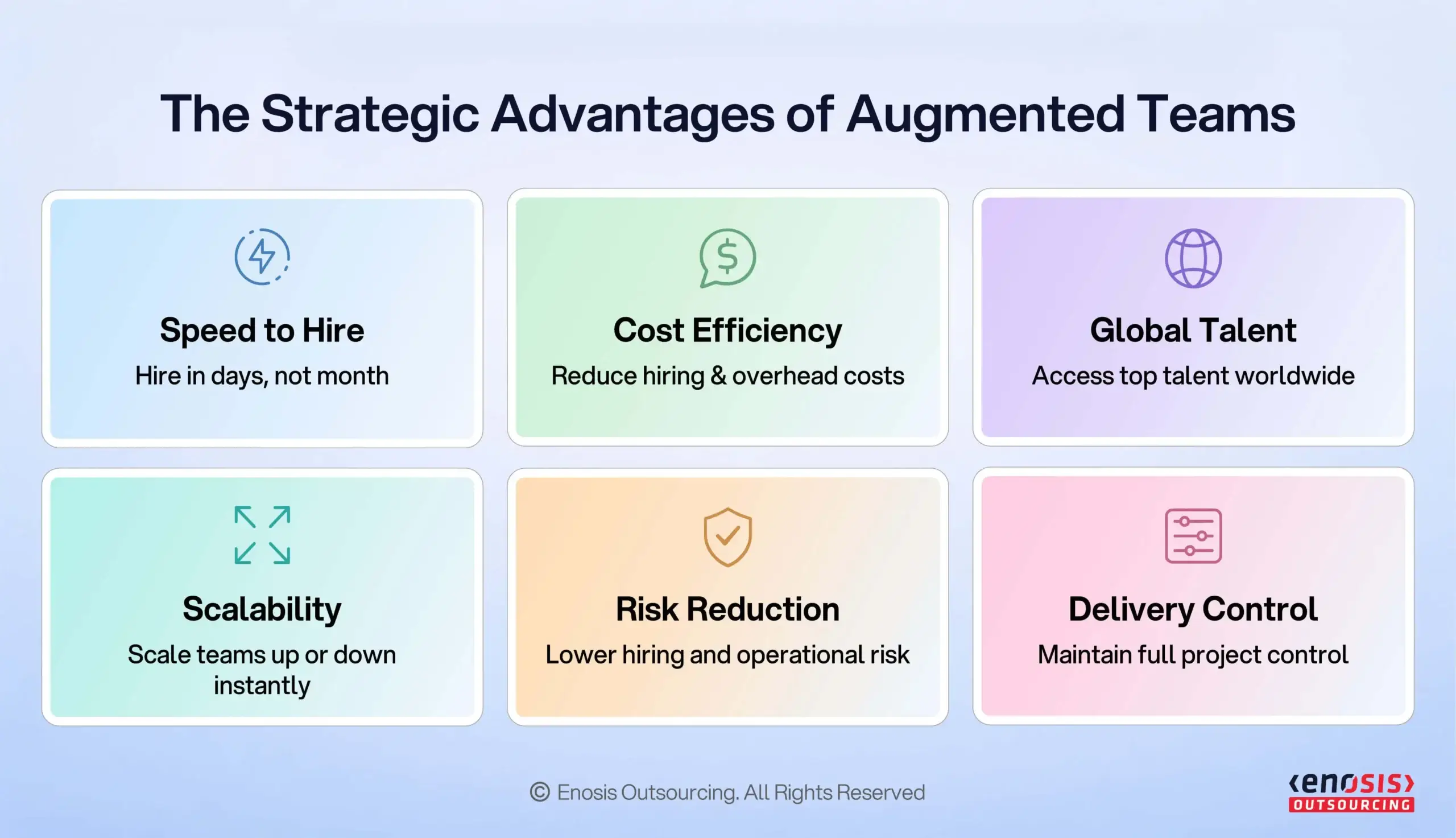
The most direct benefit is speed. While recruiting a full time engineer often takes 35 to 80+ days, staff augmentation can often be completed in one to two weeks. The goal is simple: hire developers faster than traditional recruiting allows, without lowering the quality bar. For teams trying to protect a roadmap, a shorter hiring timeline can be the difference between hitting a release window and missing it.
Cost Efficiency
Augmentation can be cost efficient compared to full time hiring. The fully loaded cost of a mid-level engineer in the United States (salary, benefits, equipment, overhead) often ranges from $150,000 to $200,000 annually. An augmented engineer from a nearshore provider might cost $60,000 to $80,000 annually for comparable output, depending on the role, region, and engagement terms.
A helpful way to think about this is cost per hire, not just salary. Internal recruiting cycles, interviewer time, onboarding load, and the cost of replacing a bad fit all add up. Many teams see meaningful cost savings because they avoid long-term overhead and reduce the risk of mis-hires.
Access to Global Talent
Staff augmentation expands your hiring pool beyond your geography. If you need Kubernetes expertise, advanced DevOps support, or deep domain experience, you can access global technical talent rather than competing only in your local market.
Scalability and Flexibility
As your business grows, you can scale capacity up or down without committing to permanent headcount. This flexibility is especially useful when demand is uncertain and you need to protect runway, budgets, or staffing plans.
Risk Reduction
Full time hiring carries hiring risk. People can look strong on paper and still struggle in real delivery environments. Staff augmentation reduces that risk because engagements are time-bound and vendors often offer a replacement guarantee. If an engineer is not working out, you can request a replacement within two to four weeks, depending on the contract.
Delivery Control
Control stays internal, unlike project outsourcing with your organization. You set priorities, manage execution, and drive decisions. That control helps protect quality standards and development velocity, especially when requirements shift mid sprint or customer feedback changes priorities.
Challenges and Risks of Staff Augmentation
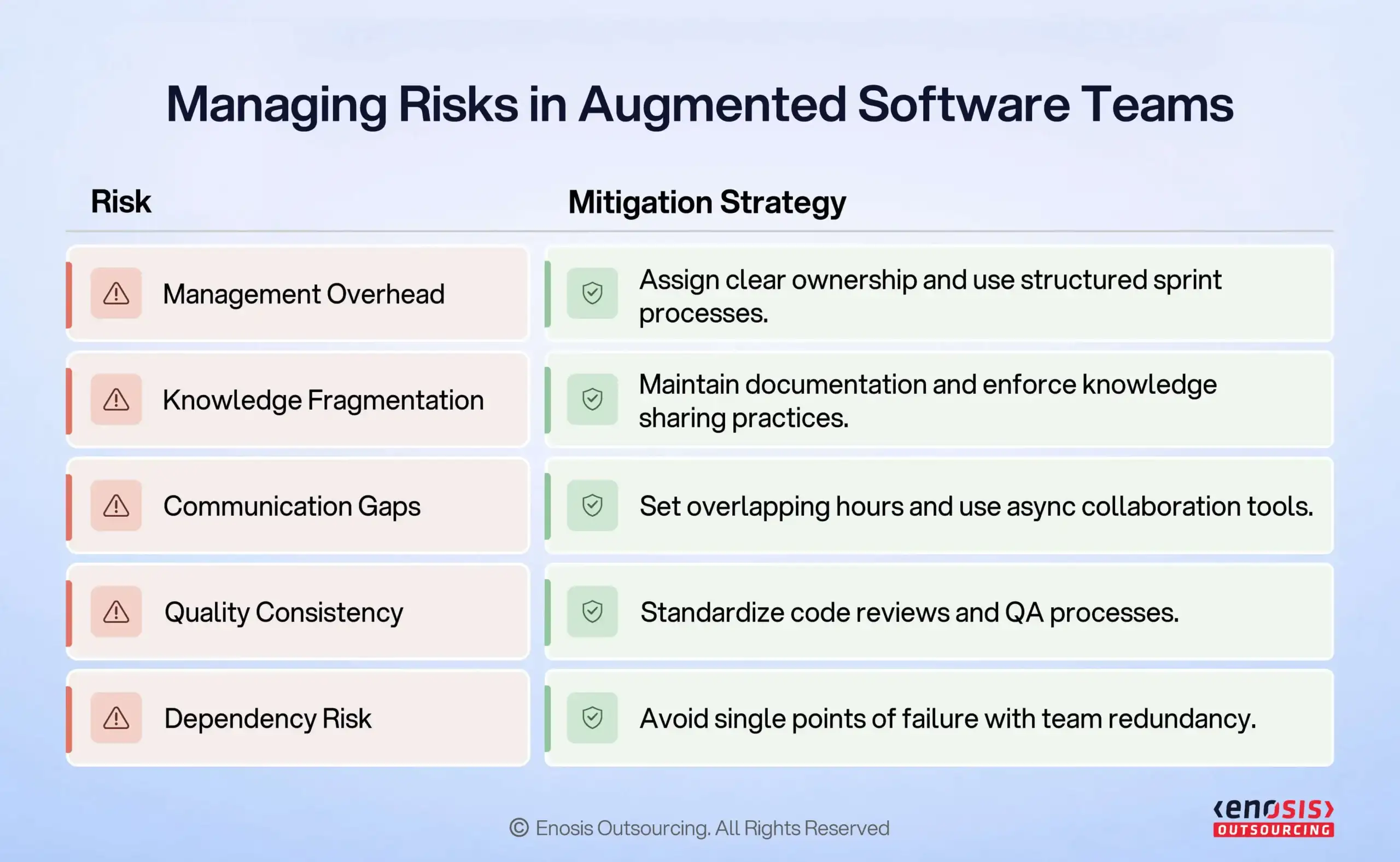
The staff augmentation model offers flexibility and speed, but it also introduces risks that must be managed deliberately. Most issues associated with staff augmentation do not come from the model itself. They come from gaps in internal readiness, unclear ownership, or weak execution discipline.
Management Overhead
For most teams, onboarding is the real make or break step. Augmented staff still require management, onboarding, and ongoing direction. Someone on your internal team must dedicate time to explaining architecture, reviewing code, and providing context. This overhead is highest in the first few weeks and typically stabilizes once the engineer is productive.
If your team is already stretched thin, this added responsibility can slow delivery instead of improving it. Staff augmentation works best when managers have the capacity to integrate new contributors rather than simply assign tasks.
Knowledge Fragmentation
As staff augmentation engagements are time bound, there is a risk that knowledge leaves when the engineer exits. This becomes a problem when an augmented engineer becomes the sole owner of a system or workflow.
Mitigation requires intentional documentation, shared ownership, and regular code reviews. Treat augmented engineers as contributors, not isolated specialists, and avoid building critical dependencies around a single person.
Communication and Cultural Gaps
Remote team building requires clarity and discipline. Augmented engineers may work in different time zones and cultural contexts, which can expose gaps in how your team communicates requirements and decisions.
Teams that rely heavily on informal, in person communication often struggle with augmentation. Clear tickets, documented decisions, and predictable feedback loops reduce friction and support consistent development velocity, even when collaboration is partially asynchronous.
Quality Consistency
While reputable vendors conduct screening, quality still varies across individuals. Some engineers contribute immediately. Others take longer to adapt to internal standards.
Early code reviews, clear expectations, and fast feedback help surface issues quickly. The goal is not perfection on day one, but steady improvement within the first month.
Dependency Risks
If an augmented engineer becomes critical to delivery and exits unexpectedly, momentum can drop. This risk is higher for long engagements and for roles involving specialized expertise.
Mitigation includes cross-training, shared ownership, and ensuring the vendor can activate a replacement guarantee quickly if needed. Avoid allowing short-term capacity solutions to quietly turn into single points of failure.
What matters is not avoiding risk entirely, but catching it early and managing it deliberately.
Want to See What a Vendor Has Actually Delivered?
Explore real project experience to understand a company’s capabilities before adding it to your shortlist.
Explore ProjectsStaff Augmentation vs. Other Engagement Models
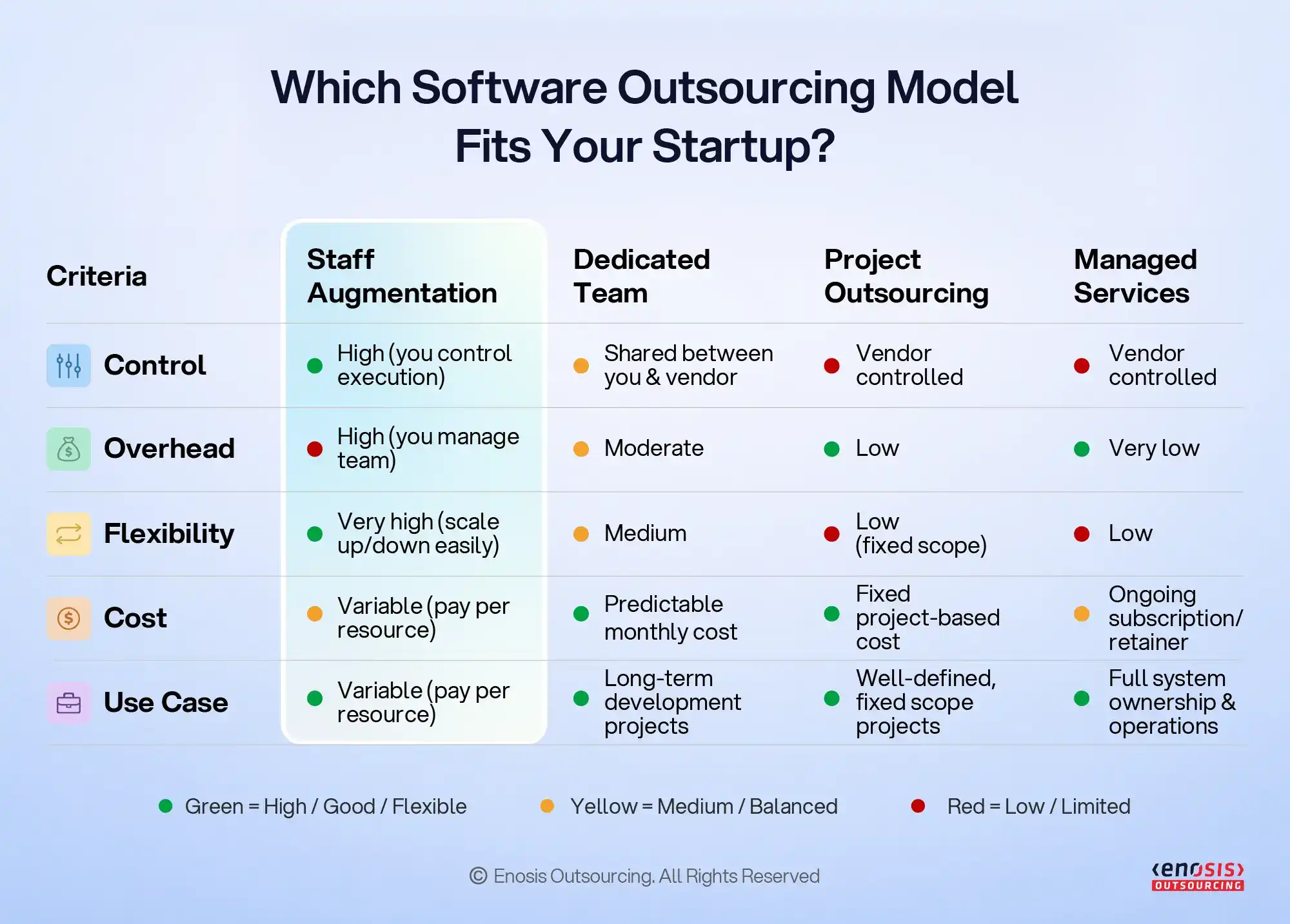
Organizations occasionally evaluate staff augmentation in isolation. It is usually compared against dedicated development teams, project outsourcing, and managed services. Each model shifts control, risk, and accountability in different ways.
Staff Augmentation vs. Dedicated Development Team
A dedicated development team is a group of engineers hired from a single vendor who work exclusively on your product. The team often includes its own lead or manager and operates with some autonomy.
Staff augmentation places individual engineers directly inside your existing teams. You maintain daily management and delivery control, while the vendor focuses on talent supply rather than execution oversight.
Dedicated teams can be more cost effective for long running, stable initiatives because the vendor absorbs more coordination overhead. Staff augmentation is better when you need precise skill placement, tighter integration, or flexibility to scale capacity up or down without reorganizing teams.
Staff Augmentation vs. Project Outsourcing
Project outsourcing shifts responsibility for delivery outcomes to the vendor. You define scope, timelines, and success criteria, and the vendor delivers against those commitments.
Staff augmentation keeps ownership internal. You manage priorities, execution, and tradeoffs. This makes augmentation better suited for evolving products, continuous delivery environments, and situations where requirements are expected to change.
Outsourcing works best for well defined, fixed scope projects. Staff augmentation works best when adaptability and internal control matter more than contractual certainty.
Staff Augmentation vs. Managed Services
Managed services transfer responsibility for a system or capability entirely to a vendor. You define outcomes, and the provider handles staffing, execution, and ongoing improvements.
Staff augmentation is not about offloading responsibility. It is about extending your team with on demand expertise while keeping ownership in house.
Managed services fit scenarios where you want to remove operational burden. Staff augmentation fits scenarios where you want to increase capacity, preserve control, and maintain internal knowledge over time.
When to Use the Staff Augmentation Model
Staff augmentation works especially well when you need on demand expertise for a narrow initiative and do not want to carry that capability as permanent headcount.
Product Scaling
You have achieved product market fit and need to scale the engineering team quickly to support growing customer demand. Your product roadmap requires more engineers than you can hire quickly. Staff augmentation allows you to add capacity immediately while recruiting permanent staff for longer term growth.
Skill Gap Coverage
You need a specific skill (Kubernetes, machine learning, Rust) that is scarce and expensive to hire permanently. Rather than hiring someone full time, you hire an augmented engineer for the project or initiative that requires the skill. Once the project concludes, the engagement ends.
Modernization Initiatives
You need to modernize legacy systems or migrate to new platforms. This work is often time bounded and requires deep, specialized expertise. Staff augmentation allows you to bring in engineers who have experience with the new technology and then exit the engagement once the migration is complete.
Delivery Acceleration
You are facing a market deadline or need to accelerate delivery on a critical feature. Rather than hiring, you augment your team with additional capacity immediately. Once the deadline passes, you can reduce capacity.
Managing Hiring Uncertainty
You think you need more engineers, but you are not certain whether the need will persist. Rather than hiring and risking layoffs, you augment for a few months to test the hypothesis. If the need is real, you convert some augmented roles to permanent hires. If it were temporary, you exit cleanly.
When Staff Augmentation Is Not the Right Fit
Staff augmentation is not always the right choice. There are scenarios where it creates more problems than it solves.
Lack of Internal Technical Leadership
If your engineering team lacks clear leadership or technical direction, augmentation will not fix it. An augmented engineer needs clear work direction and integration into an existing team structure. If your team is chaotic, augmentation will be chaotic too. Fix your leadership first.
Fully Defined and Fixed Scope Projects
If you need an engineer for a small, discrete project that will take two weeks, the overhead of integration and onboarding makes augmentation inefficient. Hire a contractor or use project outsourcing instead.
Process Immaturity
If your team does not have clear processes, documented requirements, or standard code review practices, augmentation will struggle. Augmented staff need context and clarity to be productive. Without that, both the augmented engineer and your team will be frustrated.
Completely Novel Technology
If you are building something with technology that your team has never used and has no expertise in, you might need more than augmentation. You might need a dedicated team, a consulting engagement, or a managed services partner who can take more responsibility. An augmented engineer in this scenario will be productive only if your internal team can guide them, which is difficult if no one has used the technology before.
Need Help Choosing the Right Outsourcing Partner?
Tell us what you need, and we’ll help you identify companies that fit your project requirements.
Schedule Your Free CallCost Structure and Pricing for Staff Augmentation
Staff augmentation pricing is typically hourly or monthly. The cost structure depends on the engineer’s seniority, the geographic region, and the engagement duration.
Regional Cost Ranges
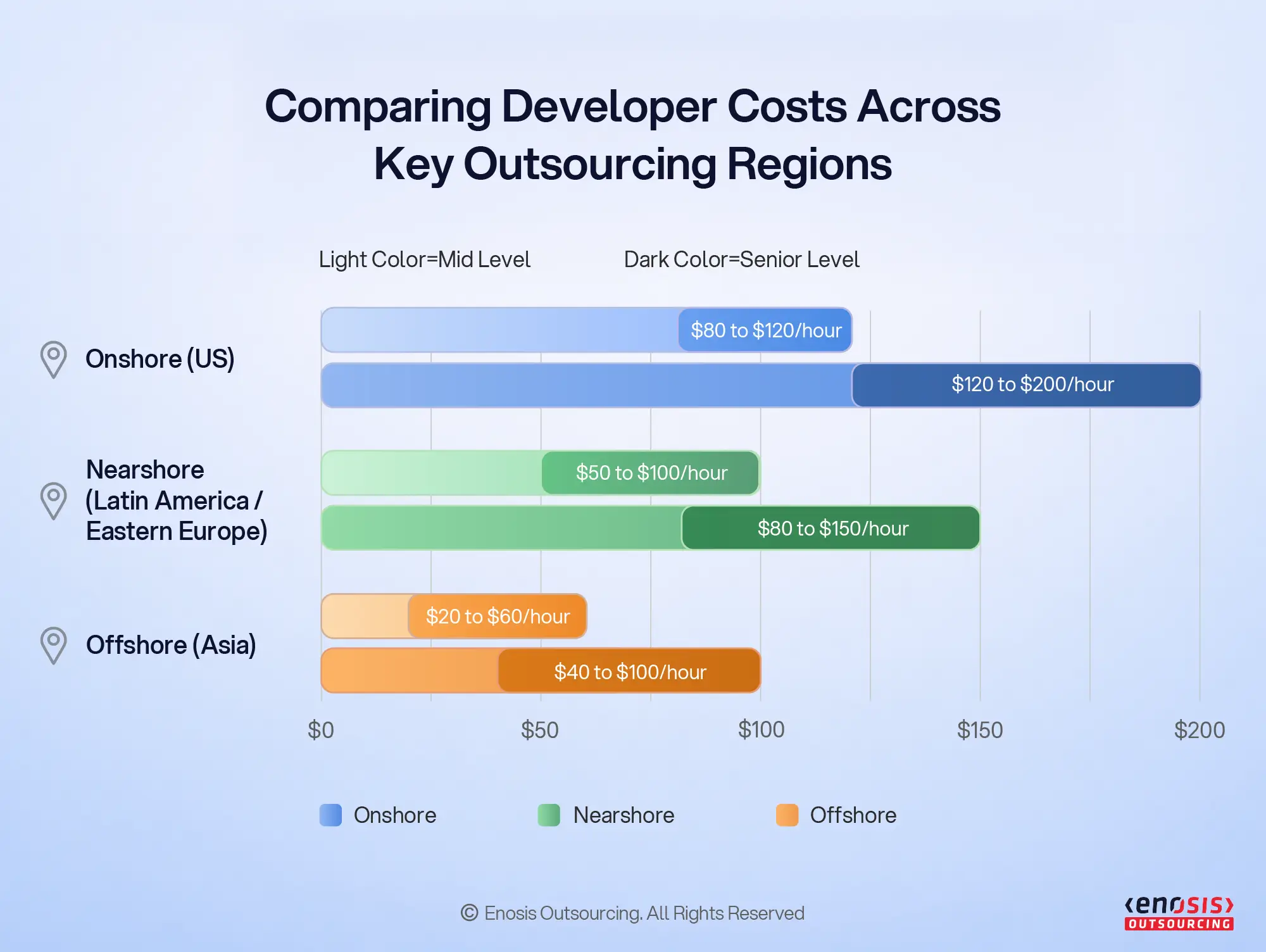
Onshore augmentation in major U.S. markets ranges from $80 to $150 per hour for mid level engineers, with senior engineers at $120 to $200 per hour. Some specialized skills (machine learning, blockchain) command premium rates.
Nearshore augmentation (Latin America, Eastern Europe) ranges from $50 to $100 per hour for mid level engineers and $80 to $150 for senior engineers. Nearshore often provides the best balance of cost and ease of collaboration.
Offshore augmentation (Asia) ranges from $20 to $60 per hour for mid level engineers and $40 to $100 for senior engineers. Offshore is most cost effective but requires more disciplined communication practices.
Cost Drivers
Seniority is the primary cost driver. Junior developers cost less than mid level developers, who cost less than senior engineers. Specialized skills command premiums.
Engagement duration affects cost. Short engagements (less than one month) often carry a premium to account for sourcing and onboarding overhead. Longer engagements (six months or more) sometimes include discounts.
Geographic location is significant. The same engineer level costs three to five times more in the United States than in India.
Total Cost Considerations
Do not evaluate augmentation cost based on hourly rate alone. Shorter engagements often compress the hiring timeline even further, so you want a realistic view of ramp up, not just the start date. This is where cost savings usually come from, not the lowest rate, but faster productivity with fewer handoffs and less rework. Consider total cost, including onboarding overhead, management time, and ramp up productivity loss. An engineer who costs $100 per hour but is productive within two weeks has a lower true cost than an engineer who costs $50 per hour but takes a month to be productive.
Additionally, consider replacement risk. Some vendors charge for replacement engineers if the initial hire does not work out; others provide a grace period. Understand the vendor’s replacement policy before signing.
How to Choose the Right Staff Augmentation Partner
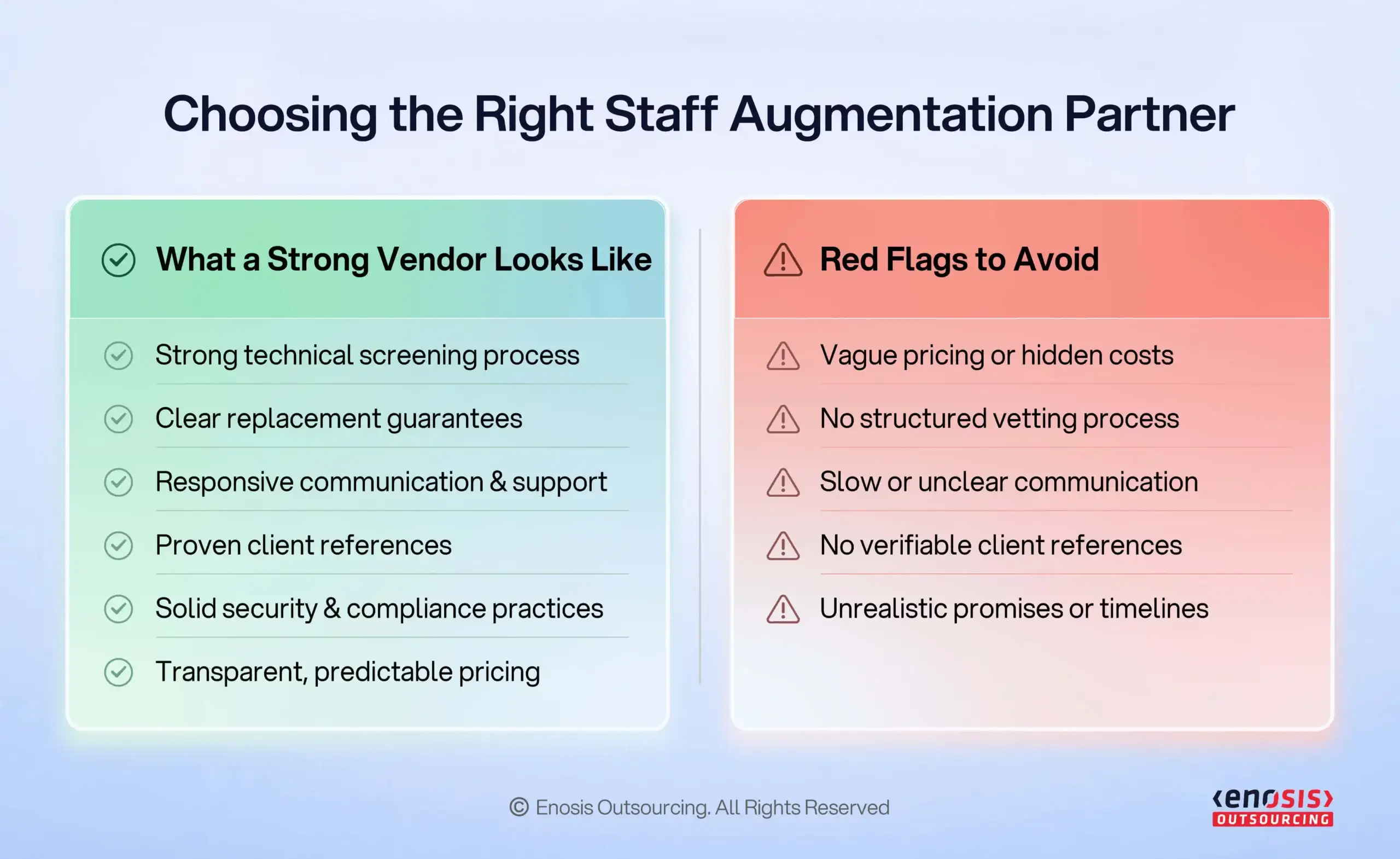
Choosing the right augmentation partner is often the deciding factor between a smooth engagement and a frustrating one. Strong providers reduce risk through consistent vetting, reliable communication, and clear contractual terms.
Vendor Selection Criteria
Technical Screening Rigor: Ask how engineers are vetted. Do they run live technical interviews, code assessments, and communication checks? Request examples of their screening workflow. Strong screening improves quality and shortens the hiring timeline because fewer candidates are mismatched.
Replacement Guarantees: A good vendor will treat replacement as routine, not a negotiation. Confirm whether there is a written replacement guarantee, how long it lasts, and the expected turnaround time. A good partner treats replacement as operational, not a negotiation.
Communication and Support: Ask how the provider supports you after placement. Is there an account manager? How quickly do they respond when issues arise? Smooth engagements depend on fast resolution and clear escalation paths.
Client References: Ask for references from similar organizations and similar engagement types. Use those calls to validate responsiveness, consistency, and how well the provider handled problems when they occurred.
Security and Compliance: Confirm NDA and IP protection terms, and verify whether the vendor follows standards aligned with your risk posture (ISO 27001, SOC 2, or industry specific requirements when relevant). Security is not an add-on in augmentation, because augmented staff work inside your systems, so cyber security and compliance cannot be treated as an afterthought.
Pricing Transparency: Pricing should be clear, including minimum commitments, payment terms, and what is included. Avoid vendors who cannot explain rate drivers or who add fees after initial alignment.
Red Flags to Avoid
Pressure to commit long term without a pilot
Vague or inconsistent technical screening
No written replacement policy
Slow communication during the evaluation phase
Unclear pricing, hidden fees, or shifting rate structures
No credible client references
Conclusion
Staff augmentation helps companies add engineering capacity without the delay and cost of permanent hiring. It works best when you have clear work, strong internal leadership, and time to onboard external engineers properly. It fails when used to cover weak direction or missing technical ownership. Before committing, check three things: clear scope, internal owner, and vendor quality. Start with a short pilot, then scale only if the engineers fit your process and delivery standards.