

 14 min read
Outsourcing Node.js development means hiring external developers or a software company to build, improve, or maintain applications using Node.js. Businesses choose this approach when they need backend expertise, additional engineering capacity, or support without hiring a complete internal team.
However, lower hourly rates do not always lead to lower project costs. The right partner depends on technical experience, delivery responsibilities, communication, and long-term maintenance needs.
Some companies need one experienced Node.js developer. Others need a dedicated team to build APIs, modernize applications, or manage cloud infrastructure.
This guide explains when to outsource Node.js development, which models to consider, how much it costs and how to choose a provider while retaining control of your software.
Looking to Outsource Your IT Projects?
Enosis Outsourcing helps technology leaders scale their teams with expert offshore engineers. Get a free consultation today.
Get a Free ConsultationWhen Should You Outsource Node.js Development?
Outsourcing makes sense when your business needs Node.js expertise or development capacity that your internal team cannot provide efficiently.
Node.js is commonly used for APIs, SaaS platforms, and real-time applications. Its event-driven architecture helps handle multiple data requests efficiently, although performance still depends on architecture and code quality.
When Outsourcing Makes Sense
Businesses commonly outsource Node.js development when:
Building new products: Startups need backend expertise for MVPs, APIs, and SaaS platforms without hiring a full engineering team.
Accessing specialized skills: External engineers provide expertise in architecture, performance optimization, and security.
Modernizing applications: Outsourced teams can update backends, build APIs, and integrate legacy systems.
Managing workload changes: Companies can add development capacity during busy periods without permanent hiring.
When In-House Development May Be Better
Outsourcing may be better when | In-house development may be better when |
|---|---|
Your team lacks Node.js skills | Your team has the required skills |
You need extra developers temporarily | You have steady, long-term work |
You need specialized expertise | Your project needs frequent internal experimentation |
A provider can manage the work | Managing an external team would add too much work |
Outsourcing offers flexibility and potential cost savings, but requires oversight. If your team has the necessary skills and capacity, in-house development may provide better continuity.
Need a Team for a Custom Software Project?
Explore companies with experience building software around specific business requirements, workflows, and technical needs.
Find Custom Software Teams
What Node.js Development Services Can You Outsource?
Node.js outsourcing can cover individual backend tasks or complete application development. The appropriate services depend on whether you are building, improving, or maintaining a product.
Backend and API Development
External developers can build REST or GraphQL APIs, authentication systems, database integrations, and backend services for web and mobile applications.
Frameworks such as Express, NestJS, and Fastify support different architectures. Ask the provider why its proposed framework fits the application's requirements.
For example, a SaaS company may outsource API development while keeping product design and business requirements under internal management.
Real-Time Applications and Microservices
Node.js supports applications that handle frequent network events and active connections, including messaging systems, collaboration tools, live dashboards, and IoT platforms.
Developers may use WebSockets, message queues, and caching tools such as Redis.
For complex applications, microservices can separate parts of a system into independently deployable components. However, they also increase monitoring and deployment requirements. Smaller products may be easier to maintain with a well-structured monolithic architecture.
Modernization and Performance Optimization
Businesses can outsource dependency upgrades, database optimization, API refactoring, caching, and legacy integrations without rebuilding an entire application.
Developers may also investigate event-loop blocking, memory problems, and slow database queries.
The official Node.js documentation explains how blocking operations can affect application responsiveness.
Performance improvements should begin with measurements. Without evidence of the actual problem, a major redesign may create unnecessary costs.
QA, Cloud Deployment and Maintenance
Service | Typical Deliverable |
|---|---|
Backend development | APIs and application logic |
Real-time development | WebSockets and event processing |
Modernization | Updated architecture and code |
QA and testing | Automated tests and bug reports |
Cloud and DevOps | Cloud setup and deployment pipelines |
Maintenance | Monitoring, updates, and production support |
Confirm which services are included before signing a contract. Building an application does not automatically mean the provider will operate it after launch.
Node.js Development Outsourcing Models
The best outsourcing model depends on your internal engineering capacity, project scope, and how much responsibility you want to transfer.
Staff Augmentation
Staff augmentation adds external Node.js developers to your existing team.
Your company manages architecture, priorities, code reviews, and releases. This approach works when you have experienced engineering leadership but need additional developers.
However, staff augmentation is a poor fit if nobody internally can direct technical work. Adding developers without proper management may increase coordination problems.
Dedicated Development Team
A dedicated team provides consistent external engineering capacity for ongoing development.
It may include Node.js developers, a technical lead, QA specialists, and DevOps support.
This model suits businesses with evolving requirements and long-term product roadmaps. Both parties should agree on priorities, technical decisions, and delivery responsibilities.
Project-Based Outsourcing
With project-based outsourcing, a provider delivers an agreed scope of work.
For example, a business may outsource a Node.js API modernization project covering development, testing, and deployment.
This model works well when requirements and acceptance criteria are clear. If features change frequently, a rigid scope may lead to repeated contract changes and additional costs.
Fully Managed Node.js Services
Fully managed services can include development, cloud infrastructure, monitoring, maintenance, and production support.
They suit businesses that need continuing technical operations beyond a completed development project.
The contract should specify service coverage, incident response, infrastructure access, and which activities remain the client's responsibility.
Comparing Outsourcing Models
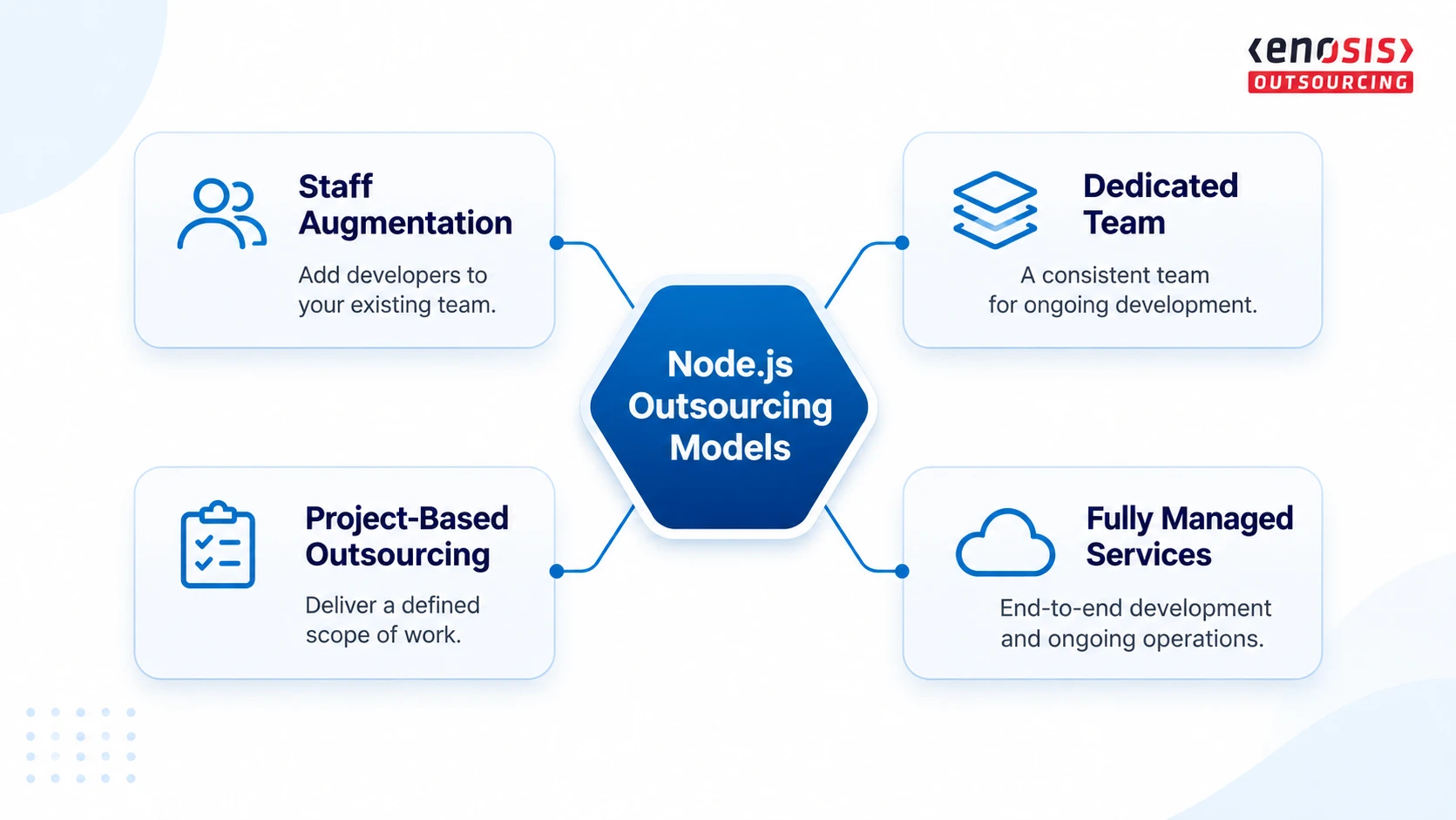
Practical choice: If your internal team can manage developers, staff augmentation is a reasonable starting point. If you lack technical leadership, consider a provider that can also manage architecture, QA, and delivery.
Fixed-price and time-and-materials agreements are pricing arrangements rather than separate outsourcing team models.
How Much Does It Cost to Outsource Node.js Development?
Node.js outsourcing costs depend on developer experience, project complexity, location, team composition, and ongoing responsibilities.
Comparing hourly rates can help with initial budgeting, but total costs also include testing, management, infrastructure, and maintenance.
Node.js Development Hourly Rates by Location
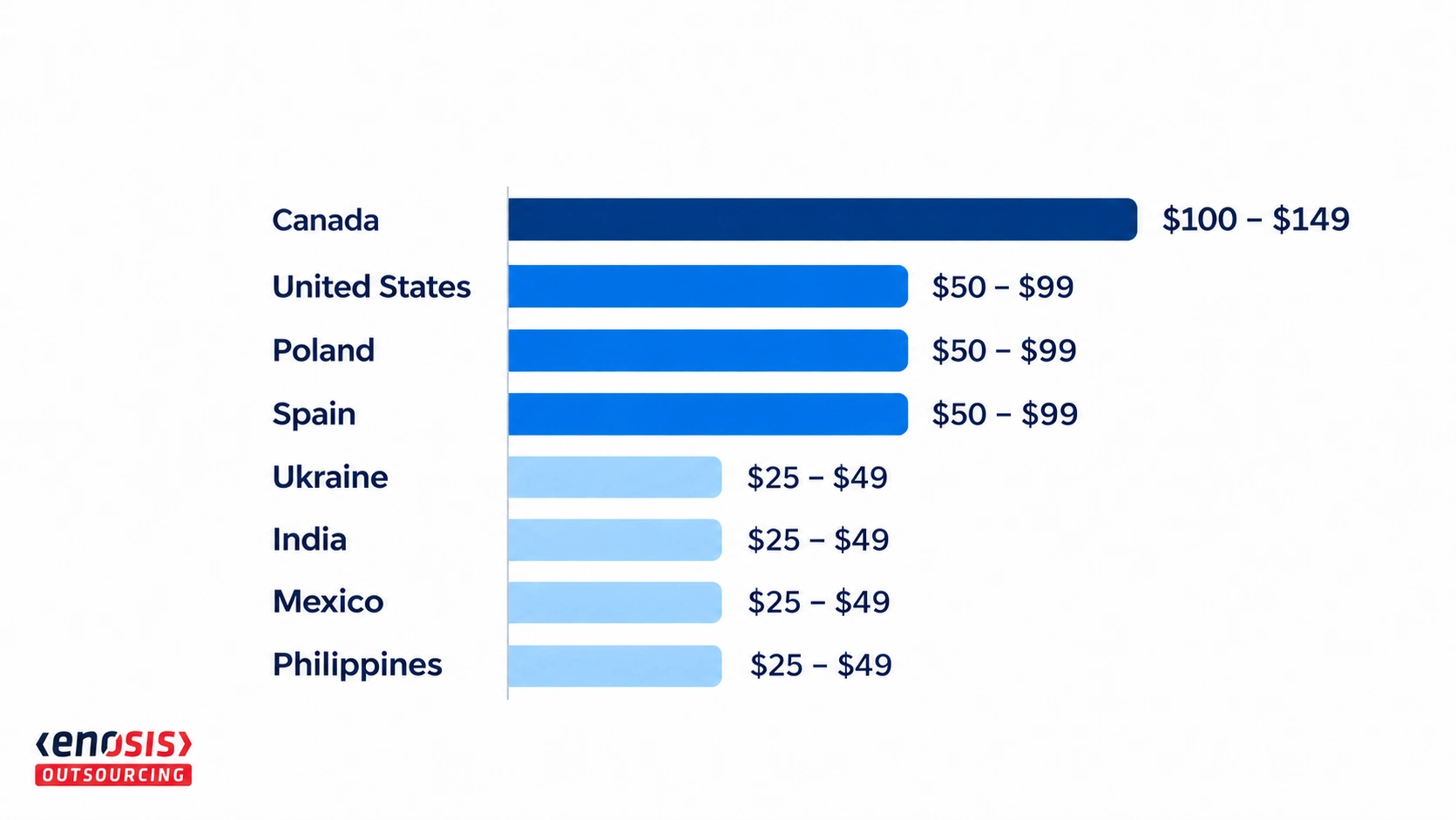
Source: Clutch, Software Development Company Pricing Guide 2026, updated September 21, 2026.
These are general software development company rates, not verified Node.js-specific quotations. Actual pricing depends on the proposed team and project requirements.
Key Factors Affecting Costs
Seniority: Experienced developers and architects generally cost more.
Complexity: Advanced integrations, real-time processing, and security requirements increase development effort.
Team composition: QA, DevOps, and project management may add to the budget.
Engagement model: Managed services may cover more responsibilities than staff augmentation.
Operations: Hosting, monitoring, security updates, and support create ongoing expenses.
Example Node.js Project Budget
Consider a hypothetical engagement to build an initial backend API module for an existing application.
The scope includes API endpoints, authentication, one database integration, automated tests, code review, and deployment pipeline configuration.
Role | Hours | Assumed Rate | Estimated Cost |
|---|---|---|---|
Node.js developer | 120 | $40/hr | $4,800 |
Senior Node.js lead | 40 | $65/hr | $2,600 |
QA engineer | 40 | $30/hr | $1,200 |
DevOps engineer | 20 | $50/hr | $1,000 |
Project manager | 20 | $45/hr | $900 |
Total | 240 | $10,500 |
Illustrative labor budget: $10,500.
The 240 hours represent combined billable work across five roles, not 240 calendar hours or one person's workload. Some activities can happen concurrently, while others depend on earlier tasks.
The project might fit within one month if requirements are defined, engineers are available, and integration work proceeds as planned. Actual delivery time depends on dependencies, reviews, and scheduling.
This example is not a vendor quotation or guaranteed estimate. Hosting, third-party services, additional discovery, taxes, contingency, and maintenance are excluded.
Compare vendors using the same scope and acceptance criteria. A lower hourly rate may produce a higher total cost if the work requires extensive rework.
How to Outsource Node.js Development: Step-by-Step
Follow these six steps to manage your Node.js outsourcing project.
Step 1: Define Requirements
Document business goals, features, integrations, security requirements, technical constraints, and timelines.
Deliverable: A project scope with measurable acceptance criteria.
Step 2: Shortlist Providers
Compare companies based on relevant Node.js projects, proposed engineers, and delivery models.
Deliverable: Comparable technical and commercial proposals.
Step 3: Agree on Contracts and Responsibilities
Define payment terms, intellectual property, confidentiality, scope changes, and acceptance conditions.
Clarify who controls repositories, testing, deployment and infrastructure.
Deliverable: An agreement with clear responsibilities.
Step 4: Run Discovery or a Paid Pilot
Start complex projects with a limited assignment, such as an API module or architecture review.
Set success criteria covering automated tests, performance under an agreed load, documentation, and technical decisions.
Deliverable: Reviewed work showing whether the team meets your requirements.
Step 5: Manage Development and Testing
Use a shared backlog, regular demonstrations, code reviews, and automated tests.
Measure progress against accepted deliverables rather than hours alone.
Deliverable: Tested software and documented technical decisions.
Step 6: Deploy and Complete Handover
Verify production access, monitoring, deployment instructions, and rollback procedures.
Confirm the transfer of agreed source code and documentation.
Deliverable: An accepted release with clear support responsibilities.
Need Help Building Your Vendor Shortlist?
Tell us what you're looking for and get help identifying companies relevant to your requirements.
Get a Free Consultation
How to Evaluate a Node.js Outsourcing Partner
An outsourcing provider should demonstrate relevant technical experience, dependable delivery, and an understanding of your project.
Verify Relevant Project Experience
Review Node.js projects similar to your application in complexity, architecture, or industry.
Ask what the provider actually delivered, which challenges it addressed and whether it managed production support.
A technology list alone does not demonstrate delivery experience. Where possible, review project evidence and speak with a client reference.
Assess Node.js Technical Skills
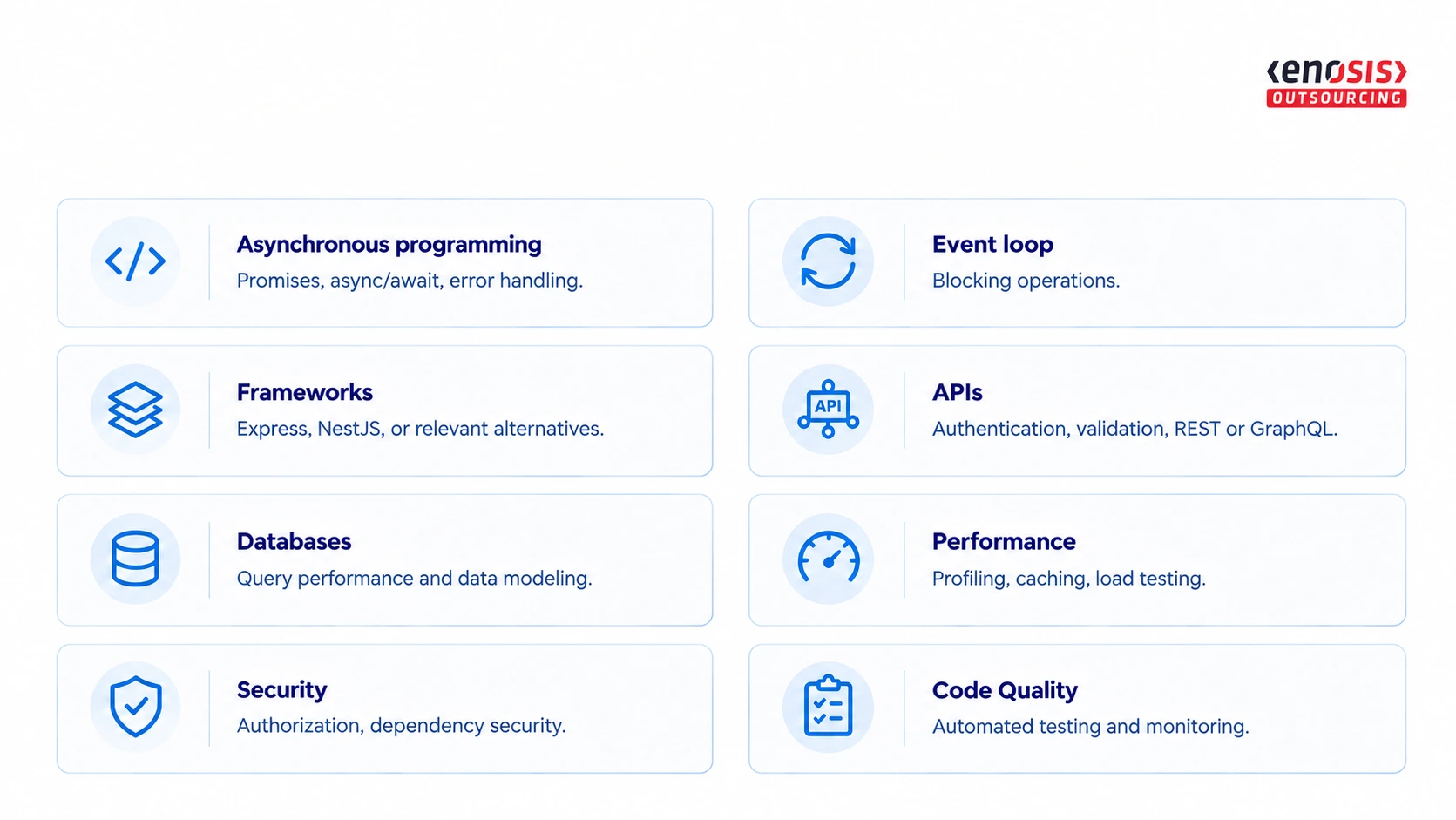
Ask how developers would investigate a slow Node.js API. A capable engineer should discuss measurements, database queries, blocking operations, and infrastructure before recommending architectural changes.
Evaluate Communication and References
Request a sample progress report or release checklist. Ask how the team handles changing requirements, delays, and unavailable engineers.
Watch for two warning signs: a provider that refuses to identify the engineers assigned to your project, or one that cannot explain its testing and release process.
Client references can also help establish whether the provider communicates problems early and delivers maintainable code.
Five Questions to Ask
How have you resolved Node.js performance problems?
What tests and security checks are required before deployment?
Can you explain a difficult project and its technical decisions?
What happens when a key engineer becomes unavailable?
Who handles production incidents and deployment failures?
If two vendors offer similar prices, compare their engineers, testing practices, and responsibility for production issues before deciding.
Risks of Outsourcing Node.js Development and How to Manage Them
Outsourcing introduces technical and operational risks when requirements, ownership, or responsibilities are unclear.
Risk | Potential Problem | How to Reduce It |
|---|---|---|
Weak architecture | Slow performance | Architecture reviews and load testing |
Poor code quality | High maintenance costs | Code reviews and automated tests |
Security issues | Data exposure | Security testing and access controls |
Unclear requirements | Rework and delays | Shared requirements and acceptance criteria |
Poor communication | Unresolved issues | Progress reports and escalation rules |
Vendor dependency | Difficult provider changes | Documentation and source-code access |
Unclear infrastructure ownership | Unmanaged incidents | Clear operational responsibilities |
Technical and Security Risks
Blocking operations and inefficient database queries can reduce Node.js performance. Require profiling and relevant load testing instead of accepting broad claims about scalability.
The OWASP API Security Top 10 identifies risks such as broken authorization, authentication weaknesses, and security misconfiguration.
Ask providers how their testing and review processes address the risks relevant to your application.
Delivery and Operational Risks
Unclear requirements often cause rework. Regular demonstrations and acceptance checks help identify problems before release.
For example, if a production API repeatedly fails after deployment, the agreement should identify who investigates, how quickly incidents must be acknowledged, who can approve a rollback, and how the client receives updates.
These arrangements matter particularly when development and hosting are managed by different organizations.
10 Node.js Development Companies to Consider
Relevant Node.js projects offer stronger evidence of a company's capabilities than technology lists alone.
The following companies were selected from project records in the Enosis Outsourcing directory, covering SaaS development, API engineering, modernization, and staff augmentation. This is not a quality ranking, and reported project outcomes have not been independently audited.
1. Geniusee — SaaS and Product Development
Location: Ukraine
Geniusee developed mobile and web applications for WayWiser, an eldercare coordination platform. The project used Node.js, NestJS, MongoDB, React, and React Native, covering architecture review, backend APIs, and product features.
Best suited for: SaaS products requiring coordinated backend, web, and mobile development.
2. Yellow Systems — Node.js APIs and Microservices
Location: Poland
Yellow Systems provided Node.js backend development for an AI medical web application associated with SolveIt. Its work included an API layer, event-driven microservices, and data storage integration. The published case study reports support for complex real-time workloads.
Best suited for: API-driven applications requiring backend architecture and real-time processing.
3. Empat — Node.js Product Engineering
Location: Ukraine
Empat developed DreamX, a wealth-building platform using Node.js, PostgreSQL, React, and AWS. The engagement covered authentication, banking integrations, CI/CD, and monitoring. Its published case study reports more than 1,200 users onboarded within three weeks.
Best suited for: Startups needing integrated backend, frontend, and cloud development.
4. KnubiSoft — Node.js Applications and DevOps
Location: Ukraine
KnubiSoft developed a React application with Node.js APIs, authentication, integrations, and CI/CD. Its case study reports approximately 40% faster page loads and over 35% lower backend response times.
Best suited for: Businesses combining application development with performance improvements and deployment automation.
5. ATeam Soft Solutions — IoT and Modernization
Location: India
ATeam Soft Solutions modernized HandsOn Systems' fleet-management platform using Node.js, React, REST APIs, and database optimization. The work included legacy-data migration, which its case study reports was completed without downtime.
Best suited for: IoT platforms, operational dashboards, and backend modernization.
6. SpaceDev — Node.js Staff Augmentation
Location: Uruguay
SpaceDev supplied development capacity to Swordfish Solutions for React and Node.js work. The developer joined the client's existing engineering process rather than managing the complete project.
Best suited for: Companies with internal technical leadership that need additional Node.js developers.
7. Bright Inventions — Backend Modernization
Location: Poland
Bright Inventions worked with Relevo to migrate an existing backend from PHP to Node.js. The project also included AWS improvements and support for mobile and web applications.
Best suited for: Businesses modernizing legacy backends while maintaining existing products.
8. LDT Technology — Node.js and AWS Support
Location: India
LDT Technology provided Node.js backend implementation and AWS-related managed services for Cloud Ingenious. Its project record reports an on-schedule launch and positive client feedback about coordination.
Best suited for: Businesses requiring backend development alongside AWS technical support.
9. Celadonsoft — SaaS and Cloud Development
Celadonsoft developed bTrade's SaaS managed-file-transfer product using Node.js, React, SQL, and AWS. The engagement covered discovery, backend services, integrations, QA, and project management.
Best suited for: SaaS applications involving cloud infrastructure and third-party integrations.
10. Snappymob — Node.js Payment Integrations
Location: Malaysia
Snappymob supported SMG Entertainment with a payment gateway migration involving Node.js middleware, serverless APIs, testing, deployment and post-release support.
Best suited for: Payment integrations and transaction-related backend development.
Comparing Node.js Outsourcing Companies
Company | Documented Project Focus | Potential Buyer Fit |
|---|---|---|
Geniusee | NestJS APIs and mobile/web applications | SaaS development |
Yellow Systems | Node.js APIs and microservices | Backend architecture |
Empat | Node.js/PostgreSQL platform and AWS | Product development |
KnubiSoft | Node.js APIs and CI/CD | Web applications and DevOps |
ATeam Soft Solutions | IoT backend and data migration | Modernization |
SpaceDev | React/Node.js development support | Staff augmentation |
Bright Inventions | PHP-to-Node.js migration | Legacy modernization |
LDT Technology | Node.js and AWS support | Managed technical services |
Celadonsoft | SaaS and cloud integrations | SaaS development |
Snappymob | Payment gateway APIs | Payment integrations |
These projects demonstrate relevant experience, not guaranteed future performance. Evaluate the assigned engineers, proposed scope, delivery responsibilities and support arrangements before choosing a provider.
Need Help Choosing the Right Outsourcing Partner?
Tell us what you need, and we’ll help you identify companies that fit your project requirements.
Schedule Your Free Call
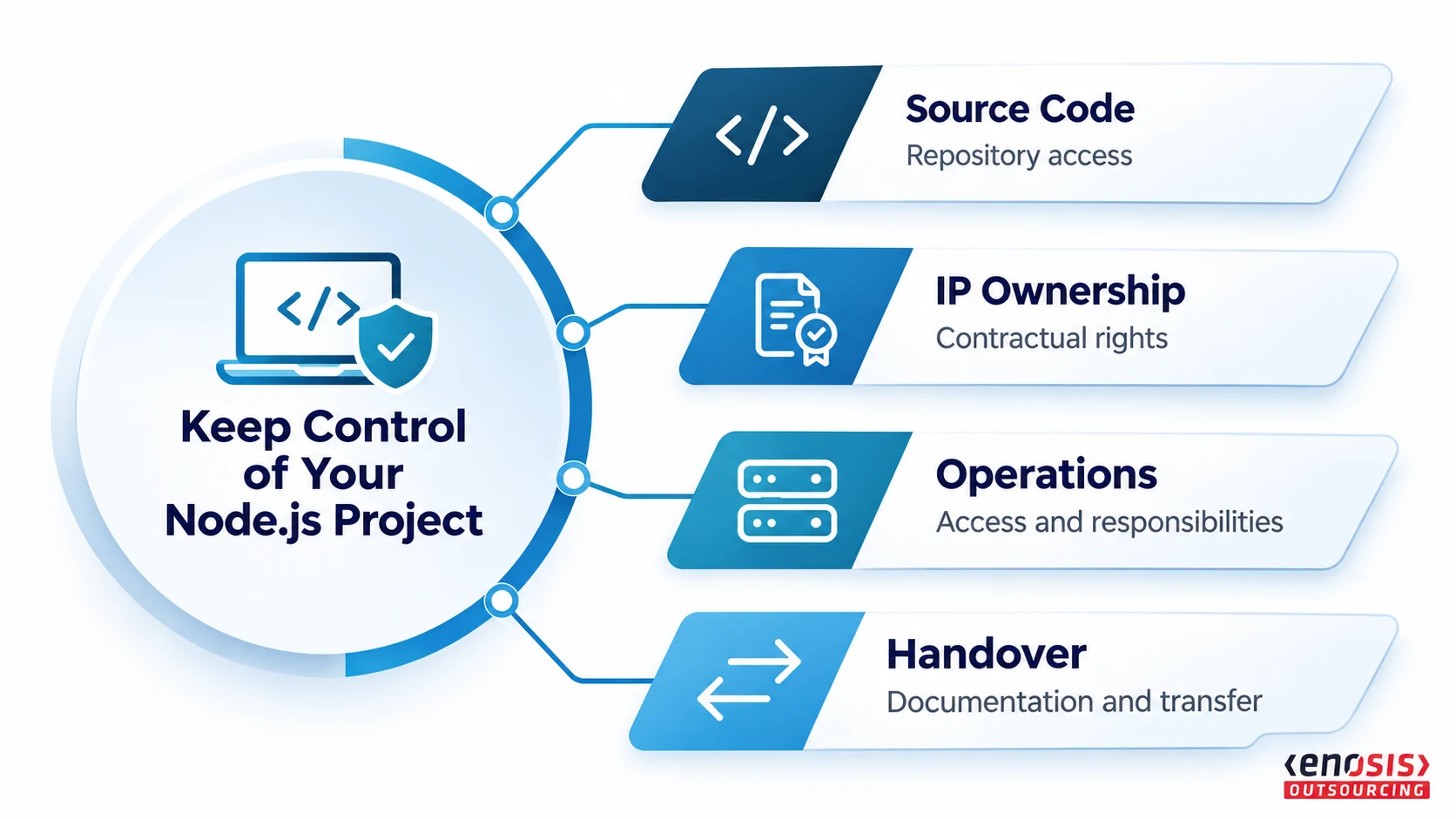
How to Retain Control of Your Outsourced Node.js Project
Outsourcing development should not leave your business dependent on a single provider for access to its software.
Protect Source Code and Intellectual Property
Where practical, maintain repositories under your organization's account.
The contract should clarify ownership of custom code, documentation, third-party components and other deliverables.
Repository access supports technical control, but legal ownership depends on the agreement and applicable law.
Define Operational Responsibilities
Identify who handles testing, deployment, monitoring, backups, security updates, and production incidents.
A provider may develop an application without agreeing to handle ongoing software maintenance and support. Confirm support coverage, escalation procedures, and infrastructure access before launch.
Avoid Vendor Lock-In
Before changing providers or bringing development in-house, ensure access to:
Source code and relevant licenses
Architecture, API, and database documentation
Infrastructure and deployment instructions
Accounts, credentials and monitoring records
Outstanding defects and technical debt
Knowledge-transfer arrangements
During a vendor transition, the incoming team should review the system and verify deployment access before taking responsibility for production operations.
Conclusion
Outsourcing Node.js development can provide specialized engineering expertise, increase delivery capacity and support application modernization without building every capability internally.
Start by defining your technical requirements and choosing an engagement model that matches your management capacity. Compare providers using relevant projects, proposed engineers, delivery practices and total costs.
Finally, establish clear ownership, testing, infrastructure, maintenance and handover arrangements.
A successful outsourcing relationship should leave your business with software it can operate, maintain, and improve, regardless of whether the original provider remains involved.