


 13 min read
Imagine reviewing a customer portal built with AI. The pages look polished. Customers can sign in, check orders, and request refunds. If AI can build business software this quickly, will companies still need programmers in 20 years?
The answer matters to companies planning their development teams and technology investments.
But a working demo is not the same as a reliable product. What happens if a refund fails halfway through? Or if a customer can access another company's records? Someone must make sure the software handles these problems safely.
So, will AI replace programmers by 2046? AI could automate much of their work and reduce some jobs. But there is not enough evidence to conclude that the entire profession will disappear.
For business leaders, the bigger question is what AI can reliably handle. They also need to know how it will affect staffing and where engineers still add value.
Will AI Replace Programmers by 2046?
Whether AI replaces programmers depends on what we mean by "replace." Automating coding tasks, reducing programming jobs, and replacing the entire profession are three different outcomes.
The key is to understand each one:
Task automation: AI completes work that programmers previously handled.
Job displacement: Companies need fewer programmers because AI handles more of their work.
Replacing the profession: AI takes over most programming and software engineering responsibilities with little human help.
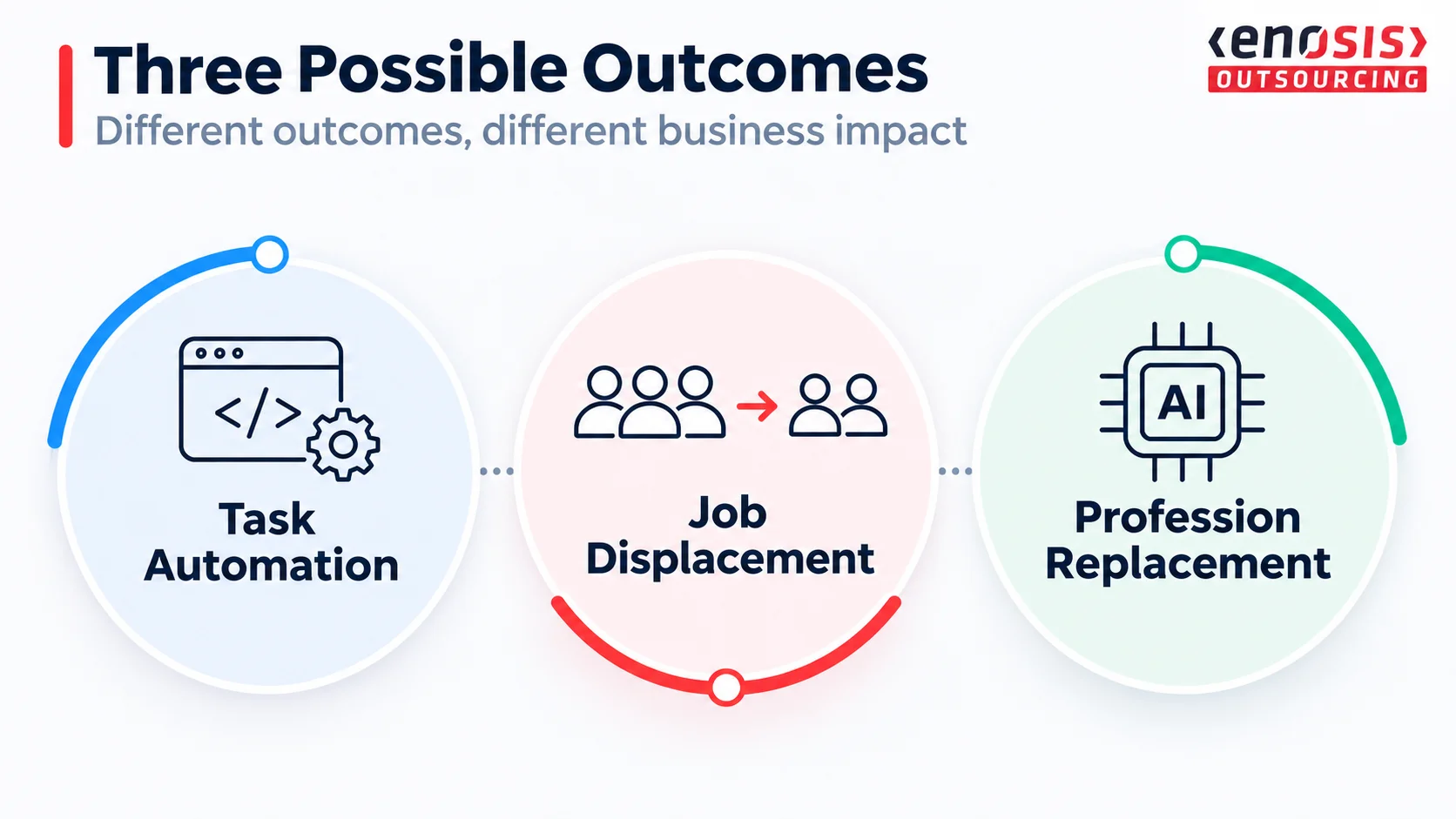
These outcomes are different. AI does not need to replace the entire profession to reduce hiring. A company might keep a smaller engineering team while AI handles more coding, testing, and maintenance.
Today's limits may not last forever
It would be a mistake to assume AI will never handle complex engineering tasks. Its ability to design systems, fix bugs, and plan projects may improve greatly over the next 20 years.
However, generating working code is not the same as delivering reliable software. AI must also deal with changing requirements, unexpected failures, and ongoing maintenance.
For businesses, the question is how reliably AI can handle these tasks. They must also consider whether it can reduce costs without creating new risks.
To understand what AI might replace, we first need to look at what today's tools can do.
What Can AI Coding Tools Do Today?
AI coding tools can write code, explain existing programs, generate tests, and help fix bugs. GitHub identifies repetitive coding, test generation, and basic fixes as strengths of Copilot.
These tools can reduce manual coding work. However, teams must still check the quality of AI-generated code before using it in a real product.
From code suggestions to multi-step tasks
AI coding agents can do more than suggest code. They can use development tools to complete several steps in a task.
For example, GitHub's cloud coding agent can make code changes and submit them for review. Other agent features can edit files and run commands.
This changes how developers work with AI. Instead of requesting one function, they can assign a larger task, such as adding and testing a feature.
But completing multiple steps does not guarantee a correct result. GitHub still recommends reviewing and testing AI-generated changes.
Clear tasks give automation a better starting point
AI coding agents perform better when tasks have clear instructions and testable results. GitHub recommends defining the problem and providing project instructions.
Teams should also set acceptance criteria. These explain what the finished work must achieve.
Consider our customer portal. "Send an email after an approved refund" is easier to test than "improve the customer experience."
Clear requirements help teams assign work to AI and check the results.
But writing code is only one part of building software. The next challenge is making sure everything works together reliably.
Why Generated Code Is Not the Whole Software Product
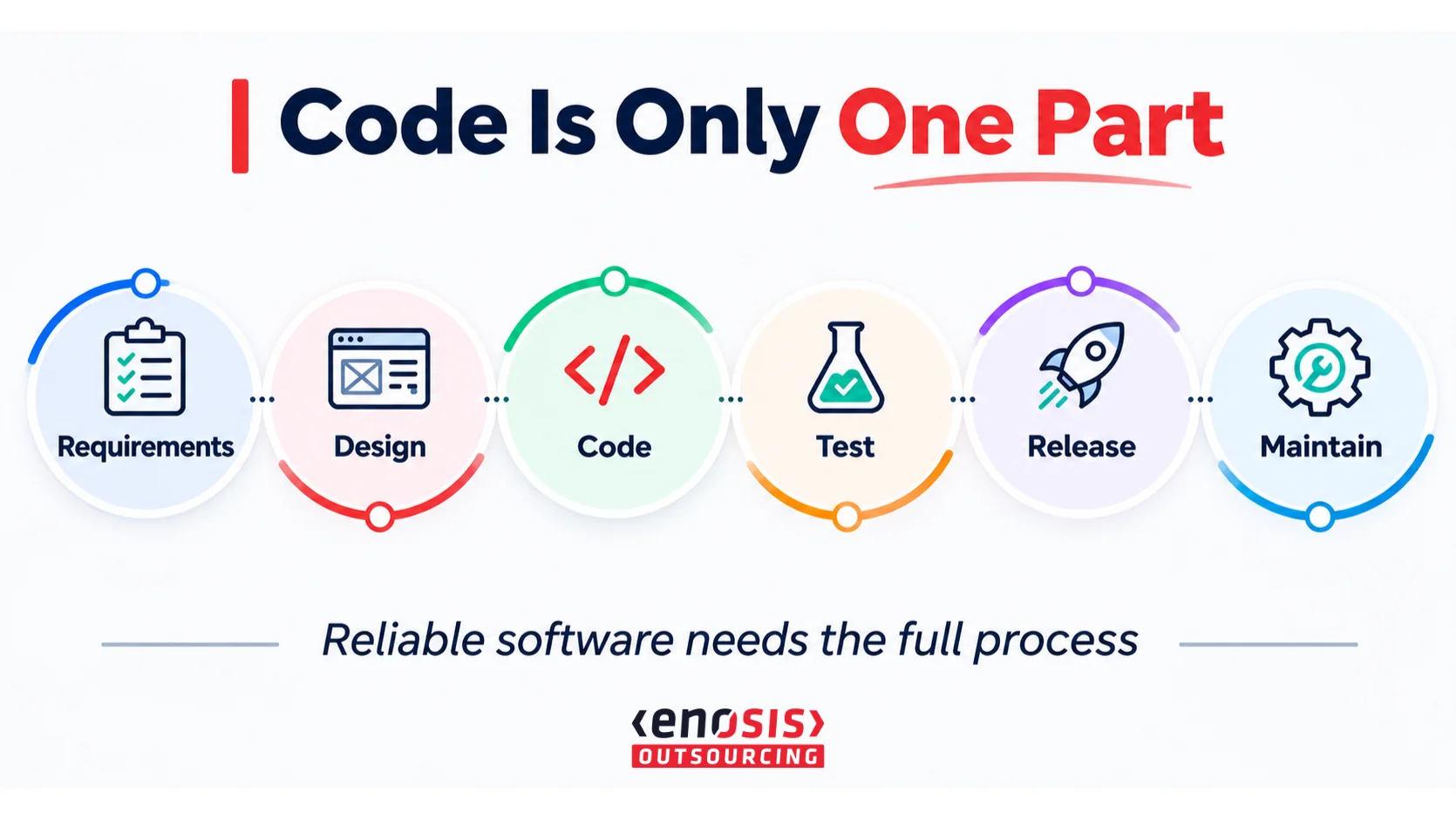
Software development involves more than writing code. Teams must understand business needs, design connected systems, test features, and maintain software after launch.
Software architecture defines how the main parts of a system work together. The U.S. Bureau of Labor Statistics includes design, testing, and maintenance among software development responsibilities.
Our customer portal example shows why these tasks matter beyond a working demo.
Before launch, define the rules and test failures
A refund button may look simple. But the business must decide who can approve refunds, which orders qualify, and how to handle exceptions.
Developers must then connect these rules to payments, inventory, and customer records.
Suppose a payment provider confirms a refund. But the portal loses its connection before recording the result. The software must recover without issuing the refund twice.
AI may help build this process. But the team must still identify possible failures and test how the system responds.
Security matters too. A successful login test does not prove that customers can access only their own records.
After launch, the responsibility continues
Software needs attention after release. Payment providers change their services. Components need updates, and customers report unexpected problems.
Teams must investigate failures and fix issues without breaking existing features. They also need a way to restore an earlier version if an update fails.
AI could automate more of this work in the future. However, businesses should still include ongoing software maintenance costs in their budgets.
A working demo shows what software can do. A reliable product must keep working when conditions change.
That difference matters when measuring how much time AI actually saves.
Looking to Outsource Your IT Projects?
Enosis Outsourcing helps technology leaders scale their teams with expert offshore engineers. Get a free consultation today.
Get a Free ConsultationFaster Coding Does Not Always Mean Faster Delivery
AI can help developers write code faster. But faster coding does not always mean faster software delivery.
Teams still need to review, test, and release the code. These steps take time. The results also depend on the task and the developer's experience.
Measure the work that reaches users
When testing AI tools, measure the time needed to finish and release a useful change. Include code review, testing, and fixes.
Consider our customer portal. AI might generate refund-related code in minutes. But unclear approval rules could slow down the release.
If AI produces code faster than developers can review it, unfinished work may pile up. Faster coding would then have little effect on delivery time.
Faster coding also does not guarantee lower costs. AI tools, testing, integration, and maintenance still require resources.
Businesses should compare the full software development timeline, not just coding hours. They should apply the same quality standards when measuring results.
Productivity studies answer different questions
Research shows mixed results on AI productivity.
A 2025 study examined 4,867 developers across Microsoft, Accenture, and another large company. It estimated about 26% more completed tasks among developers whose AI assistant use was affected by the experiment.
Less experienced developers saw larger gains. However, the study tested coding assistance, not AI delivering complete software products. The combined finding was more certain than the results of individual experiments.
A separate METR (Model Evaluation & Threat Research) study found a different result. Experienced open-source developers took 19% longer to complete tasks when AI tools were allowed in early 2025.
But METR's February 2026 update warned against treating this as a measure of current AI performance. Follow-up research suggested possible gains. However, changes in participation and time tracking made the findings uncertain.
A May 2026 METR survey raised another concern. Technical workers reported that AI made them more productive. But METR warned that self-reported gains may overstate actual improvements.
These studies examined different tools, tasks, and working conditions. None can predict how many programmers companies will need in 2046.
Faster coding may reduce some workloads. Whether it reduces jobs depends on what businesses do with the time saved.
Looking for a Team That Can Turn AI Into a Real Product?
Explore companies with experience building AI and machine learning solutions around practical business requirements.
Find AI Development TeamsHow Will AI Affect Demand for Programmers?
AI could reduce demand for some programming jobs while creating new opportunities. The outcome depends on how businesses use the time and money saved through automation.
Some companies may reduce hiring. Others may invest in more software projects. Both outcomes could happen at the same time.
Smaller teams and more software can coexist
Consider a company with a fixed amount of maintenance work. If AI handles more of that work, the company may need fewer programmers.
Now consider a business that has delayed several software projects because of high costs. AI could make some of those projects affordable.
The company might then build more products instead of reducing its development team.
But cheaper development does not guarantee more projects. Businesses still need customer demand, funding, and a clear software development scope of work.
This means AI could reduce jobs in some companies while supporting growth in others.
Employment forecasts distinguish different roles
U.S. employment forecasts show why job titles matter.
The Bureau of Labor Statistics projects a 7% decline in computer programmer employment from 2025 to 2035. Automation of repetitive tasks and changes in job responsibilities are among the reasons.
However, the same projections show 10% growth for software developers, quality assurance analysts, and testers combined.
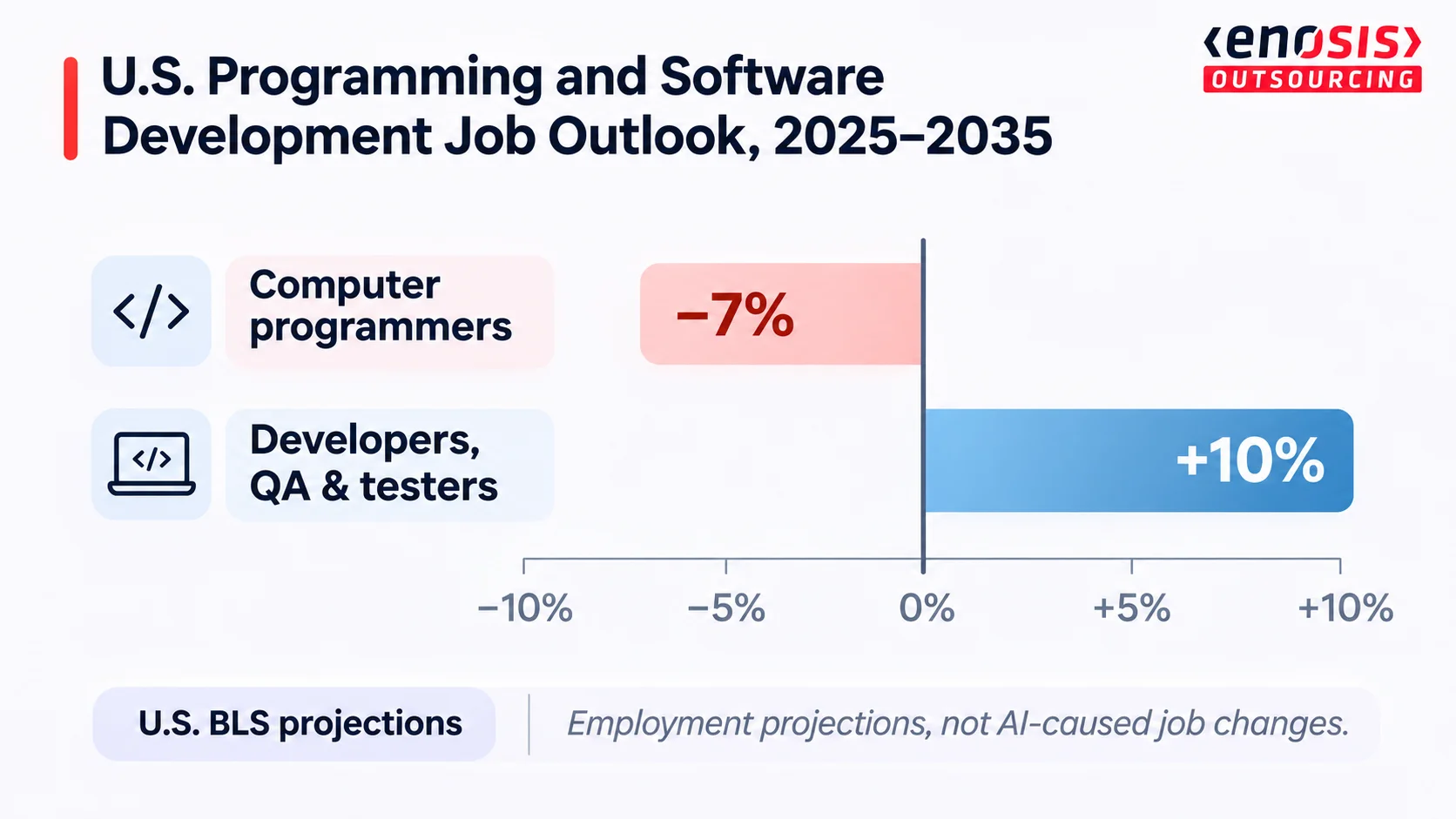
These are different occupations. Computer programmers focus more on writing and modifying code. Software development roles cover broader responsibilities, including design, testing, and maintenance.
The forecasts also have limits. They cover U.S. employment through 2035, not the global workforce through 2046. They do not show how much of the change AI alone will cause.
AI may reduce demand for some programming roles without reducing demand for every type of software engineer.
The impact will also depend on the type of work each programmer performs.
Which Programming Tasks Are Most Likely to Be Automated?
Repetitive tasks with clear requirements are easier to automate. Tasks involving uncertain needs, complex systems, or costly mistakes are harder to automate reliably.
This does not mean AI will never handle complex work. It means companies should judge each task by how easily they can test its results.
The table below compares common programming tasks. It is a planning guide, not a prediction of future job losses.
Programming task | What businesses should check |
|---|---|
Repetitive coding and standard features | Can tests confirm that the code works as expected? |
Changes to existing applications | Could the change break other features? |
Connecting business systems | Can the system recover from failures without losing or duplicating data? |
Software architecture and changing requirements | Does the design meet business needs, costs, and long-term goals? |
Can the software be tested under real operating conditions? |
No task is guaranteed to remain beyond AI's abilities. A programmer may also handle several types of work.
For businesses, the key is to understand the risks of each task. Clear tests and low-cost mistakes make automation easier to assess.
Junior developers need a different kind of support
AI may automate many basic tasks once assigned to junior programmers. This creates a new challenge: how will beginners gain experience?
Junior developers learn by writing code, finding mistakes, and solving problems. If AI handles every basic task, they may have fewer chances to develop these skills.
But this does not mean junior programmers will disappear. The field experiments discussed earlier found larger productivity gains among less experienced developers.
Companies can use AI while protecting learning opportunities. Junior developers should explain generated code, practice debugging, and take ownership of small features under supervision.
The goal is to develop programmers who understand the software, not just those who can generate code.
These differences help explain why AI may change programming jobs in several ways over the next 20 years.
Three Possible Futures for Programming by 2046
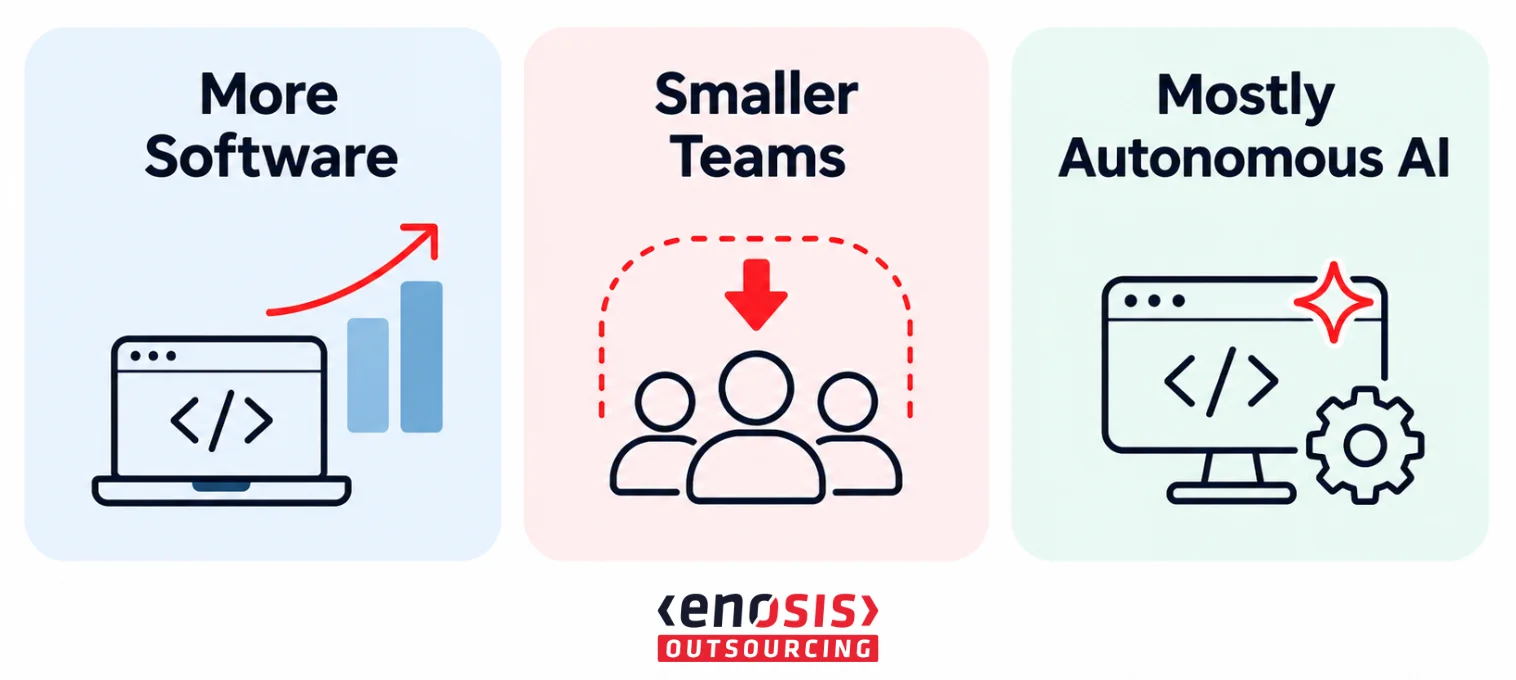
AI could change programming jobs in several ways over the next 20 years. The outcome will depend on how capable AI becomes and how businesses use it.
The following three scenarios are possibilities, not predictions. They may also happen in different industries at the same time.
AI expands the amount of software people build
In this scenario, AI makes software development faster and more affordable. Businesses use the savings to build new products, improve existing systems, and launch projects they previously could not afford.
Programmers remain important, but their work changes. They spend less time on routine coding and more time guiding development and solving business problems.
However, this outcome depends on demand. Companies must have enough useful projects to make the extra development worthwhile.
For businesses, the opportunity is to deliver more software with their existing teams.
Smaller teams manage larger workloads
In this scenario, AI agents handle more coding, testing, and routine software maintenance.
Companies may need fewer programmers for the same amount of work. Smaller teams could manage projects that once required more people.
However, someone must still review results, handle unusual problems, and set priorities. If checking AI-generated work takes too long, the expected savings may disappear.
For businesses, the key test is whether a smaller team can maintain reliable delivery over time.
AI handles most development with little supervision
This is the most disruptive scenario. AI becomes capable of taking a business idea through design, development, testing, and maintenance with little human involvement.
If this becomes reliable and affordable, companies could need far fewer programmers.
But AI would need to handle unclear requirements, unfamiliar systems, and unexpected failures. It would also need to work reliably over long periods.
Businesses would still need to set goals and decide who is responsible when something goes wrong.
There is not enough evidence today to know whether this level of automation will become common by 2046.
These scenarios point to different futures. They also show why businesses and programmers should prepare for changing responsibilities rather than assume one outcome is certain.
Need a Team for a Custom Software Project?
Explore companies with experience building software around specific business requirements, workflows, and technical needs.
Find Custom Software TeamsSkills Worth Building in an AI-Assisted Team
As AI handles more coding tasks, programmers will need skills that help them guide, test, and improve software.
For businesses, these skills can also help when hiring developers or training existing teams. However, no skill can guarantee job security over the next 20 years.
Code understanding and independent debugging
Developers should understand the code AI generates. They need to explain how it works, test assumptions, and identify problems.
Asking the same AI to check its own work is not enough. GitHub recommends understanding suggested code and using tests to check the results.
A proper AI code audit should also examine security, readability, and future maintenance.
Consider our customer portal. A useful test would be to create a failed refund and ask the developer to find the cause.
This shows whether the developer can solve problems, not just generate code.
Business understanding and clear communication
Developers also need to understand why software is being built. They should connect technical decisions to business needs.
For example, a developer should explain why a design was chosen, what it costs to maintain, and what alternatives were considered.
AI skills matter too. But knowing how to use AI tools should not replace technical understanding, debugging, or communication.
For businesses, the goal is to build teams that can use AI effectively while taking responsibility for the software they deliver.
The same principle matters when choosing an external development team. Buyers need evidence of reliable delivery, not just promises of faster coding.
Choosing an AI-Assisted Development Team
Businesses should evaluate AI-assisted teams based on results, not promises of faster coding.
Start with a small pilot project. Choose work that reflects your actual needs. Then compare delivery time, quality, and total costs before making staffing decisions.
Match the team to the consequences of failure
Not every software project needs the same level of engineering oversight.
For a simple prototype using test data, AI-led development with limited review may be enough. The goal is to test an idea, not launch a finished product.
Customer-facing software needs greater care. Payment systems, sensitive data, and connected applications can create serious risks when something fails.
For these projects, keep experienced engineers responsible for delivery. Require proof that the team can test, release, monitor, and fix the software.
Even internal applications can carry risks. The right level of oversight depends on the data involved and how much the business relies on the system.
Ask for evidence beyond an impressive demo
Whether hiring developers directly or evaluating software outsourcing partners, ask for three things:
A reviewed code change: What did AI generate? What did an engineer correct, and why?
A failure test: What happens when a payment service or another connected system stops working?
An ownership plan: Who approves releases, handles failures, and maintains the software?
These checks help reveal whether a team can manage AI-generated code safely. A claim that "AI checks everything" is not enough. GitHub recommends human review alongside AI code review because automated checks can miss problems.
Businesses should also separate time savings from actual cost savings.
If employees finish coding faster, they may have more time for other projects. That does not automatically reduce payroll.
An outsourcing provider may also spend fewer hours coding without lowering its project fee.
Use the pilot results to decide whether to change team size, delivery targets, review capacity, or pricing. Do not assume every area will improve at once.
The goal is not to hire the smallest possible team. It is to find the right balance between AI automation, engineering oversight, and reliable delivery.
Need Help Choosing the Right Outsourcing Partner?
Tell us what you need, and we’ll help you identify companies that fit your project requirements.
Schedule Your Free CallWill AI Replace Programmers? What Businesses Should Do Now
AI could replace many programming tasks and reduce some jobs by 2046. It could also create demand for more software. But today's evidence cannot tell us whether AI will replace the entire profession within 20 years.
Businesses should prepare for change without assuming one future is certain. Test AI-assisted development on real projects. Use the results to guide staffing and investment decisions.
Companies can also explore AI-assisted software development while keeping responsibility for results clear.
Think back to the customer portal. AI may build an impressive version quickly. But the real test is whether the software works reliably as customers, systems, and business needs change.
The question is not only how much programming AI can replace. It is how much reliable software your team can deliver with it.