

 27 min read
Choosing a software development company is not just a procurement decision. It is a risk decision that shapes your product, your timeline, and your long term costs.
If you are figuring out how to choose a software development company, the challenge is not a lack of options. It is knowing how to evaluate them properly. The right partner helps you move faster, make better technical decisions, and build a system your users will actually adopt. The wrong one slows everything down, increases rework, and leaves you managing problems that should not exist in the first place.
Most of that outcome is decided before development even begins. Vendor selection is where expectations are set, trade offs are made, and risks are either reduced or introduced. This is also where many teams struggle. Too many options, too little reliable information, and a process that often turns into comparing presentations instead of actual capability.
What you need is a clear way to evaluate vendors and make the decision with confidence.
This guide covers: Project Scope Definition | Engagement Model Selection | Vendor Evaluation Framework | AI Capability Assessment | Outsourcing Locations | Pricing and Total Cost | Risk Signals and Red Flags | Paid Pilot Strategy | Vendor Shortlisting with Enosis | Business Case Development | FAQ
How to Choose a Software Development Company in Six Steps
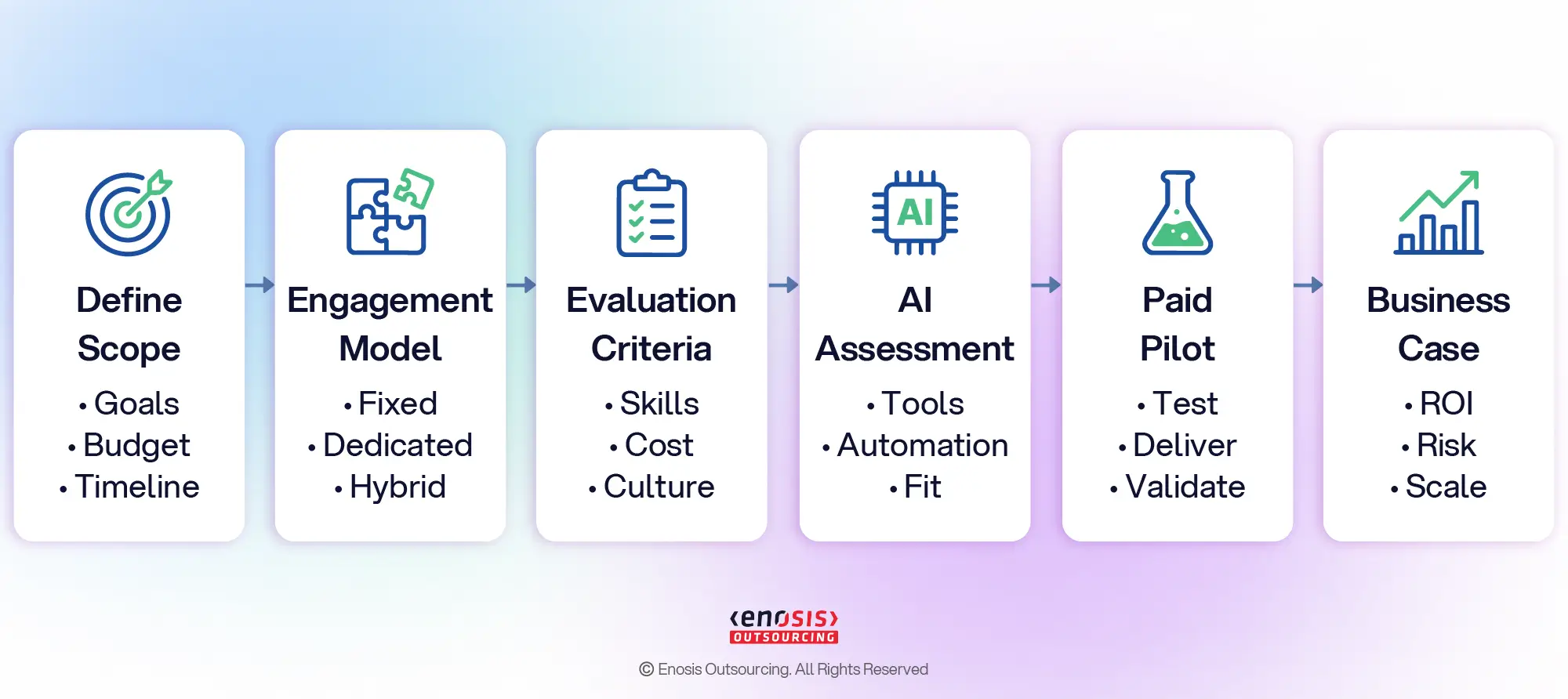
Define your project scope and success criteria before speaking to any vendor.
Choose an engagement model that fits your project type and timeline.
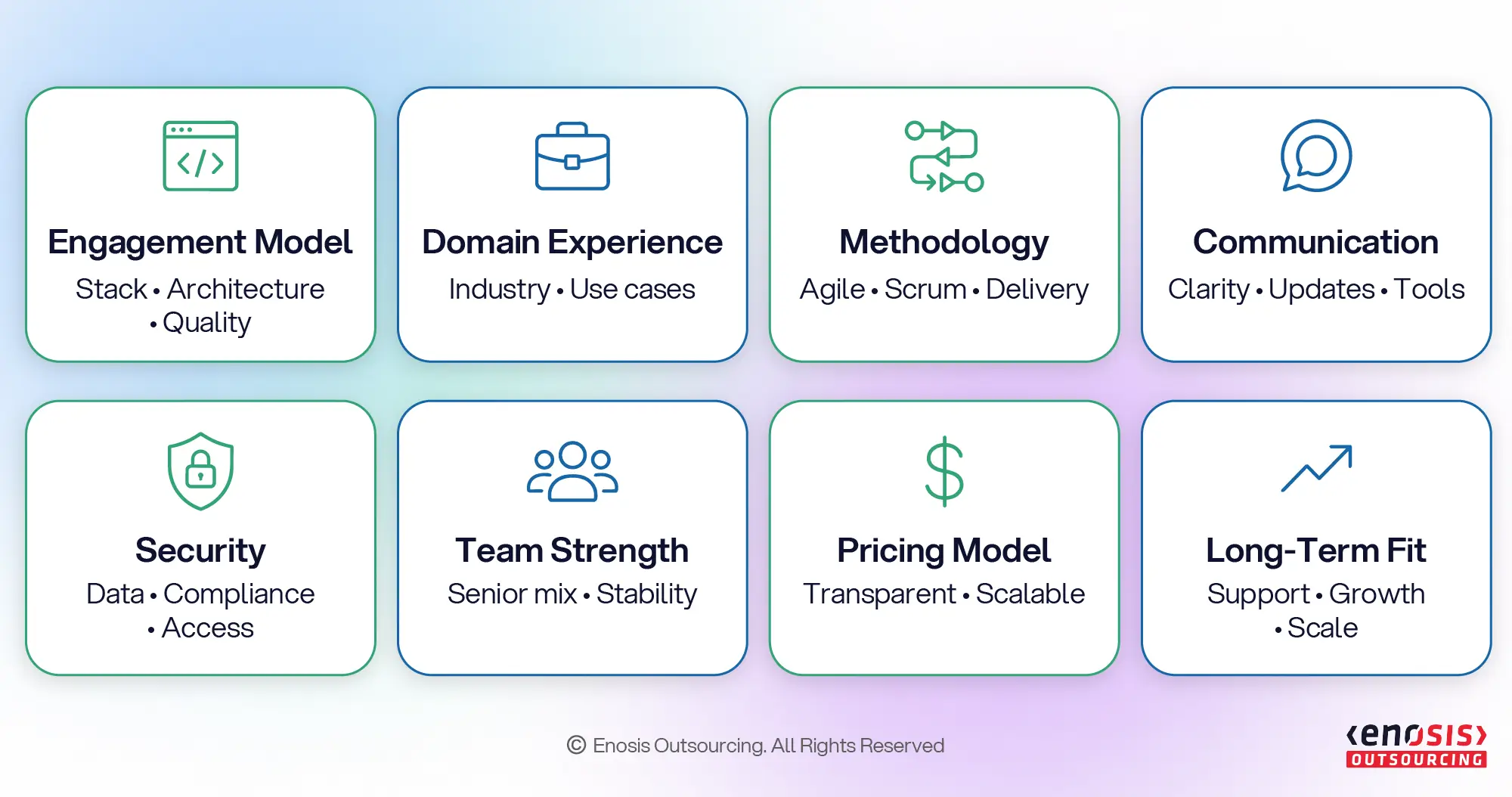
Evaluate vendors using clear criteria such as technical expertise, domain experience, communication, security, team stability, pricing, and long term capacity.
Assess how the vendor actually uses AI in their development workflow.
Run a paid pilot before committing to a full engagement.
Build a clear internal business case before signing anything.
Why the Vendor Selection Decision Carries More Risk Than Most Leaders Expect
Most leaders underestimate how much of a software project is determined before any code is written. Vendor selection is where the risk begins, not execution.
Research from the Project Management Institute's Pulse of the Profession shows that a large proportion of technology projects miss their original scope, schedule, or budget targets. When teams look back, the same issues keep appearing. Expectations were not aligned early enough. Scope was unclear. Success criteria were vague. The team behind the vendor was never properly evaluated.
The cost of a wrong decision builds quickly. A vendor that looks affordable but delivers slowly ends up costing more than expected. You pay once in direct spend, then again in delayed time-to-market. A vendor without a clear IP assignment clause turns into a legal risk once your product gains traction. A team that cannot scale forces you into a transition right when stability matters most.
Project management cannot fix these problems later. By the time they appear, the decision has already been made.
Need Help Choosing the Right Outsourcing Partner?
Tell us what you need, and we’ll help you identify companies that fit your project requirements.
Schedule Your Free CallPrepare Before You Contact Any Vendor
The fastest way to waste time with vendors is to approach them before you know what you need. A serious vendor will ask specific questions about scope, compliance requirements, budget structure, and success criteria. If you do not have answers, the conversation becomes a sales pitch instead of a meaningful evaluation.
Before using any vendor selection framework, make sure outsourcing is the right decision in the first place. If your team has the capacity, domain knowledge, and budget to build in house, that option may be more stable. For teams still weighing outsourcing instead of hiring in house, the decision should factor in hiring time, management overhead, delivery speed, and long term ownership. Once that direction is clear, the next step is choosing the right partner.
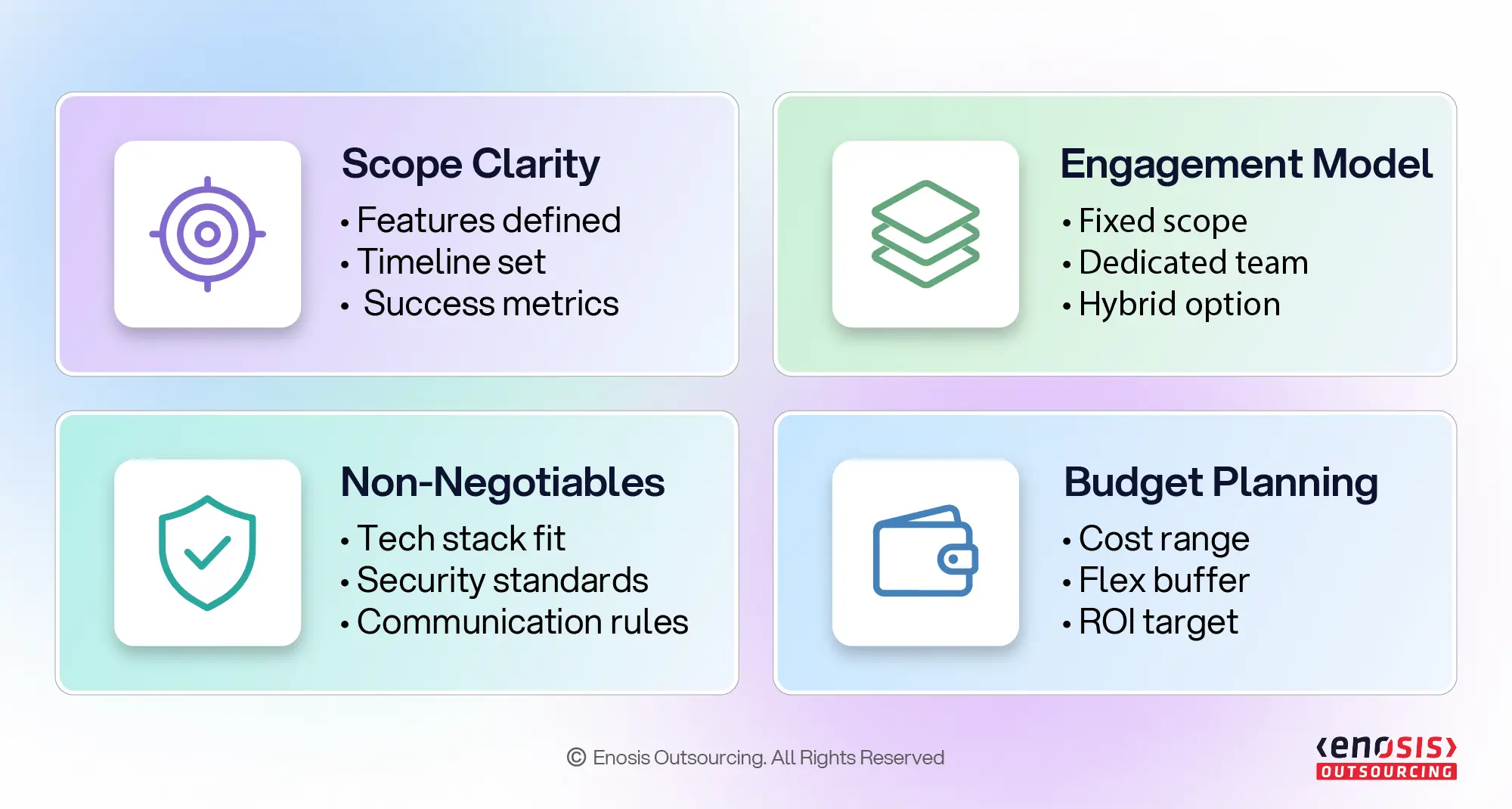
Four things to complete before your first vendor call.
Write Down Your Project Scope and Success Metrics
You do not need a formal software requirements specification (SRS). What you need is clarity.
At a minimum, your scope should answer a few basic questions. What problem does the system solve? Who will use it? What does success look like six months after launch? What constraints cannot be ignored, such as compliance requirements, technology choices, or integration dependencies?
Vague statements create weak conversations. "We need a platform" does not give a vendor anything to work with. Specificity changes everything.
"We need a B2B portal that integrates with Salesforce, supports 5,000 concurrent users, and meets SOC 2 Type II requirements before Q3." This gives vendors something concrete to respond to.
The difference shows up immediately. Vendors who engage with the second version tend to ask better questions. Those are the conversations worth continuing.
Choose Your Engagement Model Before Vendor Conversations Start
Three primary engagement models apply to most software outsourcing decisions. A dedicated team is a group of engineers assigned only to your product, usually for six months or longer. The staff augmentation model adds individual developers to your existing team without changing your structure. A project based model assigns a vendor team to deliver a defined scope within a fixed timeline.
This choice should happen before you speak with vendors. Each model comes with different cost structures, communication expectations, and risk levels. If you delay this decision, vendors will guide you toward the model that fits their delivery model, not your needs. In practice, this is where many projects lose control early.
List Your Non Negotiables
Non negotiables are the criteria that will disqualify a vendor regardless of price. Common examples include geographic data residency requirements, regulatory compliance such as HIPAA, GDPR, PCI-DSS, minimum seniority levels, onshore or nearshore delivery requirements, and required technology certifications. Write these down before vendor conversations.
This does two things. It saves time and removes bias. A strong presentation should not override a failed requirement.
Budget for Total Cost, Not Just the Quoted Rate
The quoted rate is not what an engagement costs. A realistic budget includes onboarding time, which often reduces productivity for the first two to four weeks. It includes internal management effort, communication overhead, and the cost of handling scope changes. At the end of the engagement, transition and knowledge transfer also carry a cost. For international engagements, currency fluctuation adds another layer of uncertainty, a pattern often seen in custom software development outsourcing.
This is where many comparisons break down. A vendor quoting $35 per hour offshore and another quoting $75 nearshore can end up with similar total costs once you consider the rework, coordination effort, and delivery speed. Thus, the rate looks different. The outcome often does not.
Looking for Companies With the Right Expertise?
Explore software development companies by service and narrow your options around what your project requires.
Find Relevant CompaniesHow to Evaluate a Software Development Company: Eight Weighted Criteria
No two projects require the same type of vendor. Still, a consistent evaluation framework helps you compare options without relying solely on instinct.
These eight criteria apply across most software development engagements. If you score vendors against each other, you start to see where differences actually matter. A scoring table appears at the end of this section.
1. Technical Expertise and Stack Alignment
Technical claims are easy to make. Evidence of technical depth takes longer to review but is far more reliable.
Start with real work, not capability statements. Find projects that are similar to your own in scope, technology stack, and compliance complexity. Ask which developers worked on those projects and what they actually contributed. If the vendor has public GitHub repositories, review them. Ask for code samples if your project involves custom algorithms or complex integrations.
Certifications can add context. ISO 9001 for quality management practices. CMMI points to process maturity. Cloud partnerships with AWS, Google Cloud, or Microsoft Azure indicate a process with those ecosystems. None of these proves delivery quality on its own. However, their absence from enterprise level discussions should raise questions.
Client testimonials need careful reading. Platforms like Clutch.co or GoodFirms are useful, but only if you go beyond ratings. Focus on recent reviews, ideally within the last 18 months. Verify whether the project size and industry align with yours. Pay attention to how the vendor responds to criticism.
A vendor with only positive reviews may be filtering feedback. A vendor with negative reviews and thoughtful responses often tells you more about how they operate under pressure. For custom enterprise software development engagements specifically, the absence of verifiable references from comparable enterprise projects is a meaningful gap.
Want to See What a Vendor Has Actually Delivered?
Explore real project experience to understand a company’s capabilities before adding it to your shortlist.
Explore Projects2. Industry Domain Experience
Domain experience is not a bonus. In many cases, it is a cost control factor. A vendor who has never worked under HIPAA requirements will learn those rules during your project, at your expense. The same applies to financial services, insurance, or any regulated environment. That learning curve shows up in time, mistakes, and rework. Vendors with prior experience move faster. They already understand common constraints, typical edge cases, and compliance expectations.
Ask direct questions. Have they delivered a product in your industry? Can they provide a reference from that sector? What specific challenges did they handle? If the answer is no, adjust your expectations. You are not only paying for delivery. You are also funding their learning process.
3. Development Methodology and Process Maturity
Saying "we use Agile" is not an answer. Agile is a philosophy, not a process. What matters is what their development process is like in practice?
Look for meaningful process specifics. Sprint length. Retrospective cadence. CI/CD pipelines. Automated test coverage is a standard part of delivery. Code review protocols. How do they track and manage technical debt over time?
Ask for a sample sprint report from a completed project. A vendor with a mature process can share one within twenty four hours. Pay close attention to quality assurance. If testing is treated as optional or delayed until the end, problems will surface after launch. Those problems are more challenging and expensive to resolve.
Process maturity is not about documentation. It shows up in how consistently a team delivers working, tested software at each stage of the project.
4. Communication Protocol and Time Zone Coverage
Communication gaps show up as delays. In offshore engagements, they also show up as a cost. In most cases, you need at least four overlapping working hours each day. Below that threshold, small blockers turn into full day delays. A simple clarification can take 24 hours. Sprint reviews become harder to schedule and easier to postpone.
Ask direct questions early. Who is the single point of contact (SPOC) for this engagement? What hours do they work relative to your team? What happens if the SPOC is unavailable? Will the team use project management tools, such as Jira, Trello, Linear, or Asana? Will you have direct access?
Watch how communication is structured. If everything is routed through a project manager and you cannot interact with developers, you are not getting transparency. You are getting filtered information.
5. Security, Compliance, and IP Protection
The NDA (non-disclosure agreement) is the minimum baseline, not the finish line. It does not fully protect your intellectual property.
Real protection comes from a contract structure. Source code ownership must be clearly assigned to the client upon payment. Data residency rules should be specified. You also need to understand how the vendor handles your code inside their own systems.
In 2026, AI tooling adds a new layer of risk. If developers use AI code generation tools that learn from project data, your codebase could be exposed in ways a standard NDA does not address. Ask how those tools are used, what data is retained, and whether your code is ever used for training.
For regulated projects, prior experience matters. Healthcare systems require HIPAA compliance. European user data brings GDPR obligations. Enterprise SaaS products often require alignment with the SOC 2 framework.
Request existing certifications and, equally important, how those standards are maintained during delivery. Compliance should already be part of the vendor’s operating model. It should not be something they figure out during your project.
6. Team Composition and Staff Retention
As a buyer, you need to look closely at the actual team and ask two simple yet important questions.
First: Who specifically will work on your project? Not a general profile. Not a capability overview. Ask for names, roles, and seniority levels.
Second: What is this vendor's employee retention rate? High staff turnover creates direct project risk. When engineers leave mid project, they take institutional knowledge with them. New team members require time to ramp up, which impacts delivery speed and code consistency.
A vendor with low retention will show signs of churn in your project. Frequent handoffs. Repeated onboarding. Shifts in code quality. If a vendor avoids committing to specific team members before the contract is signed, pay attention. That often means they assign based on availability, not fit.
7. Pricing Transparency and Contract Clarity
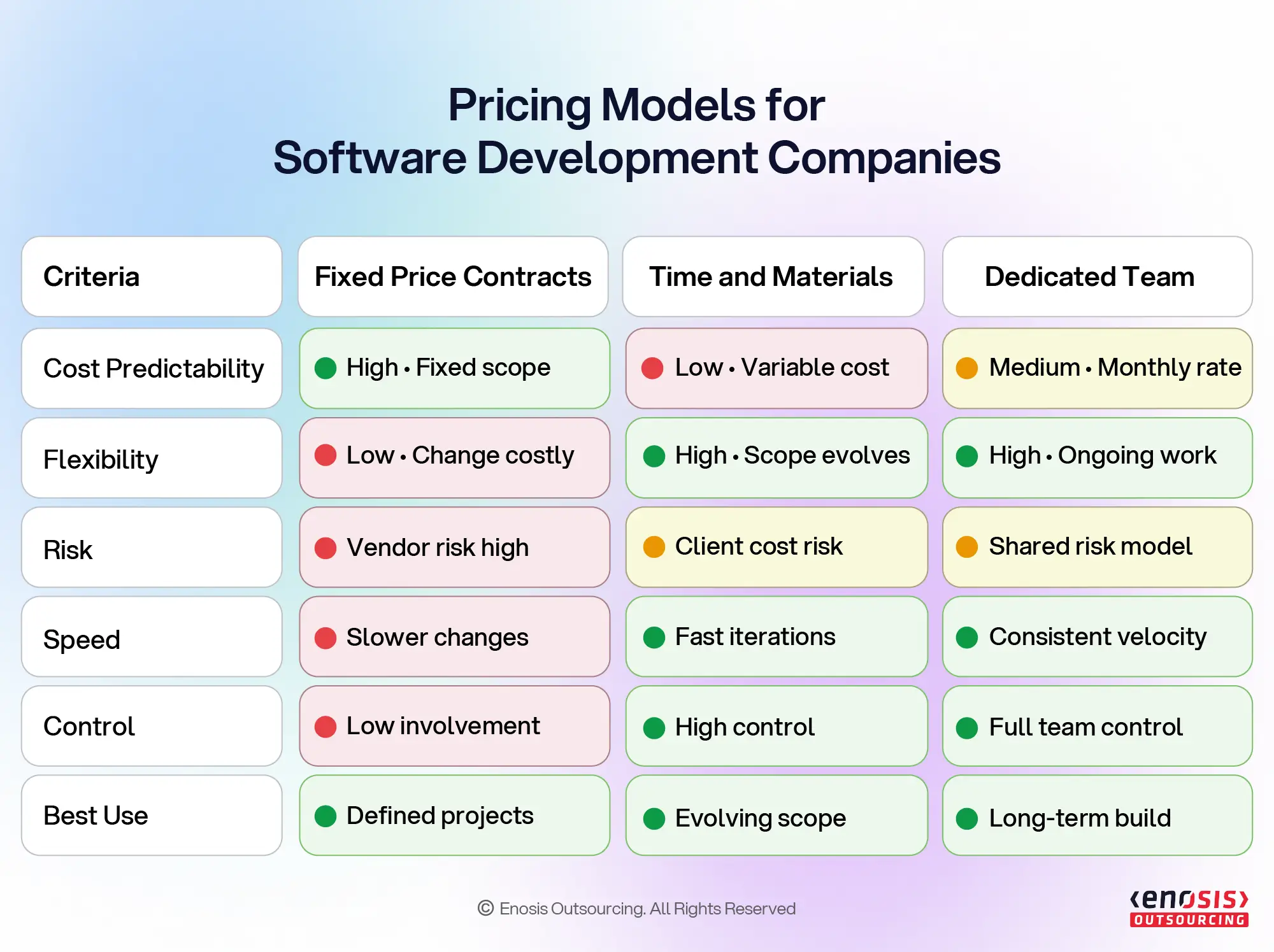
Three pricing models shape how risk is shared between you and the vendor.
Fixed price contracts work well when projects have stable requirements. Time and materials (T&M) contracts are offered for complex or evolving projects where project flexibility matters. Dedicated team models work well for long term product development with continuous iteration. Each carries a different risk profile for the client.
The pricing model is only part of the picture. Look at how changes are handled. What triggers a change order? How are payment milestones structured? What happens if the project needs to pivot?
Exit terms matter just as much as entry terms. Vendor lock in is a genuine risk in long engagements. Your contract should clearly define what you receive if the relationship ends. This includes full access to the source code, documentation, and a structured knowledge transfer period, typically lasting two to four weeks.
For business critical systems, a software escrow arrangement adds an additional layer of protection by storing code and build assets with a neutral third party. Any vendor who resists these terms is planning for the relationship to be harder to exit than it should be.
For international contracts, include a clause that addresses currency fluctuation. Over time, shifts in exchange rates can affect pricing in ways neither side initially expects. If a vendor pushes back on these points, it is worth asking why.
8. Long Term Partnership Capacity
Choosing a vendor is not just about delivery. It is about what happens after launch. A vendor's ability to scale with you is not just about team size. It is about whether they can grow as your product evolves.
Ask how they handle scope expansion. Ask what their post launch SLA (Service Level Agreement) looks like. Specifically, response time for critical issues, maintenance costs, and transition from active development to support.
Some vendors are highly structured during the build phase, then become vague once the product goes live. That usually reflects how their business is set up. A reliable partner treats post launch support as part of the same lifecycle, not an afterthought.
Criterion | Weight | Key Evaluation Focus | Score (1-5) |
|---|---|---|---|
Technical Expertise | 15% | Depth of portfolio, certifications such as ISO 9001 and CMMI, cloud partnerships, GitHub evidence, and access to code reviews | Enter score (1–5) |
Domain Experience | 15% | Relevant industry projects, understanding of compliance such as HIPAA, GDPR, SOC 2, and verifiable client references | Enter score (1–5) |
Methodology Maturity | 15% | CI/CD pipeline maturity, automated test coverage, sprint structure, QA process, handling of technical debt | Enter score (1–5) |
Communication Protocol | 10% | Defined point of contact, time zone overlap of at least four hours, direct access to developers, and visibility into tools | Enter score (1–5) |
Security and IP | 15% | Clear IP assignment, NDA scope, AI usage policies, compliance certifications, escrow readiness | Enter score (1–5) |
Team Stability | 10% | Named team members before the contract, retention rate, and transparency on subcontracting | Enter score (1–5) |
Pricing Clarity | 10% | Full cost visibility, change order handling, exit terms, knowledge transfer expectations, and currency risk handling | Enter score (1–5) |
Long Term Capacity | 10% | Post-launch SLA clarity, ability to scale, transition to support, and ongoing maintenance structure | Enter score (1–5) |
Total | 100% | ———————– | /40 |
Use the table below to evaluate each vendor on a scale of 1 to 5, where 1 indicates a clear risk and 5 indicates strong confidence. Multiply each score by the assigned weight, then add the results to get a weighted total out of 100.
This approach forces trade offs into the open. A vendor may excel in one area but still fall short overall. The weighted score makes those gaps visible.
One thing you will notice when using this table: vendors with strong presentations do not always score well once each area is broken down. That gap is often where the real risk sits.
How Relevant Is a Vendor’s Past Experience?
See how Project Capability Score helps you assess whether a company has completed work relevant to your requirements.
See How PCS WorksWhat Does Genuine AI Capability Look Like in a Vendor Worth Hiring?
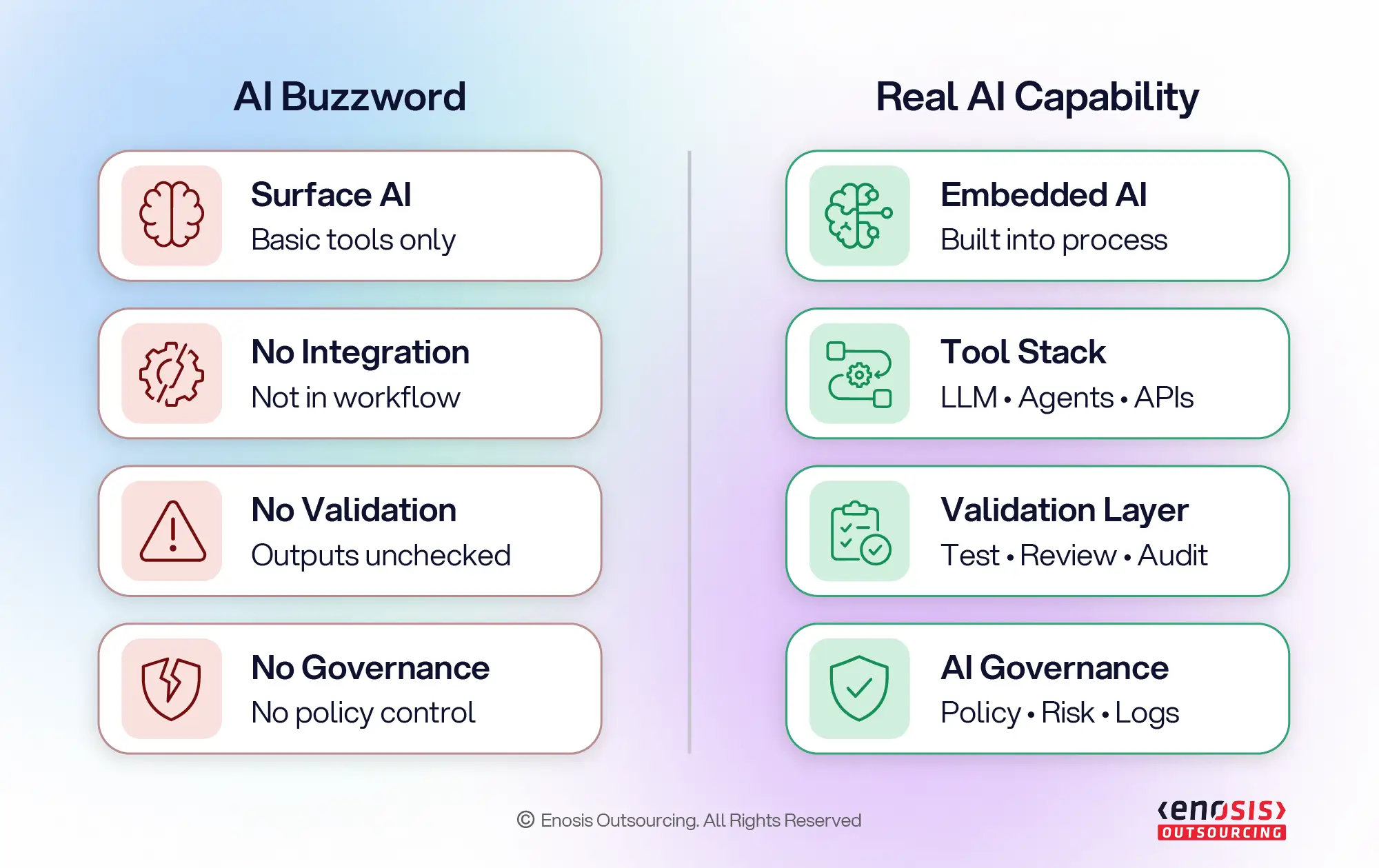
AI capability is now a standard criterion for vendor evaluation, not an optional one. McKinsey's State of AI research shows that 78% of organizations use AI in at least one business function, yet only 1% consider themselves fully mature in AI deployment. The same gap exists across development vendors. Almost every vendor claims to be AI enabled. Very few can explain what that actually means in practice.
There is another key point most teams overlook. The same research found that experienced developers using AI coding tools can take 19% longer to complete tasks compared to those who do not use them. That challenges the assumption that AI always improves productivity. It depends on how it is used.
If a vendor cannot explain how they measure the impact of AI on delivery speed and code quality, AI is likely a talking point, not an operational advantage.
Is AI Built Into Their Development Workflow?
Start with a simple question. What tools do their developers actually use every day? Common answers include GitHub Copilot, Cursor, and Tabnine. The tools matter less than how they are used.
Ask how the team validates AI generated code. What checks are in place before that code becomes part of the system? How often do they reject or revise AI outputs?
According to the Stack Overflow Developer Survey 2024, over 76% of developers use or plan to use AI coding tools. But satisfaction and trust in their outputs vary significantly by use case.
A vendor who uses AI tools and has a validation process for their outputs is using AI responsibly. A vendor who uses AI tools without a QA protocol for those outputs is introducing risk into your codebase without your knowledge.
Can They Build AI Powered Features?
Using AI tools internally is one thing. Building AI driven features into a product is something else. The difference becomes appreant quickly when you request examples.
If your roadmap includes large language model (LLM) integration, retrieval augmented generation (RAG) architectures, predictive analytics, or agent based workflows, the vendor should be able to point to real world implementations. Not concepts. Not experiments. Production systems.
Ask what problems they solved, what models they used, and how those systems perform under real conditions. Without that evidence, you are evaluating potential, not capability.
Do They Have AI Governance Policies?
AI introduces a new category of risk that most standard contracts do not fully cover. When a developer uses an AI coding tool, where does your code go? Does the provider store it? Is it used for training? Can it be accessed outside your project? These questions need clear answers.
A serious vendor will have written policies outlining how AI tools are used in conjunction with client code. They will define when cloud based tools are allowed, when they are restricted, and whether sensitive work requires isolated or self hosted models.
If those policies do not exist, the risk is not theoretical. It is already part of the workflow.
Five Questions to Ask Any Vendor About AI in 2026
Which AI tools do your developers use daily, and how do you validate AI generated code before it enters the codebase?
Can you share a case study where you integrated an LLM or built an AI powered feature into a production system?
Do you have a written policy governing how AI tools interact with client source code?
How do you handle data residency for client code submitted to cloud based AI tools?
What is your process for validating AI generated outputs before they enter the codebase?
Where Should You Hire? Understanding Your Outsourcing Location Options
Where your vendor is based affects more than cost. It shapes how your team communicates, how quickly issues are resolved, and how predictable delivery becomes.
Many teams treat location as a pricing decision. It is not. It is a delivery decision. A more detailed breakdown of how geography affects outsourcing outcomes is covered in location based outsourcing models.
Nearshoring, Offshoring, and Onshoring: What Each Model Actually Means
Nearshoring refers to collaborating with a development partner in a nearby country that has a significant time zone overlap.
For US companies, that often includes Mexico, Colombia, Brazil, or Argentina. For UK companies, common options include Poland, Romania, and Portugal. The main advantage is real time collaboration. Teams can work in parallel, resolve blockers quickly, and keep momentum across sprints. The trade-off is a slightly higher cost compared to offshore options.
Nearshoring in business explains why this model is becoming more common for teams that need closer coordination without moving fully onshore.
Offshoring places your development team in a more distant region, often in Eastern Europe, South Asia, or Southeast Asia. Rates are usually lower, but time zone gaps introduce coordination challenges. Communication becomes more structured, and delays are harder to avoid.
Onshoring keeps both vendor and client in the same country. Collaboration is straightforward, and compliance requirements are easier to manage. The cost is significantly higher, which limits scalability for many teams.
Regional Comparison at a Glance
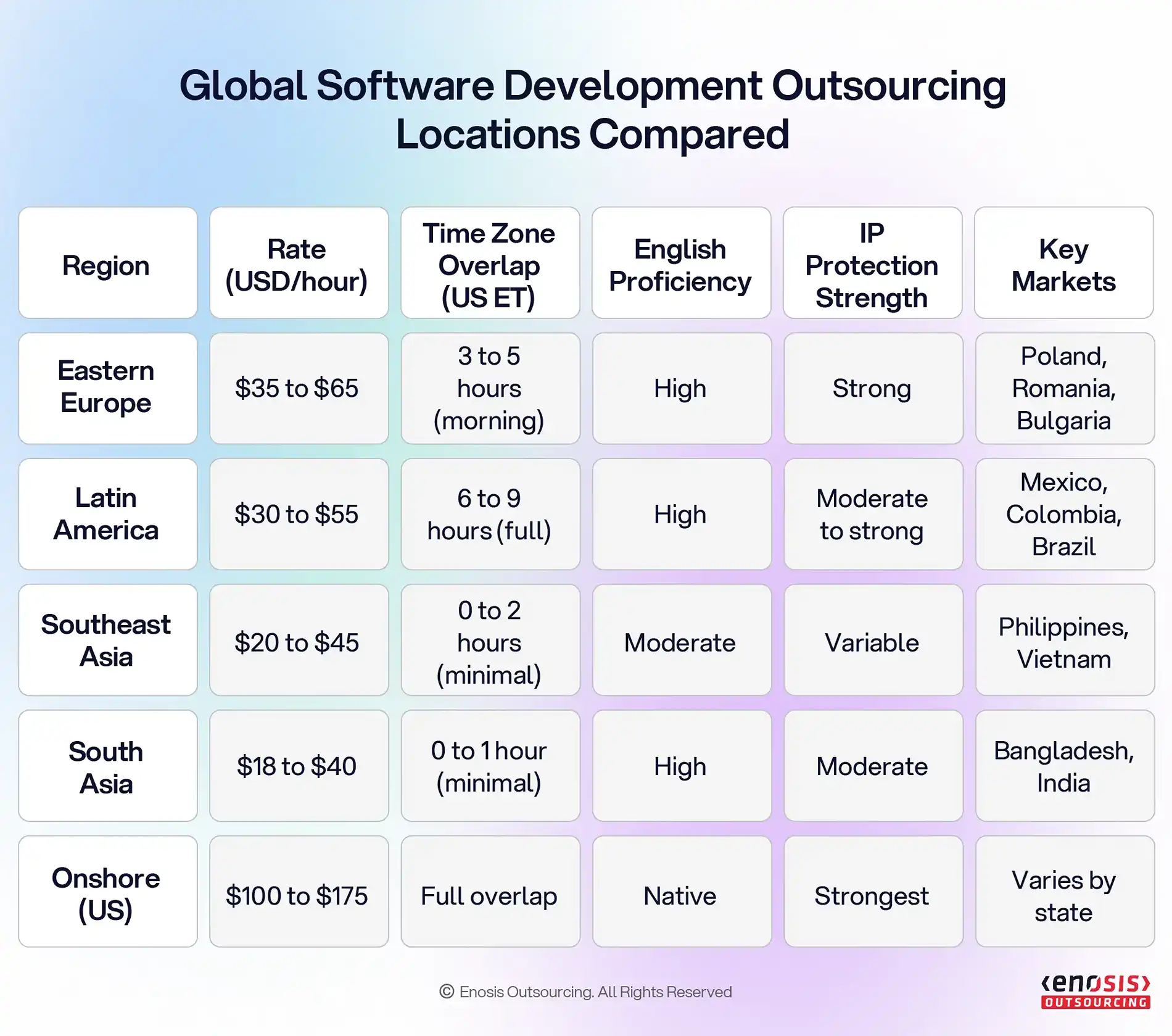
The comparison highlights how outsourcing regions differ across cost, collaboration overlap, communication efficiency, and legal protection.
Eastern Europe ranges from $35 to $65 per hour with 3 to 5 hours of overlap and strong IP protection across markets such as Poland, Romania, and Bulgaria. Latin America ranges from $30 to $55 per hour with 6 to 9 hours of overlap, making countries such as Argentina, Mexico, Colombia, and Brazil strong nearshore options for US companies.
Southeast Asia offers lower rates between $20 and $45 per hour, but limited overlap and variable IP protection across markets including the Philippines and Vietnam. South Asia ranges from $18 to $40 per hour with minimal overlap and moderate IP protection across Bangladesh and India. Onshore US vendors range from $100 to $175 per hour, offering full collaboration overlap, native English communication, and the strongest legal alignment.
The minimum workable time zone overlap for daily collaboration is around four hours. Below that, even small issues can take a full day to resolve. Over time, this slows down delivery and disrupts sprint consistency. This trade off becomes clear when comparing regions.
Southeast Asian markets such as Philippines offers significant rate advantages, but the time zone gap with North American teams requires careful scheduling to keep work moving smoothly.
Mexico is an increasingly viable nearshore option for US companies, mainly due to strong time zone alignment and an expanding STEM talent pipeline.
Need Help Building Your Vendor Shortlist?
Tell us what you're looking for and get help identifying companies relevant to your requirements.
Get a Free ConsultationPricing Models and What They Actually Cost
Choosing the right pricing model is not just about cost. It determines how risk is shared between you and the vendor, and how predictable the engagement will be.
Fixed Price Contracts
Fixed price contracts work when requirements are clearly defined and unlikely to change. In this model, the vendor takes on scope risk. The client takes on the risk of needing changes later. When the scope is stable, this setup can reduce the chance of budget overruns.
The problem appears when requirements shift, which happens in most projects. Each change leads to a new negotiation. Over time, those change orders reduce the predictability that the model was meant to provide.
This model is most suitable when the work is tightly bound: a specific feature, a well defined integration, or a clearly scoped MVP.
Time and Materials
Time and materials contracts bill based on actual hours worked at an agreed rate. Here, the client carries the scope risk. The vendor does not.
This model gives flexibility. You can adjust the scope as the project evolves without needing to renegotiate the entire contract. That flexibility comes with a requirement. You need strong governance.
Clear sprint planning, consistent change control, and regular budget reviews are essential. Without that structure, costs tend to drift beyond initial estimates.
Dedicated Team and Retainer
A dedicated team model gives you a group of engineers assigned only to your product for a fixed period. You pay a monthly retainer that covers the team’s capacity. In return, you get continuity. This model works well for long term product development. When requirements evolve, keeping the same team in place improves consistency and reduces ramp up delays.
For companies building full stack development outsourcing capability over an extended roadmap, this model often produces a better cost to output ratio once the team is fully onboarded.
Total Cost of Ownership: The Number That Actually Matters
The quoted rate is only part of the cost. What matters is the total cost of ownership.
A realistic view of cost includes several components:
The quoted development rate, whether hourly or monthly
Onboarding time is usually two to four weeks, with reduced productivity
Internal management effort, often 15% to 25% of project time from a CTO or technical lead
Communication overhead, especially for offshore teams working across time zones
Rework caused by unclear specifications often accounts for 20% to 30% of total development time
Knowledge transfer at the end of the engagement
Currency fluctuations in long term international contracts
When you look at all of this together, the picture changes.
An offshore team at $30 per hour with high rework and coordination overhead can cost more than a nearshore team at $55 per hour that delivers consistently with fewer iterations.
The difference is not the rate. It is how efficiently that rate turns into working software.
12 Early Signals That Predict a Failed Vendor Engagement
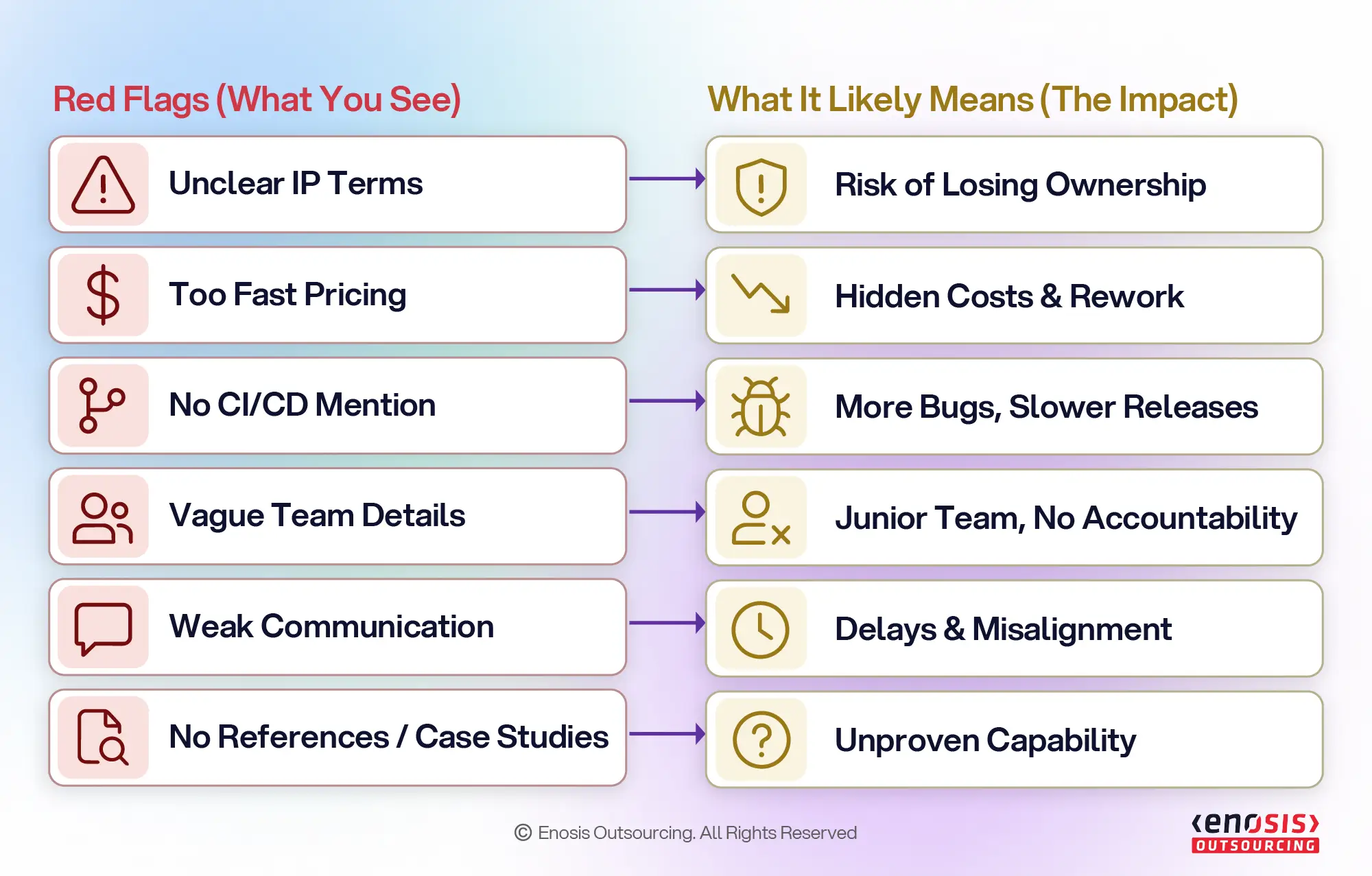
These signals show up early in vendor conversations. One on its own may not mean much. A pattern of them usually points to a failed engagement waiting to happen.
A price quote within 24 hours of first contact: No serious vendor can estimate complex work without understanding scope, constraints, and risks.
No discovery phase in the proposal: If discovery is skipped, the vendor is guessing. That guess shows up later as change orders and delays.
IP ownership language that avoids clear assignment: Phrases like “work product” without explicit transfer of ownership create legal ambiguity when your product starts to matter.
Vague answers about who will work on your project: This often means the team is not defined yet. Staffing will depend on availability, not suitability.
No CI/CD pipeline or automated testing as a standard practice: This points to a weak engineering discipline. The cost shows up later in bugs and maintenance efforts.
No case studies with verifiable references in your industry: Claims are easy to make. Without evidence, they carry no weight.
Refusal to sign an NDA before scoping: This is basic practice. Resistance here usually reflects a gap in the process.
Guaranteed delivery timelines before requirements are reviewed: Timelines built without detail are not reliable. They are placeholders.
No access to the code repository or issue tracker during the project: Lack of visibility during development often hides problems that surface late.
All communication filtered through a project manager: Technical work requires direct access to engineers. Without it, decisions slow down, and context is lost.
Claims of expertise across every technology and industry: Real expertise is specific. Broad claims usually mean shallow depth.
No defined exit or transition plan: If disengagement is not planned, you are likely being locked into the relationship.
The Paid Pilot Model: How Top Teams Eliminate Vendor Risk Before Scaling
The most effective risk mitigation strategy available to a software development buyer is the paid pilot project. It is underused because it requires upfront investment and a willingness to delay the full engagement. The return on that investment is near complete elimination of selection risk.
A paid pilot is a short engagement, usually two to four weeks, with a clearly defined outcome. It involves real work, real timelines, and real payment. The goal is not delivery alone. It is an evaluation.
The scope should reflect the actual project. A standalone module, a proof of concept, or a defined API integration works well. What matters is that the work mirrors the complexity and collaboration required later.
Want to See What a Vendor Has Actually Delivered?
Explore real project experience to understand a company’s capabilities before adding it to your shortlist.
Explore ProjectsDefine how you will evaluate the vendor before the pilot begins. Look at code quality. Communication rhythm. Whether deadlines are met. How blockers are handled. How clearly the team documents their work. These signals are hard to fake over two weeks.
Structure the agreement carefully. The pilot should include the same IP ownership terms you expect in the full contract. If a vendor hesitates here, pay attention. That hesitation often shows up later as negotiation friction when switching costs are higher.
The cost of a pilot usually falls between $5,000 and $20,000, depending on scope and rates. Seen in isolation, that may feel like an extra expense. In context, it is risk control. Compared to a six month engagement that fails midway, the pilot is a small and controlled investment. It gives you direct evidence of how the vendor works before you commit at scale.
Every serious vendor will accept this model. A vendor who refuses should be disqualified.
Not Sure Where to Start?
The framework in this guide assumes you already have a shortlist. In reality, that is often the hardest part. The global market includes thousands of software development companies. Separating credible vendors from well presented ones takes time, and most of that effort happens before any real evaluation begins.
Enosis Outsourcing's free vendor matching consultation is designed for this stage. The process starts by understanding your project goals, budget range, and timeline. Based on that, you receive a shortlist of vendors drawn from a network of more than 5,200 pre-vetted companies.
What stands out is the research behind the matching. Their recommendations are informed by over 416,000 hours of vendor analysis. That includes technical capability, client feedback, delivery history, and pricing structure, the areas that are the hardest to validate on your own.
What the Free Consultation Includes
100% free, with no commitment required
Access to a global pool of 6,000 plus vetted software development companies
Recommendations backed by 416,000 plus hours of vendor research
A reported 95% match satisfaction rate from past users
An upfront assessment of your goals, budget, and timeline before any shortlist is created
The practical value is in time compression. Instead of spending 10 to 15 hours building an initial vendor list through platforms like Clutch, LinkedIn, or outbound outreach, you start with a set of options already filtered against your requirements.
That does not replace evaluation. You still need to apply the criteria in this guide. What it does is remove the noise at the beginning. For technology leaders working under time constraints or without a dedicated procurement function, it is a practical first step before engaging with vendors directly.
Looking to Outsource Your IT Projects?
Enosis Outsourcing helps technology leaders scale their teams with expert offshore engineers. Get a free consultation today.
Get a Free ConsultationBuilding the Internal Business Case for Your Vendor Decision
Vendor selection does not end when you pick a vendor. The decision still requires approval, a budget commitment, and often sign off the board or CFO. A CTO who cannot articulate the financial and strategic rationale for a specific vendor is likely to face "cheapest bid" pressure from finance.
This is where many decisions lose momentum. A strong business case keeps the focus on value, not just cost.
Start with the cost of the current problem. What does it cost each quarter not to have this system in place? That could result in lost revenue, staff time, manual effort, or a growing competitive gap. Put a number on it. Without that number, the project looks optional.
Next, compare the total cost across vendors. Not just rates. Show the full twelve month cost, including onboarding time, management effort, communication overhead, and rework risk. The goal is to make the comparison realistic, not simplified.
Risk is the part that often determines approval. Document how you evaluated each vendor. Include your scoring framework, reference checks, and any red flags you investigated. If you ran a pilot, show what it revealed about delivery, communication, and reliability.
This changes how the recommendation is received. A decision supported by evidence and structure is easier to approve than one based on preference.
Outsourcing software development for startups comes with its own internal approval challenges. Risk tolerance is different, and governance is often less structured than in larger enterprises. Even so, the need for a clear and defensible decision record remains the same, regardless of company size.
20 Vendor Questions That Reveal Execution Reality
These questions should be addressed in direct conversations with vendors, not buried in a procurement checklist. The way a vendor answers matters as much as the answer itself. Clarity, specificity, and confidence tell you far more than polished wording.
Discovery and Scoping (Questions 1-5)
Question | What a Good Answer Looks Like | Risk Indicator |
|---|---|---|
1. How do you handle a project where requirements change significantly after the engagement begins? | A clear change order process with defined approval steps, pricing impact, and timeline adjustments. | “We are flexible” with no defined process. |
2. What does your discovery phase produce, and how long does it take? | Specific deliverables such as SRS, architecture document, roadmap, and refined cost estimate, along with a clear timeline. | “We can start building right away.” |
3. Can you show a sample SRS or technical brief from a similar project? | A real redacted document shared within 48 hours. | Hesitation or vague references to confidentiality with no alternative. |
4. How do you handle ambiguity in requirements during a sprint? | A defined escalation path, documented decisions, and client approval before moving forward. | “We make a decision and keep moving.” |
5. At what point does scope expansion require contract renegotiation? | A defined threshold, for example, more than 20% change in effort, that triggers a formal update. | No defined threshold. Handled case by case. |
Technical Process (Questions 6-10)
Question | What a Good Answer Looks Like | Risk Indicator |
|---|---|---|
6. What percentage of your codebase is covered by automated tests at delivery? | A defined target, such as 70% to 80% coverage, supported by examples. | “It depends on the project,” with no standard. |
7. Walk me through your CI/CD pipeline for a project like ours. | Specific tools, stages such as build, test, deploy, and clear environment structure. | Generic explanation with no details. |
8. How do you handle technical debt during a project, and who decides when to address it? | A defined tracking process with shared decision making on priorities. | “We try to avoid it” with no process. |
9. What code review process do you use, and who conducts it? | Named reviewers, structured pull request process, and peer review before merge. | No formal review or self review only. |
10. Which AI tools do your developers use, and how do you validate AI generated code? | Named tools, clear validation steps, and a written policy on AI usage with client code. | “We use AI to be more productive” with no safeguards. |
Team and Staffing (Questions 11-14)
Question | What a Good Answer Looks Like | Risk Indicator |
|---|---|---|
11. Who will work on this project? Can you share their profiles? | Named individuals with roles, experience, and relevant project history. | Only general team profiles, no commitment. |
12. What is your team’s average retention rate over the past two years? | A clear number, typically above 80%, shared without hesitation. | Avoids the question or gives vague reassurance. |
13. Do you subcontract any work? Under what conditions? | A clear disclosure policy with client approval required. | No direct answer or unclear conditions. |
14. What is the senior to junior developer ratio on similar projects? | At least 40% to 50% mid to senior engineers for complex work. | Mostly junior developers with no clear ratio. |
Contract and Legal (Questions 15-17)
Question | What a Good Answer Looks Like | Risk Indicator |
|---|---|---|
15. Who owns the source code, and when does ownership transfer? | Client ownership is defined clearly at each payment milestone in the contract. | Vague language or delayed ownership transfer. |
16. What are the termination terms and knowledge transfer obligations? | Defined notice period, structured handover, and full code access at exit. | No defined terms or handled on a case by case basis. |
17. How do you handle currency fluctuation in long term international contracts? | A defined adjustment clause tied to a public benchmark. | No clause or deferred discussion. |
References and Track Record (Questions 18-20)
Question | What a Good Answer Looks Like | Risk Indicator |
|---|---|---|
18. Can I speak directly to a client from a similar project? | Contact shared quickly, with a relevant and reachable reference. | Only written testimonials or no access. |
19. Tell me about a project that went wrong and how you handled it. | A specific example with clear lessons and changes made afterward. | “All our projects go well.” No failure admitted. |
20. What does your post launch SLA look like, and what are the response times? | Defined service levels, response times, and support structure. | “We are always available.” No formal SLA document produced. |
Concluding Remarks
Choosing a software development company is not a matter of preference. It is a structured evaluation problem. Every step in this guide exists to reduce uncertainty and replace assumptions with evidence.
By the time you reach a decision, the goal is not perfection. It is clarity. You have defined your scope, selected the right engagement model, evaluated vendors against consistent criteria, tested their capabilities through a paid pilot, and assessed the full cost and risk profile of the engagement. What remains is not guesswork. It is a decision supported by data, constraints, and real signals from the vendor’s actual performance.
The difference shows up quickly after signing. Teams that skip structure spend the first 60 days correcting misalignment. Teams that follow a disciplined evaluation process move directly into execution with fewer surprises, clearer communication, and a stable delivery rhythm.
A vendor worth hiring will not struggle with this level of scrutiny. Their answers will be specific. Their process will be visible. Their team will be defined. Most importantly, their performance during the pilot will match what they promise during evaluation.
At that point, the decision becomes defensible. Not because risk is eliminated, but because it has been identified, measured, and managed before it can affect delivery.