


 11 min read
Digital work may feel borderless, but the realities of delivery always pull you back to the map. Every launch, fix, and upgrade depends on teams working across different time zones, work habits, and levels of access to the business. Where those teams sit directly shapes how smoothly they move together.
What often appears to be a simple geographic choice quickly becomes a defining factor in delivery performance. Time zone overlap influences how fast teams resolve uncertainty. Cultural alignment affects how product conversations unfold. Talent availability determines how quickly teams can scale. Even regional cost structures shape how much flexibility there is for innovation.
This is the core idea behind location based outsourcing models. They provide a structured way to decide where function should happen, not just who should do it. These models help organizations understand which work benefits from proximity and which can succeed in more distant, scalable hubs. This distinction underpins many of the decisions behind modern software development outsourcing.
A thoughtful location strategy builds momentum. A poorly chosen one compounds friction. In this guide, we explore how different models work in practice and how global teams combine them into execution systems that scale without becoming fragmented.
Why Location Still Matters In A Remote First World
Modern collaboration tools make the process feel borderless. Teams share screens instantly, message across continents, and store everything in shared digital spaces. It is easy to assume geography no longer plays a meaningful role.
In reality, it still does. Real time overlap determines whether a question is answered today or tomorrow. Cultural nuance shapes how people raise concerns, challenge assumptions, or resolve conflicts. Talent concentration influences which roles can be filled quickly and which become long term bottlenecks. These factors affect every sprint, meeting, and release.
Regulation adds another layer of complexity. Some regions enforce strict data residency rules, while others impose unique tax or employment requirements. A location that looks attractive from a talent perspective can introduce output or compliance risk if these constraints are overlooked.
This is why even the most modern outsourcing strategies remain grounded in geography. Location continues to shape operational ease, risk exposure, and long term flexibility, regardless of how advanced coordination tools become.
What Location Based Outsourcing Models Actually Mean
Most discussions start with three core categories. Onshore outsourcing involves working with providers in your own country. Nearshore outsourcing refers to partnering with teams in nearby regions that share similar time zones. Offshore outsourcing places workloads in more distant locations where organizations can access larger skilled workforce pools and more competitive cost structures.
Modern execution has stretched this idea further. This broader view aligns with how many organizations now evaluate software development outsourcing models, comparing not just cost, but delivery structure, governance, and long term scalability.
Onsite outsourcing brings vendor specialists directly into your offices so they can work shoulder to shoulder with your internal teams. The hybrid outsourcing model blends multiple locations into one operating model, using each region for what it does best. It is a way to balance proximity, cost, expertise depth, and resilience without relying on a single geography.
In practice, these models are not rigid choices. They are more like building blocks. Organizations mix them based on the sensitivity of the project, the level of coordination required, and the pace they need to maintain. Geography becomes a strategic lever that supports how teams actually function, rather than just a procurement decision.
Model | Strengths | Best For | Tradeoffs |
|---|---|---|---|
Onshore | Alignment, speed, trust | High sensitivity, regulated work | Higher cost |
Nearshore | Synchronous coordination, competitive cost | Agile engineering, analytics | Wage inflation risk |
Offshore | Scale, affordability, specialization | Large programs, 24×7 ops | Time zone challenges |
How Geography Plays Out Regionally
While the labels are global, their meaning often shifts by region.
For North American companies, nearshore typically means Latin America, where time zone alignment supports overlapping work hours. Offshore often points to South or Southeast Asia for scale and specialization.
For Western European organizations, nearshore commonly refers to Eastern Europe, while offshore operation frequently involves South Asia for larger programs. Some buyers also look at EMEA delivery markets when they want competitive engineering rates without the larger time zone gap of distant offshore hubs.
In the Asia-Pacific region, companies may nearshore within Southeast Asia while still relying on established offshore hubs such as India for long term, large scale delivery.
These patterns are significant because they impact travel time, cultural proximity, regulatory exposure, and cost dynamics. Understanding regional context helps turn abstract models into practical decisions.
Onshore Outsourcing When Proximity Matters Most
Onshore outsourcing is often the natural choice for work that requires close interaction, immediate access to stakeholders, or strict regulatory oversight. When teams operate within the same country, communication tends to flow more easily, and everyone works within a shared cultural and legal framework. That familiarity helps remove friction before it appears.
This model works particularly well for projects that demand deep domain knowledge or frequent interaction with business teams. It also provides reassurance when handling sensitive data or operating in industries where trust and proximity carry real weight. For many leaders, this naturally leads to a deeper comparison of in house vs outsourcing software development, especially when control and accountability are top priorities.
The main tradeoff is cost. Onshore partners draw from the same workforce market as internal teams, which usually means higher salary expectations and stronger competition for skills. You gain clarity and alignment, but that convenience comes at a premium.
Despite this, onshore remains the preferred option for system modernization, regulated environments, and customer facing work where cultural context directly influences outcomes.
Nearshore Outsourcing: Balancing Cost And Collaboration
Nearshore outsourcing offers a middle path that preserves joint execution while reducing costs. By partnering with teams in nearby countries, organizations benefit from overlapping workdays, shared cultural reference points, and easier travel for workshops or quarterly planning.
This model is especially effective for agile product development. Standups, sprint reviews, and design discussions can happen in real time, keeping momentum high and feedback loops short. Nearshore regions often have strong talent markets that allow teams to scale while keeping costs lower than domestic options. This balance is central to a well designed nearshore software outsourcing strategy, where coordination speed is preserved without absorbing full onshore costs.
That said, nearshore familiarity can be misleading. As certain locations become popular outsourcing hubs, talent shortages and salary inflation can emerge quickly. Differences in local employment laws can also introduce complexity if they are not fully understood.
Nearshore works best when teams need frequent interaction but do not require the same regulatory environment as headquarters. It is a common choice for engineering teams, analytics groups, shared services, and work that depends on fast iteration.
Offshore Outsourcing: Expanding Access to Global Expertise Pools
Offshore outsourcing opens access to large, skilled labor markets that can scale quickly and cost effectively. For many organizations, it forms the backbone of long term execution strategies in software development, testing, operations, and customer support.
The advantages are clear. Offshore teams can grow rapidly, support follow the sun delivery models, and provide specialized skills that may be difficult or expensive to find locally. These advantages are why many organizations continue to expand their use of offshore software development services as part of long term delivery planning.
Reuters reports that India’s global capability center market alone is projected to exceed $100 billion by 2030, reflecting how offshore processes have evolved from cost savings to strategic capability.
The challenges are real but manageable. Significant time zone differences can slow decisions that require real time discussion. Cultural differences may require more deliberate onboarding and clearer documentation. Travel also requires planning and investment.
Offshore works best when the work is well defined, predictable, and supported by strong governance.
Onsite And Hybrid Models: A Blend Of Local Presence And Global Scale
Onsite outsourcing places vendor specialists directly within your facilities. They collaborate face to face with internal teams, accelerate knowledge transfer, and stay closely aligned with day-to-day priorities. This model is particularly valuable during discovery phases or complex transformations, though it is naturally limited by cost and scalability.
Hybrid outsourcing has become the dominant approach for mature organizations. In many cases, this evolution includes adopting a dedicated development team model for continuity, alongside staff augmentation to flex capacity and add specialized skills while distributing execution across locations.
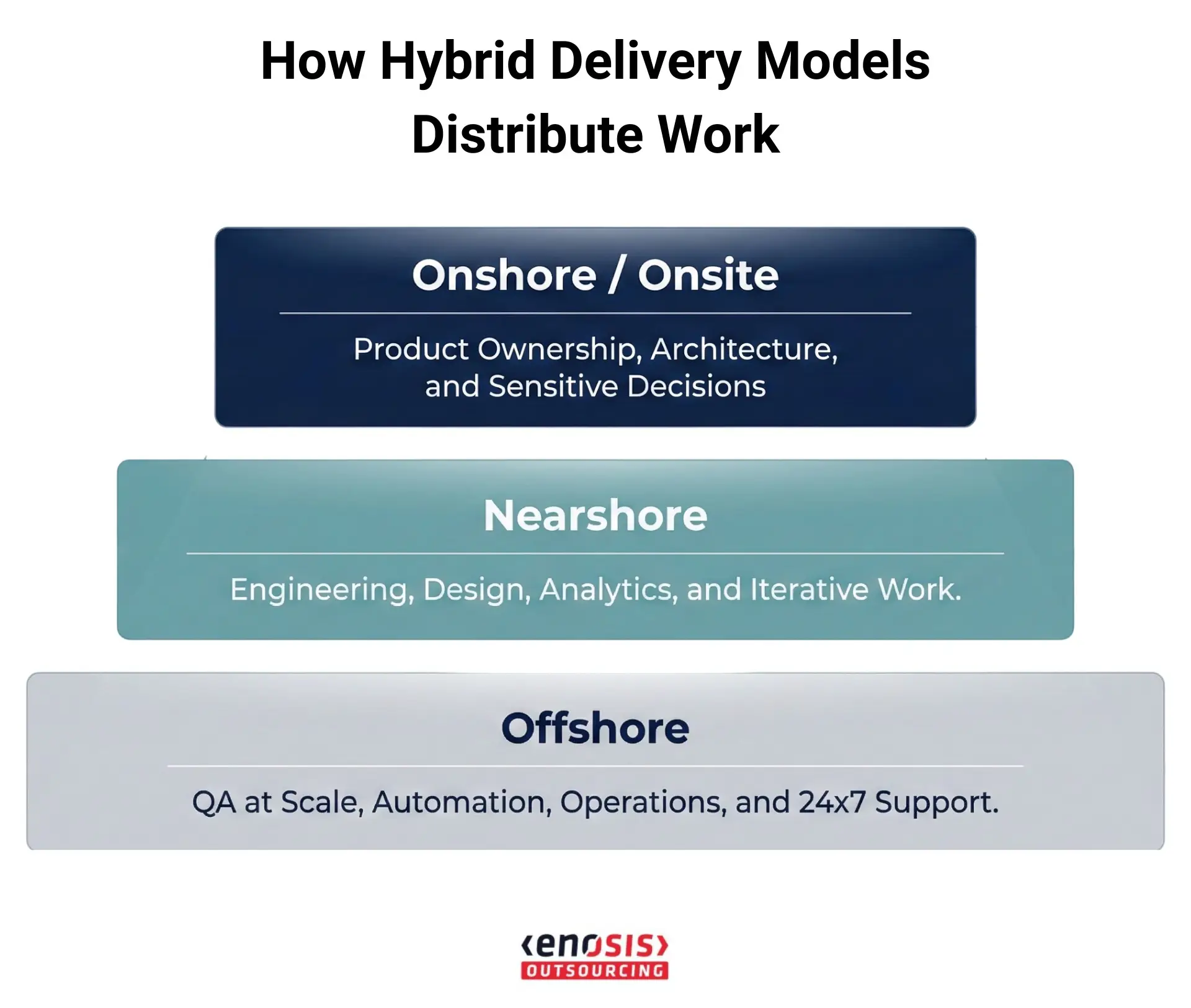
Deloitte’s Global Outsourcing Survey indicates that nearly 80% of executives plan to maintain or increase their investment in third-party outsourcing, reflecting growing confidence in distributed output models. Most enterprises now operate across multiple delivery locations to balance risk, engineering capacity, and cost efficiency.
In a well designed hybrid model, strategic roles such as product ownership and architecture remain onshore or onsite. High coordination engineering function runs nearshore, while scalable functions like quality assurance, automation, and operations function offshore. The result is a more resilient, flexible delivery ecosystem that can adapt as business priorities evolve.
How Geography Shapes Performance: Five Levers To Evaluate
Every location decision influences performance through five interconnected levers.
Talent access defines what roles you can fill and how quickly you can scale. Different regions specialize in different strengths.
Cost structure determines how far your budget stretches. Real costs emerge not just through hourly rates but through coordination, travel, and productivity gains or losses.
Collaboration and speed shape your output rhythm. Shared working hours make alignment easier. Distance demands structure.
Risk and resilience influence stability. Political, regulatory, and environmental factors vary across locations. Overreliance on one region increases exposure.
Customer and employee experience define how your brand feels externally and internally. Communication style, tone, and working norms shape both perceptions.
When viewed together, these factors reflect the broader strategic benefits of outsourcing software development, extending well beyond cost optimization alone.
Choosing The Right Model For Your Initiative
The smartest location strategies do not begin with a map. They begin with a clear outsourcing framework for decision makers, grounded in risk tolerance, interaction needs, and long term business outcomes. Country comparisons can help narrow the shortlist, but the final choice should still depend on collaboration needs, regulatory exposure, and delivery maturity.
A reliable evaluation starts with five questions:
How critical is this function to revenue, compliance, or customer trust?
How frequently will it need input from business stakeholders?
What level of regulatory exposure surrounds the data and workflows?
How flexible is your budget over the next several years?
Who owns outcomes and where those leaders sit?
These answers form the foundation. Sensitive or regulated work tends to stay onshore or onsite. High coordination engineering fits nearshore. Stable, repeatable work thrives offshore. Larger portfolios often require hybrid designs that map functions to their ideal locations. Location strategy is not vendor management. It is ecosystem architecture.
What These Models Look Like In Practice
To move beyond theory, it helps to look at how organizations combine location based outsourcing models in real operating environments. The goal is not to choose one model, but to align different types of work with the locations where they perform best. Consider three scenarios that illustrate how companies blend locations.
A global SaaS provider keeps product management and design leadership onshore, close to customers and business stakeholders. It builds a nearshore engineering hub to support its core platform, where close coordination and iteration matter. Offshore teams handle regression testing, infrastructure automation, and data labeling, enabling scale without slowing discovery.
A regulated financial institution keeps risk and compliance engineering close to home to meet oversight and governance requirements. Analytics and reporting operate from a nearshore center to maintain regular collaboration. Document processing, batch operations, and system monitoring run offshore, where teams can manage volume and extended coverage efficiently.
A fast growing consumer brand structures customer service across three layers. A premium onshore team handles sensitive or high impact cases. The main customer experience operation runs nearshore, where language and service style closely match the core market. Offshore teams support overflow and back office tasks during seasonal demand spikes.
In each case, success does not come from choosing one model. It comes from deliberately designing how multiple locations work together.
Common Mistakes When Selecting Outsourcing Locations
Organizations frequently fall into predictable traps. Some treat geography as a pure cost decision and discover later that communication delays and rework erase the savings. Others overload a single location because it works well initially, then struggle when wage inflation or political risk changes the market. Many assume that once a strategy is set, it will remain valid, even though labor markets and business priorities evolve.
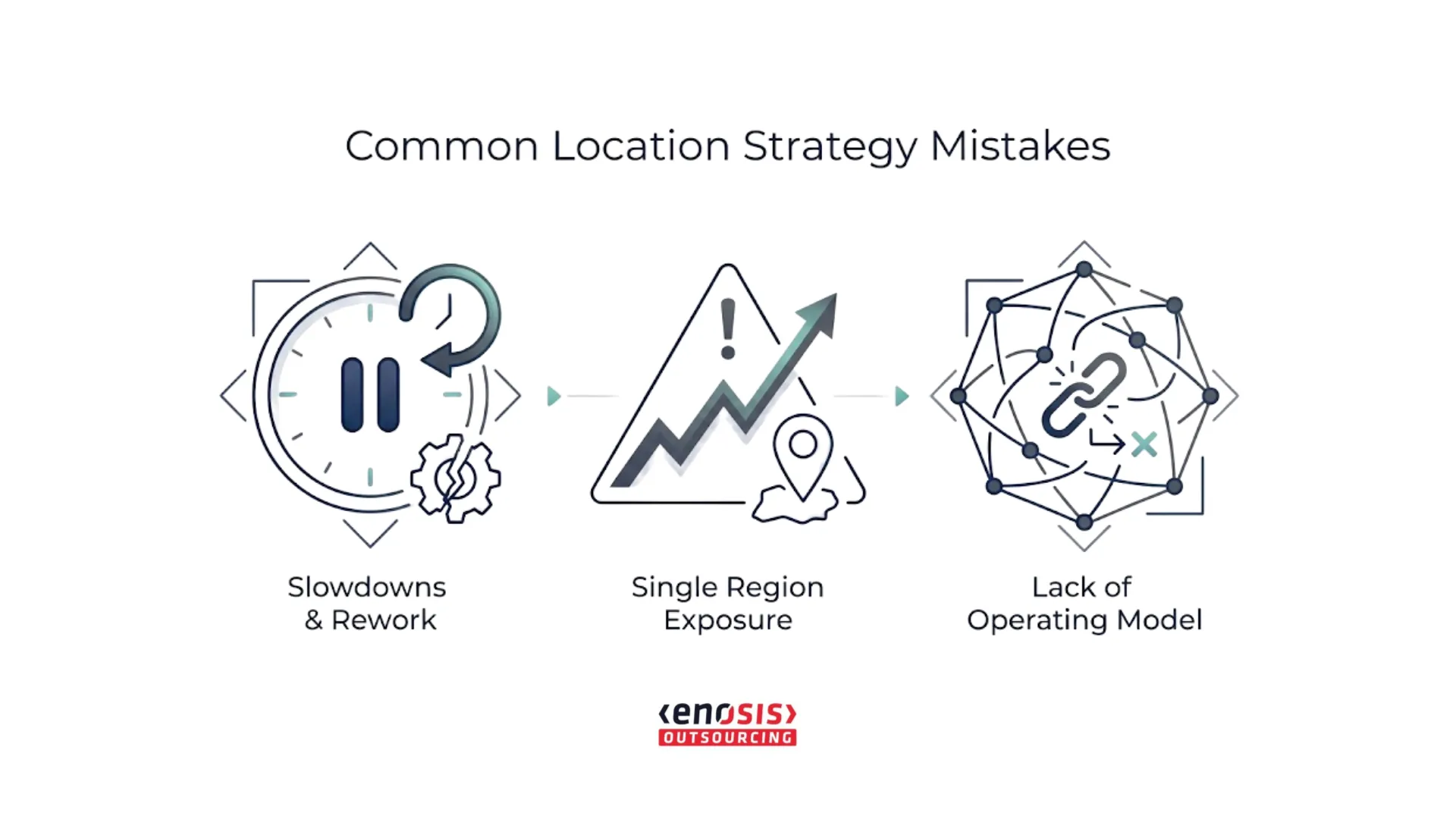
The most common mistake is underestimating the operating model required for global interaction. Without clear governance and communication rhythms, even the best location choice becomes difficult to manage.
A good location strategy does not eliminate complexity. It organizes complexity so your teams can operate effectively.
Where Location Based Outsourcing Models Are Headed
Global delivery is shifting from single region outsourcing toward multi-location ecosystems. Instead of concentrating everything in one hub, organizations are distributing product leadership, engineering, operations, and customer support across multiple regions to improve resilience and flexibility.
AI is accelerating this shift. Teams everywhere now work with AI assisted coding, testing, and support tools. These are changing productivity expectations and reshaping location decisions.
According to Deloitte, 83% of surveyed executives are already leveraging AI as part of their outsourced services, and 20% are actively developing strategies to manage AI enabled digital workers alongside human teams. This signals a move toward a blended workforce where location matters less for execution and more for oversight, integration, and decision making.
As AI absorbs more repeatable work, capability, availability amplified by AI becomes more important than talent location alone. At the same time, risk diversification is shaping future strategies. Organizations increasingly recognize that overreliance on a single region exposes them to economic shocks and geopolitical uncertainty. Flexible, multi region operating models help spread that risk while preserving operational flow.
Bringing Your Strategy Into Focus
If you want to use location based outsourcing models more intentionally, begin by mapping your current footprint. Identify where each function sits and how it performs in terms of speed, quality, and cost. Next, list your upcoming strategic initiatives and note what each one requires in terms of collaboration and sensitivity. Finally, ask which work would benefit from moving closer, which could safely move farther, and where a blended model would offer greater resilience.
Location is not the whole story, but it shapes how your story unfolds. When geography becomes an ongoing strategic design choice rather than a procurement checkbox, your teams gain the clarity and structure they need to deliver meaningful outcomes.


