Finding the right IT outsourcing partner shapes how your product is built, how your team works, and how much control you keep over delivery. For many companies, outsourcing is no longer just about cost. It is about speed, access to global engineering talent, and the ability to scale without long hiring cycles. The right partner can help you move faster, improve delivery quality, and focus your internal team on high value work.

But the decision is not risk free. The wrong outsourcing partner slows progress, creates rework, and introduces delivery and ownership risks that often appear late, when fixing them becomes expensive and time consuming. That is why knowing how to find outsourcing partner options is not just a sourcing task. It is a structured decision process that directly affects timelines, costs, and product outcomes.

This guide covers: What Should You Hand Over to an Outsourcing Partner | Where to Find IT Outsourcing Partners | How to Evaluate Vendors | How to Identify Reliable Partners | Vendor Selection Process | Enosis Free Consultation for Vendor Shortlisting | FAQ

What Should You Hand Over to an Outsourcing Partner

Before you look for an outsourcing partner, you need to be clear about what you are handing over. It sounds simple. Most teams still get this wrong. This is where many outsourcing engagements fail before a single line of code is written.

The Three Question Diagnostic

Three questions help you decide what should be outsourced and what should stay in house.
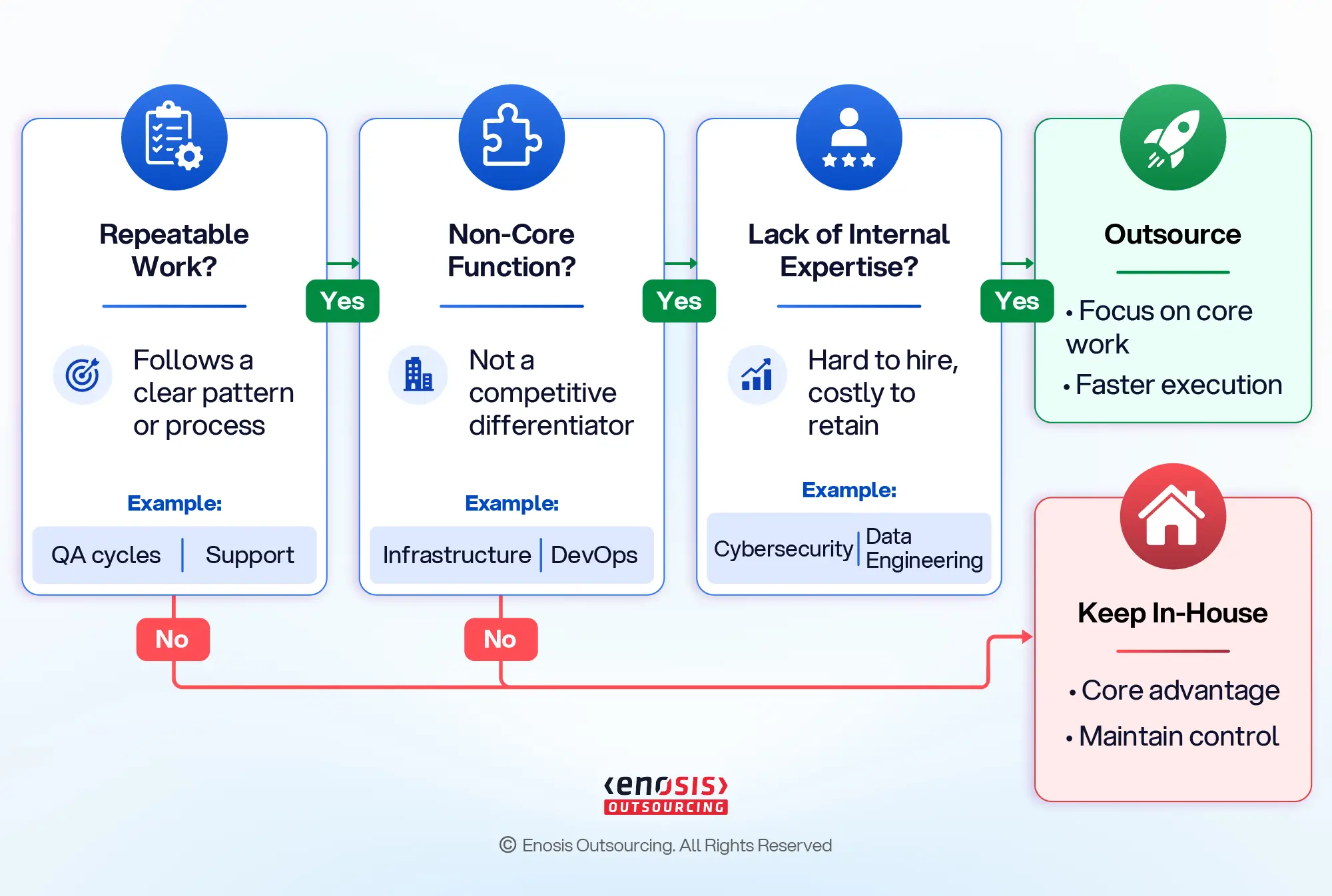
Decision-tree infographic showing how to choose between outsourcing and keeping work in-house.

  1. Is this work repeatable? Tasks that follow a clear pattern are easier to outsource. Such as QA cycles, support, or well defined feature modules. Work that depends on constant judgment or deep product context is harder to outsource.
  2. Is this core to your business? Anything that can define your competitive advantage should stay inside your team. Core product logic, proprietary systems, and customer data architecture fall under that category. Infrastructure, DevOps, testing, and supporting modules are usually safer to outsource.
  3. Do you lack the internal expertise? Some roles are expensive to hire and even more expensive to retain. For example, cybersecurity, data engineering, or niche cloud platforms. In such scenarios, working with an experienced outsourcing partner is often more practical.

Functions That Work Well with Outsourcing

Some functions consistently perform better with external teams:

  • Custom software development for clearly defined product areas
  • Quality assurance and test automation
  • Managed IT services, especially infrastructure monitoring

If you are building a new product without a ready team, outsourcing custom software development can help you move from idea to execution much faster.

Critical Functions You Should Keep Internal

Not everything should be outsourced.

Keep control of:

  • Core product ownership
  • Security policies and enforcement
  • Customer facing technical leadership

Also, avoid outsourcing anything where ownership of code or data is unclear.  That kind of ambiguity creates problems later, especially in legal or contract situations.

Where to Find IT Outsourcing Partners

Most guides focus on how to evaluate vendors. Very few explain how to actually find them, which is where many teams make their first mistake. If your sourcing process is weak, you end up comparing the wrong vendors, no matter how strong your evaluation criteria are.
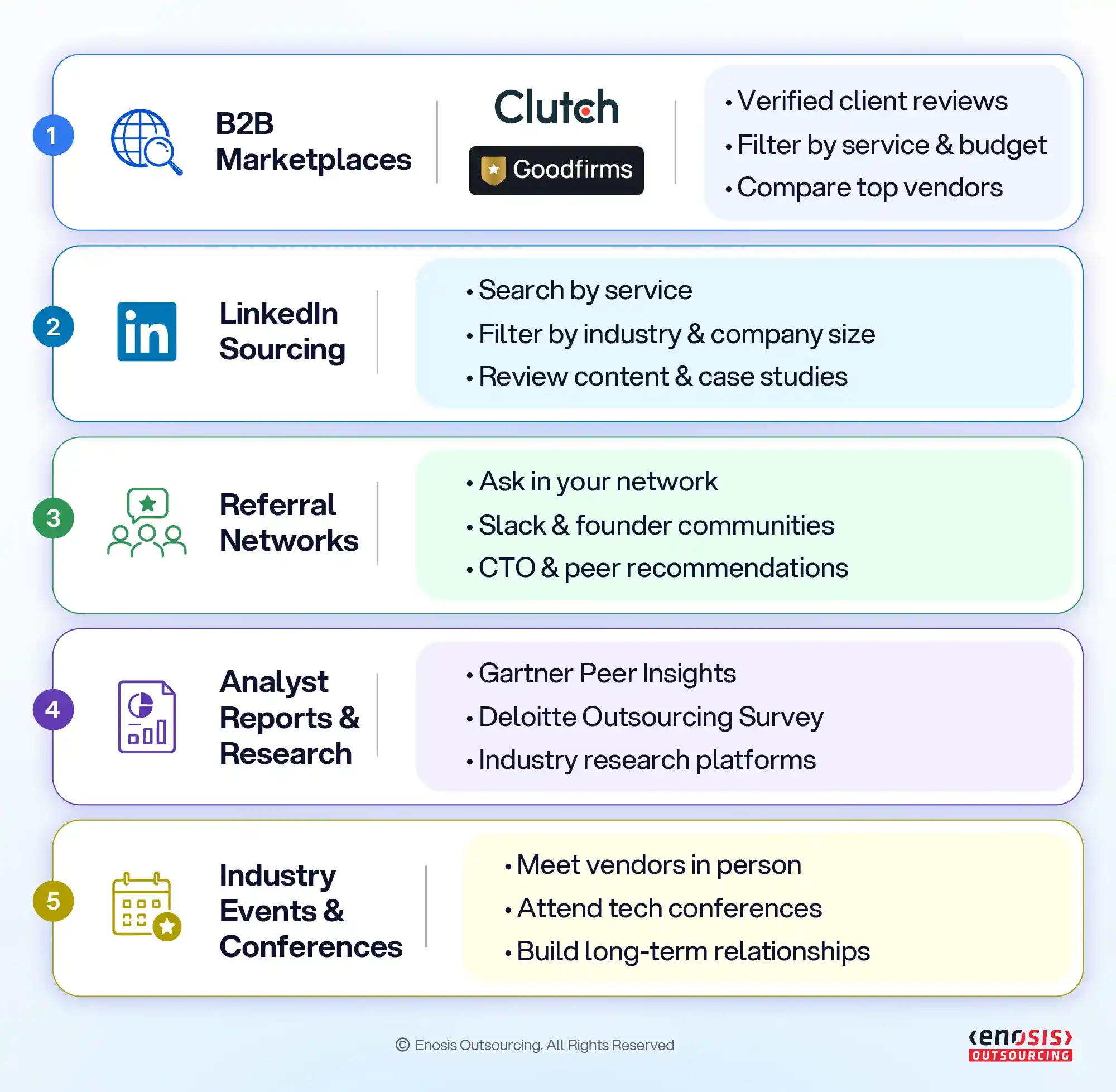
platforms to find outsourcing partners: B2B Marketplaces, LinkedIn Sourcing, Referral Networks, Analyst Reports & Research, and Industry Events & Conferences, each with a brief bulleted list of benefits or examples.

B2B Vendor Marketplaces

Platforms like Clutch and GoodFirms are a practical starting point. They organize vendors by service, industry, and budget, and they include verified client reviews.

Start with the service you need. Software development, DevOps, QA, managed services. Then narrow it down by project size and read the full reviews, not just the ratings.

Negative reviews matter more than positive ones. Look at how the vendor responds. Do they explain what went wrong? Do they show what changed? That tells you how they behave when things don’t go as planned.

Toptal and Upwork Enterprise work differently. They focus on individual contractors. Use them when you need extra hands, not when you want a full team to own delivery.

For companies evaluating full stack vendor options, the full stack development outsourcing landscape includes additional guidance on how to filter candidates by technical capability.

Analyst Reports and Research Platforms

Gartner’s outsourcing research is useful, but mostly for large enterprise engagements. If you are mid sized, Gartner Peer Insights is often more relevant. The reviews come from companies closer to your scale, so the comparisons are easier to trust.

Deloitte publishes a Global Outsourcing Survey that tracks what business and technology leaders report as their primary drivers for outsourcing decisions, and where they find the most value. It is worth reading before you start evaluating vendors, as it can help you validate your own priorities before moving forward.

LinkedIn Sourcing

LinkedIn is often overlooked as an IT outsourcing sourcing channel. Here, you should search by service rather than job title. Queries like “software development company + region” usually produce better results. You can then filter companies by industry and size, with a 50 to 500 employee range being a practical starting point for mid scale vendors.

From there, look beyond the company profile. Review their content, check the seniority of their engineers, and see whether their case studies reflect experience in your domain.

Referral Networks

Referrals tend to carry more weight than platform reviews. If a CTO has worked with a vendor and recommends them, that signal is hard to beat. 

Before expanding your search, ask within your network. Slack communities, LinkedIn connections, and founder groups often surface vendors with proven experience in specific industries or stages.

A strong referral also gives you a clearer picture of how the vendor performs under pressure, not just when things are going well. And more importantly, you hear what happens when things go wrong.

Industry Events

Industry events are another useful sourcing channel, especially for initial conversations. Conferences such as AWS re:Invent, KubeCon, and Gartner IT Symposium bring together vendors with strong technical capabilities. You get to talk directly, without going through layers of sales.

Regional events can be just as valuable, especially if you are exploring nearshore options in LATAM or Eastern Europe. Before shortlisting providers, it helps to understand how choosing the right outsourcing country affects time zone overlap, cost, talent depth, and compliance risk. Many strong development teams attend these events but remain invisible on global platforms.

TRACE Framework: How to Filter Outsourcing Partners Early

Once you have a shortlist of four to eight candidate vendors, you need a clear way to compare them. Without that, decisions quickly become subjective. 

The TRACE framework gives you that structure. It focuses on five areas: technical depth, relevant experience, agility, communication, and economics. Each one points to a specific type of risk.

If a vendor is weak in any of these, problems tend to show up during the engagement.
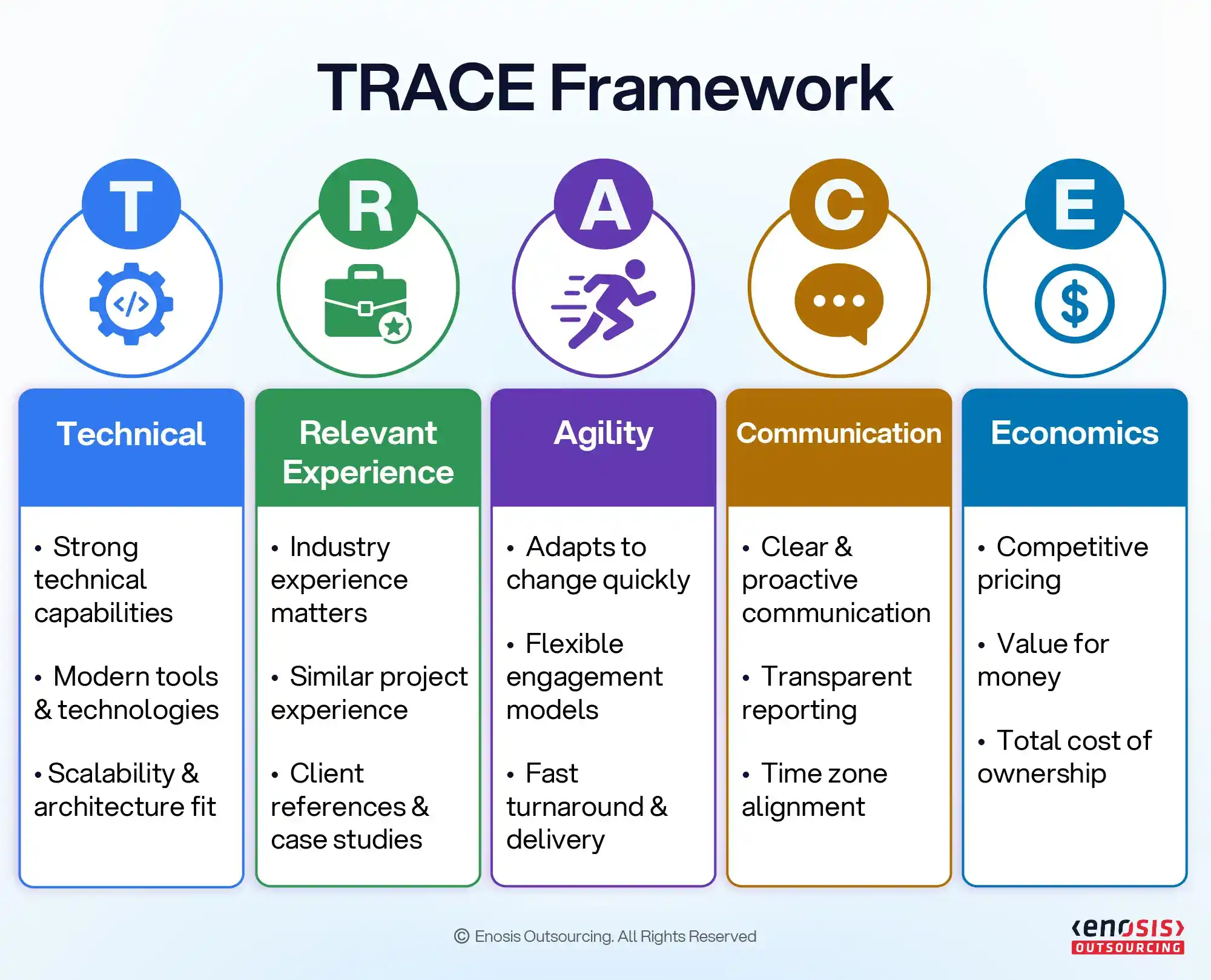
"TRACE Framework" for evaluating outsourcing vendors. It breaks down five pillars: Technical, Relevant Experience, Agility, Communication, and Economics, each with bulleted criteria for assessment.

T: Technical Depth

Technical depth is hard to judge from only a proposal document. You need to see how the team works. Start by requesting a GitHub link or portfolio of public repositories. Review commit frequency. Check how they write and structure code. See how they handle testing. If they cannot share public code, ask for an anonymized sample from a comparable project. Even that reveals how transparent they are. 

Run a small technical assessment before any contract is signed. It needs to be paid and realistic. A four to six hour task that reflects your actual work is useful. Look specifically at DevOps practices, including CI/CD pipelines, automated testing implementation, and deployment practices. Pay attention to how the team handles unclear requirements. Strong teams ask questions. Weak ones make assumptions.

AI capabilities are reshaping how software teams operate. So, ask how they use AI tools in their development workflow. Vendors who have a clear and practical approach to leveraging AI in their development process tend to produce faster output at lower defect rates.

Security certifications signal organizational discipline: ISO 9001 for quality management systems, SOC 2 Type II for data security controls, and ISO 27001 for information security management. Their presence does not guarantee delivery quality. But if a vendor handles sensitive data and has none of them, that is something you should question directly.

R: Relevant Experience

Domain experience matters more than general technical skill. A vendor who has worked in fintech for years will already understand compliance, integrations, and regulatory expectations. An unskilled team usually figures these out during the project. You end up paying for that learning curve.

Ask for three client references in your industry, at your company size, and with a comparable project scope. Also, remember that recency matters. Work done five years ago says very little about how the team operates today. Focus on projects from the last 12 to 18 months. Ask what changed, what went wrong, and how the vendor handled it.

A: Agility and Scalability

A good partner adapts as your needs change. Two capabilities define this: How quickly they can adjust team size and how they handle changing requirements.

Ask directly how the vendor handles scope changes at the sprint level. A real Agile team will explain their backlog process, product ownership, and change handling. If the answer is just “we are flexible,” take that as a warning.

Scalability also depends on their available talent pipeline. Ask how many engineers they already have in your required tech stack who are not assigned to active projects. If they need to hire after you sign, timelines usually slip.

Understanding how location affects collaboration also belongs in this evaluation dimension. The choice between location based outsourcing models, whether nearshoring, offshoring, or a hybrid structure, directly affects how easily the team can scale and collaborate.

C: Communication and Culture

Most projects do not fail because of code. They break because of the communication problems.

Run your initial discovery call without slides. Ask the vendor to walk through your problem. Listen to how they think. Do they ask questions first, or jump to solutions? The difference is small, but it matters.

Time overlap is another constraint. Four or more hours of shared working time between your core team and the vendor team is a practical baseline. Below that threshold, you are running an asynchronous delivery model.

This is where nearshore software outsourcing becomes strategically relevant for most US based organizations. Vendors in LATAM or Central European time zones typically offer four to eight hours of working day overlap with US teams, which makes day-to-day collaboration easier.

E: Economics and Engagement Model

IT outsourcing pricing structures fall into three primary categories. Fixed price works when the scope is clear and unlikely to change. It gives you cost predictability but puts pressure on your initial specifications. 

Time and materials (T&M) work better when requirements evolve. They offer you flexibility but require active scope management from your side. 

Dedicated team contracts establish a reserved team at a monthly retainer. This works best for ongoing product development, where continuity and long term ownership matter more than hourly output.

Staff augmentation is not the same as outsourcing. It means adding engineers to your team, not handing over delivery.

Total cost of ownership matters more than hourly rate. Overall cost includes onboarding time, communication overhead, rework, and internal management effort. A cheaper vendor often costs more if they need constant guidance. A stronger team may charge more but work independently and deliver faster.

The Vetting Process, Step by Step

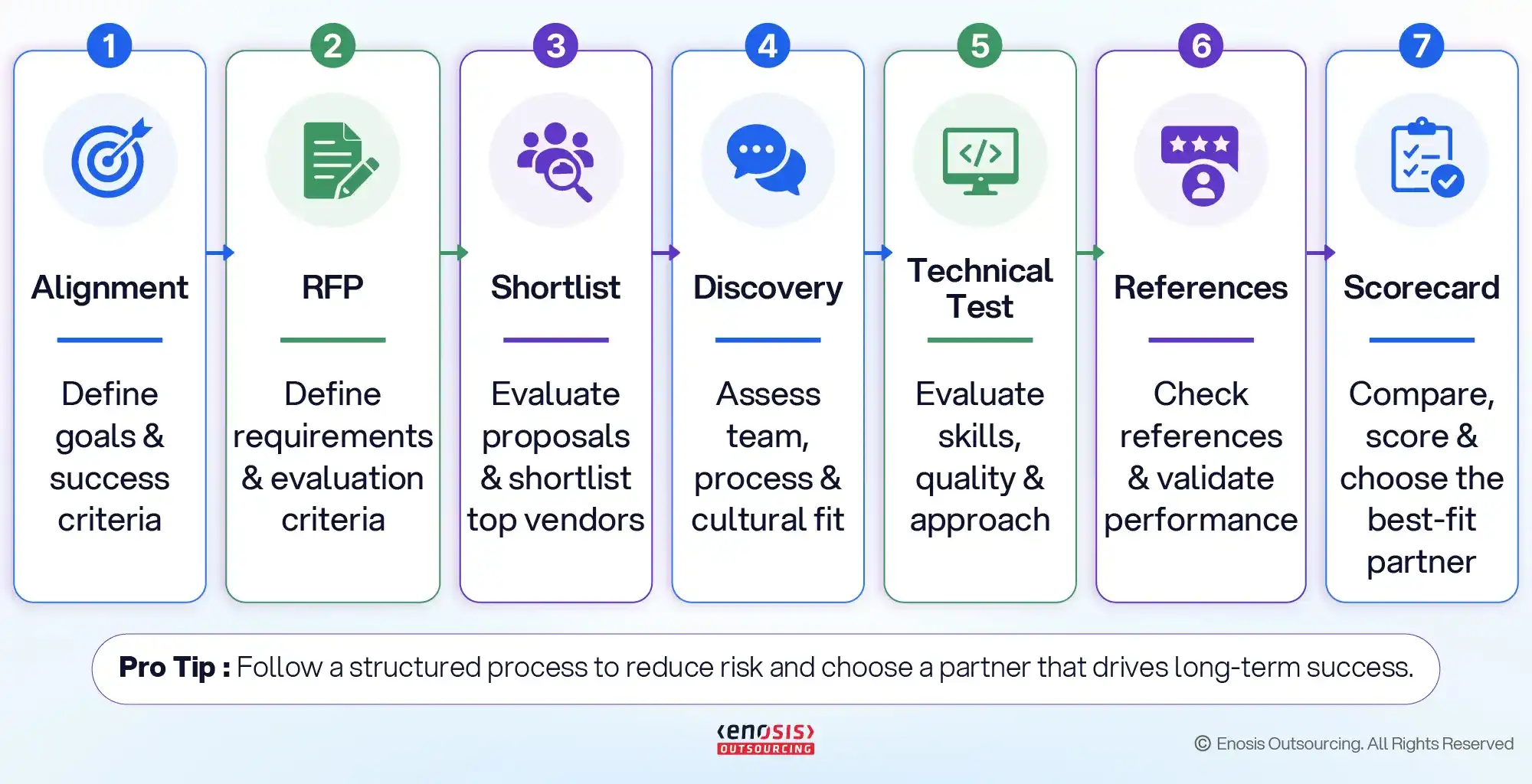
A step-by-step infographic showing a 7-stage vendor vetting process: Alignment, RFP, Shortlist, Discovery, Technical Test, References, and Scorecard.

Vendor selection works best when you follow a clear sequence. If you treat it like an open ended, important details get missed.

Step 1: Internal stakeholder alignment. Before you reach out to any outsourcing partner, get alignment inside your team. Agree on budget, timeline, tech stack, and who makes the final decision. If these are unclear, the process breaks later, usually during contract discussions.

Step 2: Issue a request for proposal (RFP). A good request for proposal helps vendors respond properly. It should cover your company, project scope, technical needs, preferred model, and timeline. Keep it focused. Eight to twelve pages is enough for most projects. The goal is clarity, not documentation for its own sake.

Step 3: Build a shortlist of three to five vendors. Limit your list to three to five vendors. More than that slows everything down. You spend less time on each vendor, and comparisons become weaker. A smaller list keeps the process sharp and manageable.

Step 4: Run structured discovery calls. Use a consistent question format across all candidates so responses are comparable. Lead with open ended questions about the process. Then move into specific questions about capabilities.

Questions to Ask a Potential IT Outsourcing Partner:

  • How do you handle requirements that change during a sprint?
  • Can you walk me through your QA process on a recent project?
  • Who will be our day-to-day contact, and what is their experience level?
  • What happens if a key engineer leaves during the project?
  • Can you share code from a similar project?
  • How do you handle IP ownership, and what does your NDA include?
  • What does onboarding look like in the first two weeks?
  • How do you manage time zone differences during active development?
  • What is your escalation process if delivery is at risk?
  • Can you share three recent client references?
  • Which security certifications do you currently hold?
  • How do you price change requests in fixed price work?
  • What is your current team’s availability in our tech stack?
  • Have you worked in our industry, and what challenges came up?
  • How do you run sprint reviews, and who joins from the client side?

Step 5: Technical assessment. Assign a paid, scoped task, not a free portfolio. Compensation signals seriousness. The task reveals how they think, how they communicate, and how they deliver under pressure. You also get actual code to review.

Step 6: Reference checks. Speak to the clients they provide, but do not stop there. Ask each reference if you can talk to someone else who has worked with them.  Independent feedback is often more useful. Ask direct questions. What went wrong? How did the vendor respond? That usually tells you everything you need to know.

Step 7: Scorecard comparison. Before making a decision, compare vendors in a structured way. Score them across the same criteria so the evaluation stays consistent. This removes bias and makes trade offs clearer.

Vendor Signals That Predict Delivery Failure

Some warning signs show up early.  If you ignore them, they usually turn into delivery problems later. Call them out clearly. It makes the decision easier.
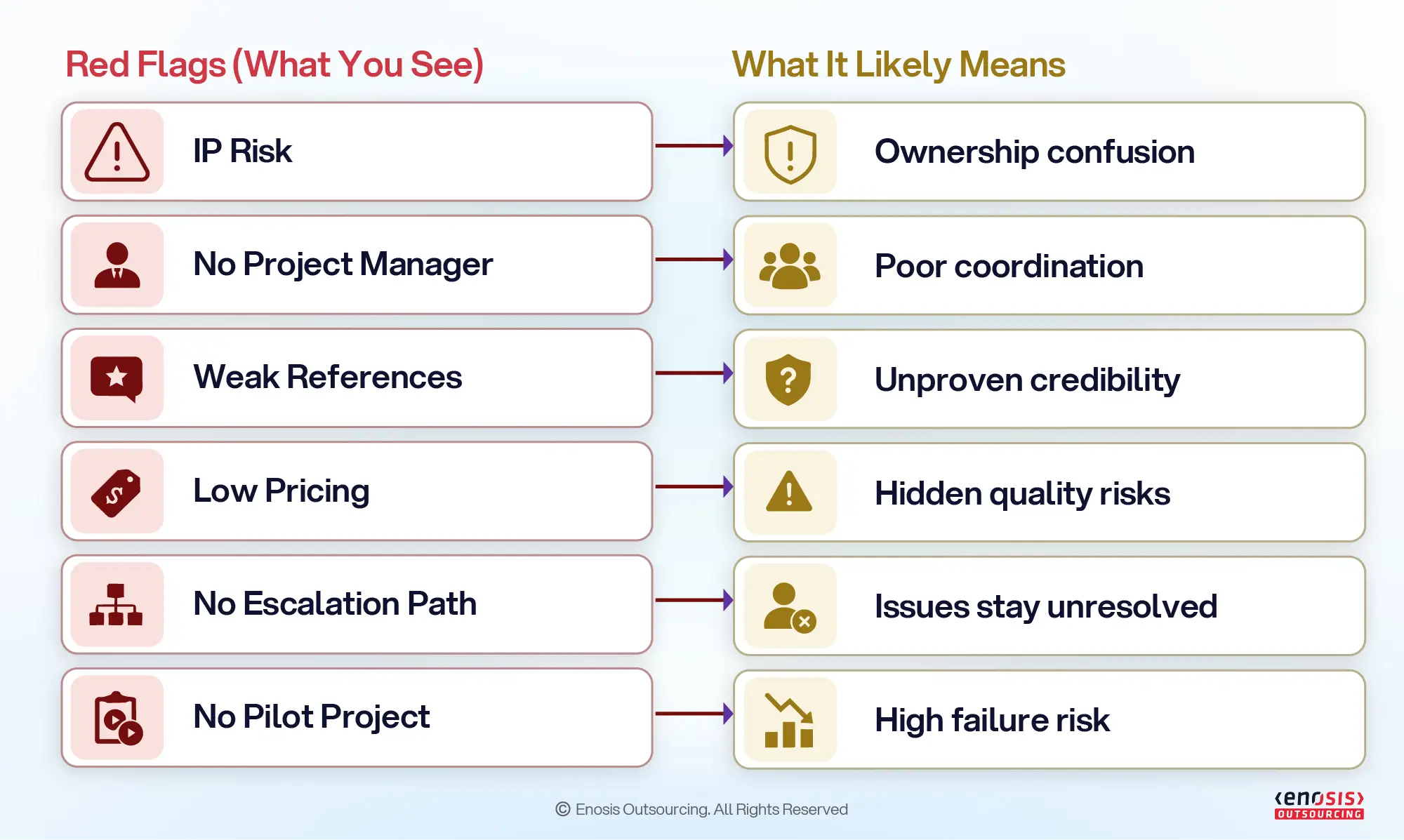
Infographic mapping 6 outsourcing red flags to what they likely mean for a project.

Vague or missing IP assignment language in the NDA. Check the NDA carefully. If it does not clearly state that all work belongs to you after payment, treat it as a serious issue. You should know what is being delivered and who owns it at every stage. If that is vague, do not move forward.

No dedicated project manager identified in the proposal. Every project needs one accountable person. If the vendor cannot name who will manage communication and delivery, expect confusion later. This usually leads to missed updates and unclear responsibility.

References who are uncontactable or who provide only general praise. References should give you real insight. If they are hard to reach or only say positive things without detail, that is not useful. You need specifics. What was delivered? What went wrong? How was it handled? Without that, you are not getting a real signal.

Pricing is significantly below market rate. According to Statista’s global IT outsourcing market data claims mid to senior software engineer rates range from approximately $35 to $80 per hour, depending on geography and specialization. A proposal that comes in at 40% below that range typically reflects one of three structural realities: junior only teams, high internal turnover, or hidden fee structures embedded in change requests.

No clear escalation path. Ask directly: “If our project falls behind schedule and we are not satisfied with progress, what is the escalation process, and who handles it?” If the answer is unclear, delays will likely stay unresolved.

Resistance to a paid pilot engagement. A reliable vendor is usually open to a small paid trial. It shows how they work and reduces risk for both sides. If they avoid this step, take it as a signal. It often points to uncertainty in their delivery.

Data Security and Compliance in IT Outsourcing

Security checks are not optional. If a vendor will access your code, infrastructure, or customer data, you need to review how they handle it. The exact requirements depend on your industry, but a few standards apply in most cases.

Core Security Certifications

Start with the basics.

SOC 2 Type II: This confirms that an independent auditor has reviewed the vendor’s security controls over time, not just at a single point.  It is stronger than Type I and should be the minimum if sensitive data is involved.

ISO 27001: This is a global standard for information security management. It shows the vendor has a structured and audited approach to protecting systems and data.

Industry Specific Requirements

Some projects require additional compliance.

  • HIPAA applies if the vendor handles healthcare data
  • GDPR applies if you work with customers in the EU

In both cases, the vendor’s data handling practices must meet these regulations.

Data Handling and Legal Safeguards

Certifications alone are not enough. If the vendor processes personal data, you should have a data processing agreement in place. This defines what data they can access, how long they keep it, and your rights as the data owner. 

Also review your contract carefully. Make sure IP ownership covers all work created during the engagement, not just the final deliverable.

AI and Data Governance

If your product involves AI or sensitive enterprise data, look beyond standard compliance. Ask how the vendor handles data usage, model training, and access control. These factors are becoming part of vendor evaluation, especially in AI driven systems.

The Vendor Scorecard

A scorecard helps you compare vendors side by side. It keeps the evaluation consistent and reduces bias. Complete one scorecard per vendor after the discovery call and technical assessment, before you enter contract discussions.

Evaluation Dimension Maximum Score Vendor A Vendor B Vendor C
Technical Depth
20
[Enter score]
[Enter score]
[Enter score]
Relevant Industry Experience
15
[Enter score]
[Enter score]
[Enter score]
Communication Quality
15
[Enter score]
[Enter score]
[Enter score]
Cultural Fit
10
[Enter score]
[Enter score]
[Enter score]
Pricing Clarity and Structure
15
[Enter score]
[Enter score]
[Enter score]
References and Reputation
15
[Enter score]
[Enter score]
[Enter score]
Security and Compliance
10
[Enter score]
[Enter score]
[Enter score]
Total
100
[Enter score]
[Enter score]
[Enter score]

A score of 70 or higher is usually a good sign, especially if the vendor also performs well in a pilot task. Below 60, the gap is often too large to ignore. The real value is in comparison.  When one vendor scores much lower than the others, the decision becomes clearer.

At this stage, the decision is no longer about which vendor is capable. It is about how you will work with them in practice.

The structure of the engagement determines how responsibility, cost, and delivery are managed over time.

Outsourcing Engagement Models Compared

Engagement models define how control, communication, and accountability are shared between you and the vendor. Choosing the right model matters as much as choosing the right partner.

The table below compares five common outsourcing engagement models: Fixed Price, Time and Materials, Dedicated Team, Staff Augmentation, and Managed Services. It shows where each model fits best, how predictable the budget is, how much management effort it requires from your side, and what risks to watch for.
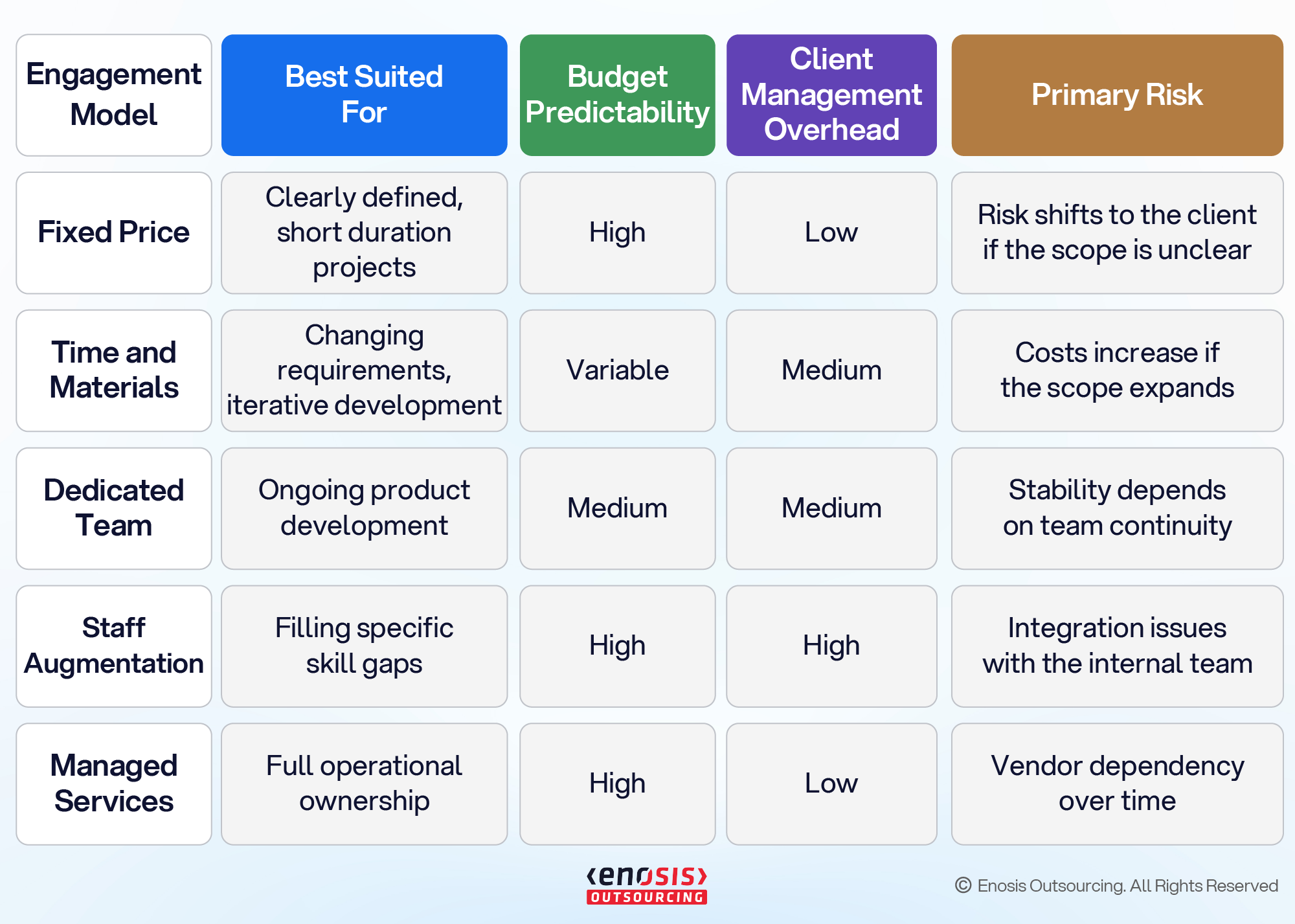
A comparison table evaluating five outsourcing engagement models across suitability, budget predictability, management overhead, and primary risks.

Choosing the right engagement model goes beyond comparing rates. Each model is built for a different operating reality. A fixed scope project does not need the same structure as an evolving product roadmap. A managed service does not require the same level of day to day involvement as staff augmentation.

When the structure matches your project, delivery is usually smoother. When it does not, friction shows up quickly.

Fixed Price is the clearest example. It offers predictability, but only when the scope is stable and well defined. Once requirements begin to shift, the limits of the model become visible. Discussions slow down. Change requests increase. Costs rise in ways that are harder to track.

The decision, in the end, is less about the lowest cost and more about fit.

Onboarding Your IT Outsourcing Partner

Most outsourcing guidance ends at contract signing. That is where the actual relationship work begins. The first few weeks of an outsourcing engagement determine whether the partnership becomes productive or expensive to manage.

Knowledge transfer. Start with a structured handover. Walk the team through your product, architecture, standards, and current priorities. Make sure they understand how things actually work, not just what is documented. Give access early. Code repositories, project tools like Jira or Linear, communication channels, and CI/CD systems. Introduce them to the people they will work with. Set expectations for communication and document how updates, feedback, and decisions will flow.

Define SLAs and KPIs from day one. Do not wait to measure performance. Set expectations from the start. Response times, sprint targets, defect thresholds, and escalation steps. Keep KPIs simple and measurable. You should be able to track them within the first sprint, not months later.

Run a structured 30/60/90 day review. At 30 days, focus on communication and how well the team follows the process. At 60 days, look at delivery quality and whether progress matches your sprint goals. At 90 days, make a clear decision on whether to scale the engagement. Keep that decision intentional. Do not let it drift. If you are moving at startup speed, onboarding becomes more challenging. Limited documentation and shifting priorities can slow things down early.

In those cases, it helps to understand the startup specific in outsourcing. This guide on outsourcing software development for startups covers how to manage onboarding when internal processes are still evolving.

Establish a quarterly business review (QBR) cadence from the start of the engagement. A QBR is not a project status update. It is a chance to step back and assess the relationship. Is the work still aligned with your goals? Has the scope changed? Do the commercial terms still make sense? These conversations keep the partnership on track as it evolves.

When Not to Outsource

This section exists because trustworthy advice sometimes requires saying the opposite of what the reader expects.

In some cases, it fails regardless of how good the vendor is. Recognizing those situations early saves time, cost, and frustration.

Your requirements are not defined enough to scope. If you cannot describe the work at a level that allows a vendor to write a credible proposal, you are not ready to outsource. You are ready to hire an internal product lead or engage a fractional consultant who can help you define the problem first.

You need to move faster than onboarding allows. Outsourcing takes time to ramp up. Even a strong vendor needs a few weeks to understand your system, your process, and your priorities. If you need meaningful output in the first week, this approach will not work. For urgent execution, internal resources are usually the better option.

The function is your primary competitive differentiation. If this is the reason customers choose you, keep it in house. Core logic, key features, and anything tied to your competitive edge should stay with your team. That is where long term knowledge and ownership need to build. This is not just about control. It is about where your company learns and improves over time.

Your internal team has no experience managing an external vendor. Vendor management is a skill. Teams encountering it for the first time consistently underestimate the process overhead required to keep the engagement aligned and moving. Address that capability gap through a fractional engagement manager, an internal hire, or structured vendor management training before signing with an outsourcing partner.

If any of these conditions apply, address them before committing to a search. The vendor selection process is much more productive when the organizational prerequisites are already in place.

Vendor Shortlisting with Enosis Free Consultation

Finding the right IT outsourcing partner is easier when you have someone who understands the vendor landscape. Enosis Outsourcing offers a free consultation designed specifically for organizations at the early stages of their vendor search, before any formal RFP or financial commitment.

In that session, their team reviews your project goals, budget range, and timeline, then recommends vendors that match your requirements. The recommendations come from a curated network of more than 6,000 pre vetted companies. Also, they are informed by over 416,000 hours of proprietary vendor research across technical capability, client feedback, delivery track record, and pricing structure.

This is not a sales call. It is a structured working session focused on your situation. The goal is to give you a clear starting point before you spend weeks evaluating vendors who were never a fit.

The practical value is speed. Instead of spending ten to fifteen hours building an initial list through Clutch, LinkedIn, and cold outreach, you start with a shortlist already filtered to your needs. The evaluation process in this guide still applies. The consultation reduces the field, not the rigor.

If you already have a shortlist, the same consultation can help you pressure test your choices and refine your evaluation process. You can also browse Enosis Outsourcing’s curated network of IT development partners filtered by service type, engagement model, and industry, to build your candidate list from a pre vetted set.

Final Thoughts

Strong outsourcing partnerships are not decided at the proposal stage. They come from a clear selection process, the right engagement model, and an onboarding approach that treats the vendor as part of your team from the start.

The TRACE framework gives you a way to evaluate vendors across the factors that actually affect delivery. The scorecard keeps comparisons consistent. The red flags help you avoid decisions that look good on paper but fail in practice. One final check still matters.

In the end, you are not choosing a vendor. You are choosing a working relationship. Look at the people, the process, and the way they approach the work.

Frequently Asked Questions (FAQs)

How long does it take to find and onboard an IT outsourcing partner?

In most cases, the full process takes about eight to fourteen weeks. Finding and shortlisting vendors usually takes two to three weeks. Evaluation, reference checks, and technical assessments take another three to four weeks. Contract discussions can take one to three weeks, depending on complexity.

Onboarding then takes two to four weeks before the team reaches steady output. You can move faster, but there is a trade off. Rushing evaluation or skipping reference checks is where most poor decisions start.

Nearshoring means working with teams in nearby time zones. For US companies, that often means Latin America. Offshoring involves teams in more distant regions such as Eastern Europe, South Asia, or Southeast Asia. Costs may be lower, but the time difference is larger. The real difference is how you collaborate. Nearshore setups allow more real-time interaction. Offshore setups rely more on asynchronous work. For a deeper breakdown, including when each model works best, see this guide on nearshoring in business guide.

Start with real evidence. Ask for access to public repositories or a sample from a similar project. Look at how the code is written, how often it is updated, and how testing is handled. Then run a small paid task that reflects your actual work. This gives you a clearer picture than any portfolio. Also review the profiles of the engineers who will work on your project. Not just the company’s overall capabilities. During discovery calls, ask about tools and processes. Clear, specific answers are a good sign. Vague ones are not.

Clarity matters here. Make sure the contract includes a clear IP assignment clause so all work transfers to you after payment. Include a non-disclosure agreement that covers code, architecture, and business logic. If personal data is involved, add a data processing agreement. Define what the deliverables are and what happens if the engagement ends. It is worth having a technology lawyer review this section, since small gaps in wording can create problems later.

Managed services means the vendor takes full ownership of a function, such as infrastructure monitoring, and delivers outcomes based on defined service levels. A dedicated team works under your direction and becomes an extension of your organization. Managed services reduces your management overhead, while a dedicated team gives you more control and faster context building. For core product work, dedicated teams often fit better. For ongoing operations, managed services is usually more efficient. For more detail, see the managed IT services guide covers the managed services model in more depth.