

 10 min read
Two proposals land on your desk for the same software project. The first offers six developers who will work under your direction. The second promises to manage the work and hand over the finished product. The prices look close.
You are buying two different things. One gives you capacity. The other is a project-based outsourcing model, where the vendor takes responsibility for an agreed outcome.
The arrangement determines who manages delivery and what your team must still oversee. In Deloitte's 2024 Global Outsourcing Survey, 80% of surveyed executives planned to maintain or increase investment in third-party outsourcing. That does not tell you which model fits your project. Who manages the team? What happens when requirements change? Who decides the work is done?
This guide covers when the model fits, how it compares with other options, delivery responsibilities, pricing, risks, and what to verify before signing.
Not Sure Which Outsourcing Model Fits?
Discuss your project needs and find an engagement approach that fits your team, scope, and level of control.
Book a Free CallWhat Is the Project-Based Outsourcing Model?
The project-based outsourcing model is an arrangement where a vendor takes responsibility for delivering an agreed software outcome. The vendor also manages the team, the process, and the day-to-day work. The client defines what success looks like and approves the result.
Four traits define it:
An agreed outcome. Both sides know what the finished project must achieve.
Defined deliverables and boundaries. The scope states what is included and what is not.
Vendor-managed execution. The provider manages how the work is done and who does it, within agreed technical and security requirements.
Client oversight. The client provides decisions, access, and approvals.
For example, imagine a company that wants a customer portal where clients can track orders and download invoices. Instead of hiring developers and directing them itself, it contracts a provider to build and deliver the portal against agreed functionality and acceptance conditions.
One distinction matters from the start. Project-based outsourcing is an engagement model, not a pricing model. A vendor can deliver an agreed outcome under a fixed fee, a time-and-materials contract, or a hybrid.
When Should You Choose Project-Based Outsourcing?
Choose it when you can define the project outcome and want a provider to manage delivery. Your team may prefer to focus on other priorities. The more clearly you can describe the finished product and its acceptance conditions, the better the model works.
When Project-Based Outsourcing Works Best
The model tends to fit when:
You can describe the outcome in terms a third party can verify.
Requirements are reasonably well understood, even if details will be refined.
You want to keep your internal team focused on other priorities.
The work has a natural end, such as a system integration, a defined-scope migration, a custom business application, or an MVP with a fixed feature set.
You can name who will approve milestones and accept the final product.
These project types do not fit automatically. A migration with unknown legacy complexity, for example, may need a discovery phase before anyone can promise an outcome.
When Another Engagement Model May Work Better
Look elsewhere when the work has no clear boundary. Three situations stand out:
Requirements and priorities change often enough to reshape the work.
You want to direct individual developers yourself.
The product needs continuous feature development.
Compare two cases. A defined integration between your billing system and a CRM has identifiable acceptance conditions, so a vendor can take responsibility for the result. A SaaS platform whose roadmap changes each quarter is different. Locking its scope into one agreement creates friction every time the roadmap moves, and a dedicated team usually fits better.
Project-Based Outsourcing vs. Other Engagement Models
The core difference is what you expect the provider to manage. In project-based outsourcing, you buy an agreed outcome and deliverables. Staff augmentation adds developers under your direction, while dedicated teams provide ongoing development capacity with management responsibilities defined by the contract.
Engagement model | Management responsibility | Primary commitment | Best-fit situation |
|---|---|---|---|
Project-based outsourcing | Vendor manages the team and delivery. Client sets requirements and approves. | An agreed outcome and deliverables | A bounded project with clear acceptance conditions |
Client directs the day-to-day work | Skilled individuals added to your team | You have a roadmap and managers but need skills or capacity quickly | |
Dedicated development team | Varies by contract, but the client usually sets priorities | A team assigned to you over time | Long-running product development with changing priorities |
Retained or managed services | Vendor manages a defined service | Ongoing support or service levels | Continuous work such as maintenance, monitoring, or support |
The table is a starting point. Governance depends on the contract. Dedicated teams may have vendor-side managers, while project engagements can involve close client oversight.
The practical consequence is about accountability. With staff augmentation, you direct delivery and usually manage more of the coordination. In a project-based arrangement, the vendor manages execution against agreed deliverables. Who bears the costs of delays, missed requirements, or added scope depends on the contract.
Need Help Choosing the Right Outsourcing Partner?
Tell us what you need, and we’ll help you identify companies that fit your project requirements.
Schedule Your Free CallWho Is Responsible for What in a Project-Based Engagement?
The vendor normally manages execution. The client remains responsible for business decisions and acceptance. Handing over the work does not hand over accountability for what the software must do.
Activity | Vendor responsibility | Client responsibility |
|---|---|---|
Requirements | Ask questions, document, flag gaps | Provide business needs and confirm intended behavior |
Team management | Staff, direct, and replace team members | Review team structure and key roles |
Technical execution | Design, build, and test | Provide necessary access; confirm technical and security requirements |
Progress reporting | Report status, risks, and blockers | Review reports and respond to issues |
Change requests | Estimate cost and schedule impact | Approve or decline changes |
Acceptance | Fix defects against agreed criteria | Test, review, and formally approve |
In the portal example, the vendor builds and tests the portal. The client confirms how invoicing should behave, provides access to billing data, reviews changes, and approves the finished work.
The vendor usually supplies a project or delivery manager and a technical lead. The client should name a product owner who can answer questions quickly and handle decisions or escalations. Slow client decisions can delay the schedule, and contracts may account for such dependencies.
How Does Project-Based Outsourcing Work?
A project moves through five stages: discovery, team setup, milestone delivery, testing and acceptance, and handover. Each stage should have a deliverable and a decision or approval point.
Discovery, Requirements, and the Statement of Work
Discovery turns an idea into something a vendor can commit to. Both sides clarify business objectives, features, integrations, and success conditions. The output is usually a statement of work (SOW) that lists deliverables, assumptions, exclusions, dependencies, and milestones.
Exclusions and assumptions deserve as much attention as features. If the portal estimate assumes the client's billing system has a usable API, the SOW should say so. Our guide to the software development scope of work covers what to include.
Team Setup and Project Execution
Once the SOW is signed, the vendor assigns the team. Typically, that includes developers, QA, and a project manager. The vendor sets up tools, plans the work, and starts building. The client stays involved through scheduled reviews, progress updates, and quick answers to questions.
Milestones, Reporting, and Progress Reviews
Milestones break the project into checkpoints, each tied to a visible deliverable such as a working login flow or a demo of the invoice list. Status reports should show progress against the plan, open risks, and decisions needed from you. Record decisions and changes in writing.
A demo, formal acceptance, and milestone payment are not necessarily the same event. The contract defines what must happen before a deliverable is accepted or payment becomes due.
QA, User Acceptance Testing, and Sign-Off
The vendor tests its own work. The client then runs user acceptance testing (UAT) against agreed criteria. A finished development task is not the same as an accepted deliverable.
Acceptance criteria must be checkable. "The portal should work properly" cannot be tested. This can: "An authorized customer can download an invoice PDF whose line items and totals match the approved billing record."
If a deliverable fails an agreed criterion, the defect should be documented and corrected under the contract. The client then retests it before sign-off. Requests for different behavior may require a change request.
Handover and Post-Launch Responsibilities
Handover should cover:
Source code and repository access
Documentation and deployment details
Credentials and system ownership
Knowledge transfer sessions
Intellectual property terms
Any agreed warranty or defect-fix period
Maintenance is not automatically included. Many agreements end at acceptance, with ongoing support priced separately. Ask about it before you sign.
How Much Does Project-Based Outsourcing Cost?
The cost depends on scope, complexity, and the pricing arrangement. There is no standard price for the model itself.
Pricing Arrangements
Fixed fee. One agreed price for a defined scope. It gives budget predictability, but changes usually mean renegotiation.
Time and materials (T&M). You pay for the time spent. It offers flexibility, but total cost is less certain.
Capped T&M. Time-based billing with an agreed ceiling. It balances flexibility and exposure, but the cap needs a clear definition of what happens when it is reached.
Milestone payments are different. They describe when you pay, such as on delivery or acceptance of each milestone, not how the total price is calculated. Both fixed-fee and capped T&M projects can use milestone payments.
What Can Increase the Final Cost?
Factors that can increase the final cost include:
Complex integrations with other systems
Requirements that were unclear at the start
Change requests during development
Client delays in providing access, feedback, or approvals
Rework caused by misunderstood requirements
Testing needs beyond what was estimated
Post-launch support that was not in the original scope
A predictable quote does not guarantee a lower total cost. If the quote excludes work you later need, the price can still rise. Compare proposals against the same scope, assumptions, exclusions, change rates, and support terms.
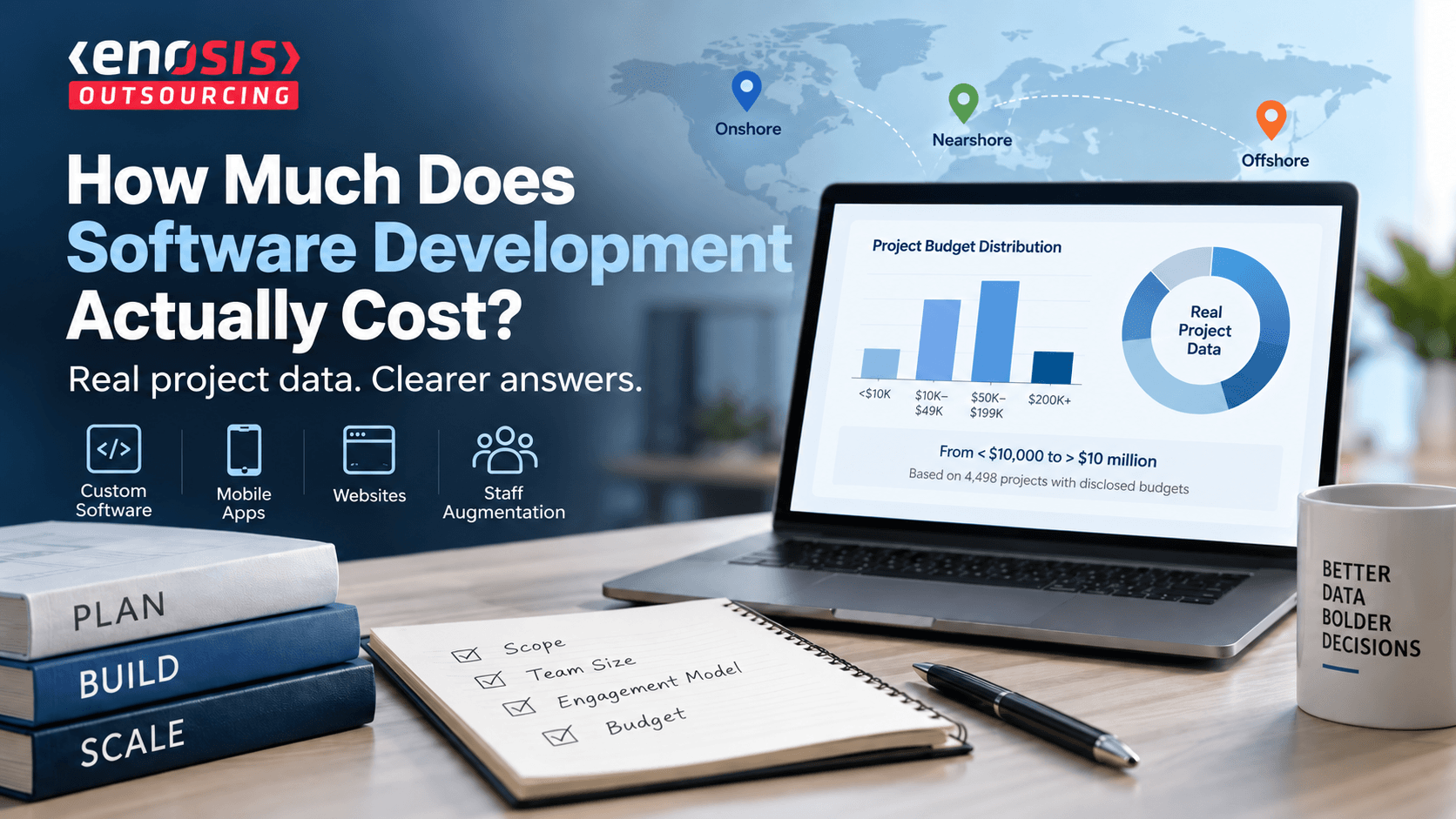
For context, Enosis analyzed 11,411 outsourced software projects with disclosed budgets. The most common range was $10,000 to $49,000 (36.9% of projects), while 19.2% reached $200,000 or more. This data covers outsourced projects generally, not project-based engagements only, and it records total value in ranges, not rates. These ranges illustrate budget variation, not a price for your project.
Looking to Outsource Your IT Projects?
Enosis Outsourcing helps technology leaders scale their teams with expert offshore engineers. Get a free consultation today.
Get a Free ConsultationWhat Are the Risks and Contractual Safeguards?
Unclear scope, weak change control, and gaps at handover can create costly problems. Each calls for a safeguard.
Scope Changes and Commercial Risk
Risk: The scope is vague, so each side assumes something different.
Consequence: Disputes over what was included, and surprise costs.
Safeguard: A detailed SOW with explicit exclusions and a change-control process.
Suppose that midway through the portal build, the client asks for a reporting dashboard. Before work starts, the vendor should estimate the added cost and timeline, and the client should approve the change in writing. The agreed scope, budget, and schedule should then be updated to reflect the change.
Not every extra cost is scope creep. Distinguish:
New scope that both sides agree to add
An original assumption that turned out to be wrong
A defect in work that was already agreed
A delay caused by a client dependency
Who pays depends on the contract. Agree on this in advance.
Delivery, Security, and Continuity Risks
Risk: Missed milestones or a single point of failure, such as one project manager who holds all the knowledge.
Consequence: Delays and rework if that person leaves.
Safeguard: Named backups, regular documentation, and an agreed process for replacing key team members.
Risk: Your data and intellectual property are accessible to a third party.
Consequence: Data exposure if access is poorly controlled, or ownership disputes if intellectual property terms are unclear.
Safeguard: Confidentiality terms, role-based access controls, and clear agreements on ownership or licensing of custom code, pre-existing vendor components, and third-party software, including when those rights take effect.
Risk: A difficult exit.
Consequence: You cannot maintain the software without the vendor.
Safeguard: Handover obligations in the contract, including code, documentation, and knowledge transfer.
Contract terms vary by jurisdiction and provider. Have counsel review the agreement.
How to Evaluate a Project-Based Outsourcing Vendor
Evaluate a vendor on evidence, not on claims. The goal is to confirm they can take responsibility for your outcome, not just supply developers.
Ask for these items:
Comparable completed projects, with similar delivery scope and references you can contact
The named delivery manager, and their experience with similar scope
A sample delivery plan or milestone schedule from a past engagement
A sample status report, so you can see how progress is communicated
Their QA and acceptance process, including how they handle disputed acceptance criteria
How change requests are priced and approved
What the proposal excludes
Handover terms, including documentation, knowledge transfer, and any agreed warranty
Post-project support options and what they cost
If a proposal is vague on exclusions or acceptance, ask for clarification. For more, see our guide to questions to ask when outsourcing software development.
Need Help Building Your Vendor Shortlist?
Tell us what you're looking for and get help identifying companies relevant to your requirements.
Get a Free ConsultationWhen comparing outsourcing proposals, ask whether you need developers to direct or a provider responsible for delivering an agreed result. Project-based outsourcing works best when you can describe that outcome and agree on how it will be built, reviewed, and accepted. If your scope changes constantly or you want to direct developers yourself, another model will likely serve you better.
Choosing the model is only the first step. The agreement still has to settle pricing, scope changes, approvals, and handover. Clear terms make the vendor's accountability easier to manage, but they do not eliminate delivery risk.