

 12 min read
As global companies look for cost-effective outsourcing and skilled IT teams, South Africa has become an option for software development and other business services. Its English-speaking workforce, growing technology talent pool, and time-zone compatibility with Europe make it worth considering alongside established outsourcing destinations in Eastern Europe and Latin America.
However, choosing an outsourcing destination involves more than comparing labor costs. Business leaders must understand which services South Africa can reliably support, how much outsourcing will cost, and what responsibilities and risks they will retain.
This guide examines outsourcing to South Africa from a buyer's perspective. It covers available services, workforce advantages, costs, engagement models, operational risks, and how to evaluate outsourcing partners.
Need Help Choosing the Right Outsourcing Partner?
Tell us what you need, and we’ll help you identify companies that fit your project requirements.
Schedule Your Free CallIs South Africa a Good Outsourcing Destination?
South Africa is a promising outsourcing destination for companies seeking skilled IT professionals, English-speaking teams, and closer collaboration with European business hours. It offers opportunities in software development, IT support, and other business services, particularly for organizations looking to expand delivery capacity without building a large internal team.
Key advantages include:
Time-zone compatibility: South Africa operates on UTC+2, allowing substantial working-hour overlap with the UK and Europe and partial overlap with North America.
English proficiency: English-speaking professionals can support communication, project coordination, and international collaboration.
Cost opportunities: Outsourcing may reduce staffing expenses compared with some Western markets, depending on the service, expertise, and engagement model.
However, buyers should also consider:
Infrastructure reliability: Verify backup power, connectivity, and business continuity arrangements.
Talent availability: Specialized IT professionals are concentrated in major cities, making recruitment capacity important.
Data protection: Confirm how providers handle personal information, cybersecurity, and applicable regulatory requirements.
South Africa is worth considering, but its suitability depends on your project requirements and the provider's delivery capabilities.
Looking to Outsource Your IT Projects?
Enosis Outsourcing helps technology leaders scale their teams with expert offshore engineers. Get a free consultation today.
Get a Free ConsultationWhat Services Can You Outsource to South Africa?
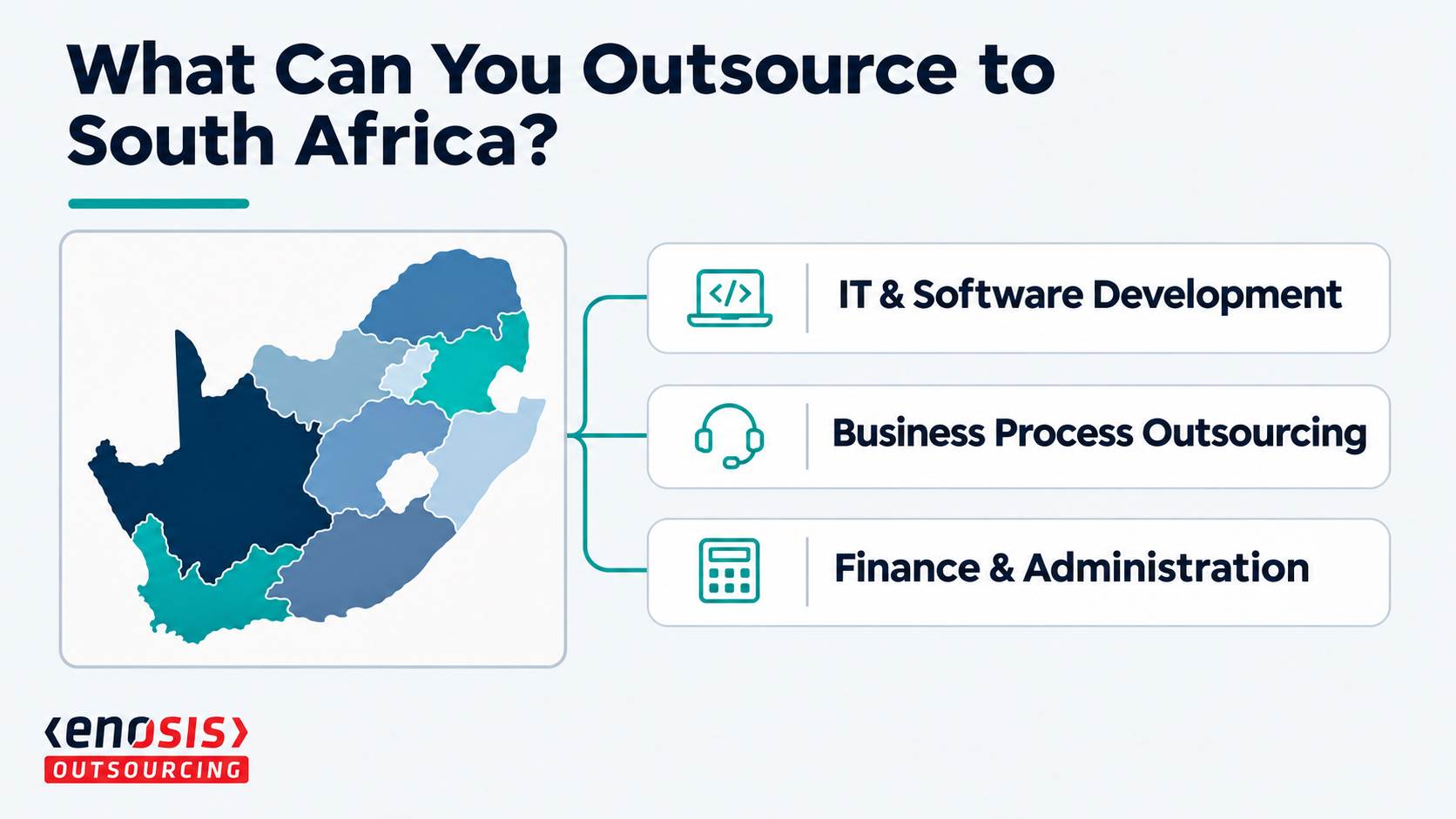
South Africa supports a range of outsourcing services, from software development and IT operations to customer support and financial administration. The right choice depends on the expertise required, how closely the external team must collaborate with your business, and which responsibilities you want to retain.
IT and Software Development Services
South African technology companies offer custom software development, mobile applications, cloud solutions, data engineering, and AI-related development. Businesses can also outsource specific technical functions, including:
Software development: Building web applications, APIs, minimum viable products (MVPs), and enterprise software.
Quality assurance: Manual testing, test automation, and software quality checks.
Cloud and DevOps: Cloud migration, deployment automation, infrastructure management, and ongoing technical support.
Data and AI: Data pipelines, analytics platforms, and AI-enabled application development.
These services can support both new product development and the modernization of existing systems. However, buyers should verify whether a provider has delivered comparable projects rather than relying on general technology expertise.
Business Process and Customer Support Services
South Africa also has an established business process outsourcing (BPO) industry. International companies use local providers for customer service, contact center operations, technical help desks, and sales support.
These services can be suitable when consistent communication, defined workflows, and measurable service levels are important. Buyers should establish performance targets and clarify who manages training, quality monitoring, and customer escalations.
Finance, Administration, and Professional Services
Companies can outsource accounting support, bookkeeping, payroll administration, recruitment coordination, and other back-office activities.
These functions often involve sensitive business information and established internal procedures. Before outsourcing them, organizations should confirm data access controls, reporting responsibilities, and the qualifications required for regulated work.
The key distinction is between outsourcing a business function and transferring accountability. External teams may perform the work, but the client still needs appropriate oversight and defined ownership of business decisions.
Why Companies Choose South Africa for Outsourcing
South Africa attracts international companies through its English-speaking workforce, established business services industry, and growing technology ecosystem. These advantages can support both customer-facing operations and specialized IT projects.
English Proficiency and Professional Talent
English is widely used in South African business, making communication with international clients more accessible. The country also has universities and technical training institutions that contribute to its software development, data analytics, and engineering workforce.
For buyers, language compatibility can simplify project discussions, documentation, and stakeholder communication. However, technical competence still needs to be verified through relevant project experience and individual skills assessments.
Time-Zone Alignment With International Clients
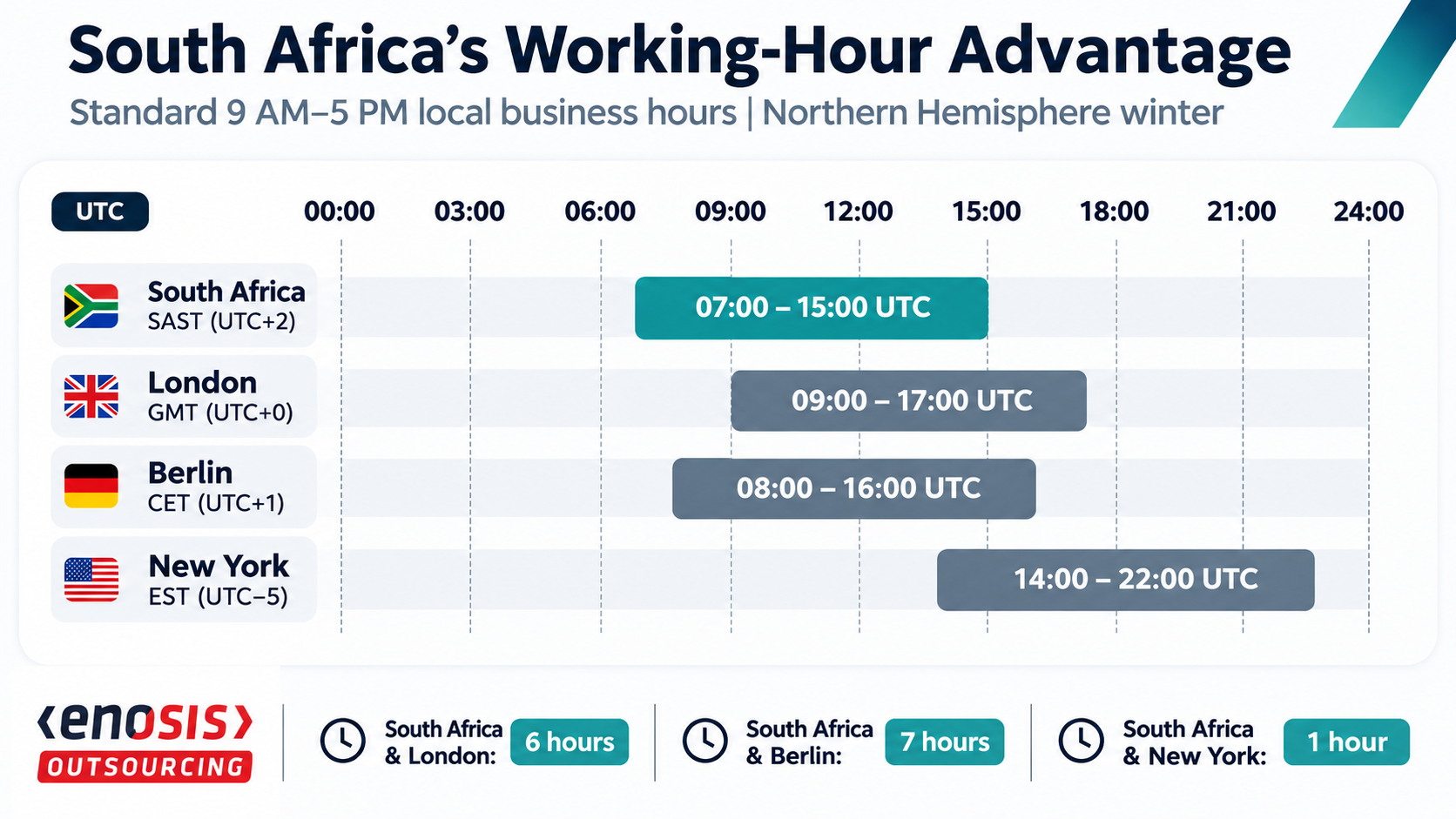
South Africa operates on South African Standard Time (SAST, UTC+2) throughout the year.
United Kingdom: South Africa is one hour ahead during British Summer Time and two hours ahead during winter.
Continental Europe: Teams can share most standard business hours with countries using Central European Time.
United States: East Coast businesses have partial morning overlap when South African teams work standard daytime hours.
This makes South Africa particularly practical for UK and European companies that require frequent collaboration and project reviews.
Established Outsourcing Hubs and Industry Experience
Cape Town, Johannesburg, and Durban are important centers for technology services and business operations. These locations offer access to outsourcing companies, professional talent, and established commercial infrastructure.
Industry growth provides additional evidence of South Africa's outsourcing activity. According to BPESA, the country's global business services sector created 26,346 new jobs serving international markets in 2025, its highest annual total since 2018. This figure covers broader business services, not IT outsourcing alone.
Industry growth indicates market activity but does not guarantee the capabilities of an individual provider.
How Much Does Outsourcing to South Africa Cost?
Outsourcing costs in South Africa vary by service, technical expertise, team size, and engagement model. A software development company may charge hourly or by project, while a dedicated staffing provider typically quotes monthly rates per employee.
For buyers, the important question is what the quoted price includes and how it affects the total project budget.
Typical Outsourcing Rates by Service and Role
South African software development companies listed on Clutch commonly advertise hourly rates between $25 and $99, although pricing varies by provider.
For dedicated staffing, Sourcefit publishes the following 2026 monthly rates:
Role | Average monthly rate |
|---|---|
Customer service representative | $1,185 |
Accountant | $1,793 |
Digital marketing manager | $2,145 |
Full-stack developer | $2,773 |
QA engineer | $2,989 |
Source: Sourcefit, 2026. These are provider-specific rates, not national market averages. Sourcefit states that its prices include salary, statutory contributions, equipment, office space, HR, and delivery management.
The difference between hourly development rates and monthly staffing fees matters. They represent different services and should not be compared without checking the responsibilities included.
What Determines the Final Outsourcing Cost?
Several factors influence the total amount a business pays:
Technical complexity: Specialized architecture, security, and AI expertise may increase pricing.
Team composition: Senior developers, QA engineers, and project managers have different costs.
Engagement model: Staff augmentation, dedicated teams, and fixed-price projects allocate responsibilities differently.
Additional expenses: Cloud hosting, software licenses, onboarding, travel, and post-launch support may be charged separately.
For example, a team of two full-stack developers and one QA engineer would cost approximately $8,535 per month using Sourcefit's published rates. This is an illustrative staffing calculation, not a complete software project estimate.
How to Compare Outsourcing Quotes Fairly
Request proposals with the same scope, team requirements, delivery expectations, and pricing period.
Compare what each provider includes, particularly project management, testing, infrastructure, security, and ongoing support. For fixed-price projects, confirm which deliverables are covered and how changes will be charged.
The lowest hourly rate does not necessarily mean the lowest project cost. A realistic comparison considers the full delivery budget.
Outsourcing Models and Delivery Responsibilities
The outsourcing model you choose determines who manages the team, controls delivery, and takes responsibility for project outcomes. South African providers offer different working arrangements, from individual specialists joining an internal team to fully managed projects.
The right model depends on your internal management capacity, project scope, and need for long-term control.
Staff Augmentation and Dedicated Teams
Staff augmentation allows companies to add South African developers, QA engineers, or other specialists to an existing team. Your internal managers typically assign tasks, set priorities, and supervise delivery.
A dedicated team provides a group of professionals working primarily on your project. Management may be shared between your company and the outsourcing provider, depending on the agreement.
Both models are suitable for ongoing development or projects where requirements evolve. However, they require clear responsibilities for technical decisions and performance monitoring.
Project-Based and Managed Outsourcing
In project-based outsourcing, a provider takes responsibility for delivering an agreed scope, such as a web application or software modernization project. The contract should define milestones, deliverables, acceptance criteria, and change procedures.
Managed outsourcing extends this approach to ongoing services such as IT support, cloud operations, or application maintenance. The provider manages daily execution against agreed service levels, while the client retains business oversight.
These models suit organizations that need external delivery management rather than additional staff alone.
Building a Company-Owned Team in South Africa
Companies planning long-term operations may establish their own South African team through a local entity or an employer-of-record arrangement. These approaches differ legally, but both can support direct management of local employees.
A company-owned operation offers greater organizational control but introduces hiring, compliance, administration, and management responsibilities.
Model | Primary delivery responsibility | Best suited for |
|---|---|---|
Staff augmentation | Client | Filling skill gaps |
Dedicated team | Shared or contract-dependent | Continuous development |
Project-based outsourcing | Provider, within agreed scope | Defined deliverables |
Managed outsourcing | Provider, against service levels | Ongoing operations |
Locally employed team | Client | Long-term team expansion |
Before choosing a model, confirm who employs the staff, directs their work, owns the deliverables, and handles replacement or termination.
Risks of Outsourcing to South Africa and How to Manage Them
Outsourcing to South Africa offers business opportunities, but buyers must account for infrastructure, data protection, talent availability, and delivery risks. These challenges do not affect every provider equally.
Power, Connectivity, and Business Continuity
South Africa has historically experienced electricity disruptions that affected business operations. However, conditions have improved. According to Eskom, the country completed the 2026 winter without load shedding, reflecting improved electricity generation performance.
Even so, buyers should verify each provider's operational readiness rather than assume nationwide improvements guarantee uninterrupted service.
Ask about backup power, redundant internet connections, remote-working arrangements, and documented recovery procedures. For critical services, request evidence that business continuity plans have been tested.
Data Protection, POPIA, and Intellectual Property
South Africa's Protection of Personal Information Act (POPIA) establishes requirements for handling personal information, including security safeguards and contractual responsibilities when third parties process data.
Companies outsourcing software development or customer operations should clarify:
Data access: Who can access sensitive information, and how is access monitored?
Security controls: Are encryption, access restrictions, and incident-response procedures documented?
Cross-border processing: Which privacy and international data-transfer requirements apply?
Intellectual property: Who owns the source code, documentation, and other deliverables?
POPIA compliance does not automatically establish compliance with GDPR or other international regulations. Buyers should confirm applicable requirements and responsibilities before transferring sensitive information.
Talent, Delivery Quality, and Financial Risks
Specialized talent availability can vary by location, technology, and seniority. A provider may have general software development experience but lack the expertise required for your architecture or industry.
Request evidence of comparable projects, verify the proposed team's qualifications, and clarify replacement procedures if key employees leave.
Delivery risks also arise from unclear requirements, weak communication, and inadequate project oversight. Define milestones, acceptance criteria, reporting schedules, and escalation responsibilities before work begins.
Currency fluctuations and contract changes can affect the final budget. Confirm billing currency, rate-adjustment clauses, additional charges, and termination conditions.
Risk | What buyers should verify |
|---|---|
Service interruptions | Backup systems and tested recovery plans |
Data security | Access controls, contracts, and incident procedures |
Delivery problems | Milestones, ownership, and acceptance criteria |
Talent turnover | Replacement and knowledge-transfer arrangements |
Unexpected costs | Pricing terms and change-control procedures |
The goal is not to eliminate every outsourcing risk, but to verify that responsibilities, safeguards, and remedies are clearly established before signing.
Need Help Building Your Vendor Shortlist?
Tell us what you're looking for and get help identifying companies relevant to your requirements.
Get a Free ConsultationHow to Evaluate South African Outsourcing Companies
Finding an outsourcing company in South Africa is relatively straightforward. Determining whether it can deliver your specific project requires more investigation.
Start by comparing providers based on relevant experience, technical capabilities, team availability, and delivery responsibilities. Company size, hourly rates, and client ratings are useful screening factors, but none independently guarantees project success.
Compare Providers Using Verifiable Project Evidence
South Africa has established software development companies serving local and international clients. The following examples illustrate different areas of expertise.
Company | Core expertise | Relevant buyer consideration |
|---|---|---|
Custom software development, dedicated engineering teams, AI-enabled delivery | Software development capacity and delivery management | |
Enterprise software, data engineering, business analysis, and QA | Complex systems and enterprise integration | |
Custom software, AI development, cloud, and managed IT services | Technical specialization and ongoing support |
Before shortlisting a provider, examine its completed projects. Look for work involving comparable technologies, business requirements, industry regulations, and project complexity.
For example, a company developing a healthcare platform should prioritize demonstrated experience with healthcare integrations, security requirements, and software testing over a provider's general reputation.
Client reviews can provide additional context, particularly when they describe communication, delivery challenges, and measurable outcomes. Check the review date, project scope, and number of reviews rather than relying on the overall rating alone.
Questions to Ask Before Signing a Contract
Use the following questions to evaluate shortlisted providers:
Relevant experience: Can you demonstrate two completed projects with similar requirements?
Team capabilities: Who will work on the project, and what are their qualifications?
Delivery management: Who owns technical decisions, milestones, and quality assurance?
Security and ownership: How will you protect sensitive data, source code, and intellectual property?
Pricing transparency: What is included in the proposal, and how are changes charged?
Continuity: What happens if key employees leave or service delivery is interrupted?
Request evidence supporting each answer, including project references, team profiles, sample deliverables, and contractual terms.
A smaller specialist team may be a better choice for a narrowly defined project, while a larger provider may offer greater staffing flexibility. The decision should depend on project fit rather than company size alone.
The strongest outsourcing partner is not necessarily the highest-rated or least expensive. It is the one whose demonstrated capabilities, delivery approach, and contractual commitments match your requirements.
Want to See What a Vendor Has Actually Delivered?
Explore real project experience to understand a company’s capabilities before adding it to your shortlist.
Explore ProjectsWhen South Africa Is the Right Choice
South Africa can be a strong outsourcing destination, but its suitability depends on your project requirements, budget, and ability to manage external delivery.
South Africa may be a strong fit when:
You need software development, IT support, or business services with proven local expertise.
English-language collaboration and overlapping UK or European business hours are important.
Verified provider capabilities and total costs align with your project needs.
Consider it a conditional fit when:
Your project requires specialized skills that may be difficult to source.
Sensitive data, complex integrations, or strict compliance requirements demand additional safeguards.
Your internal team has limited capacity to supervise external development.
Consider alternatives when:
Available providers cannot demonstrate relevant project experience.
Working-hour differences prevent essential collaboration.
Total costs, delivery responsibilities, or operational risks outweigh the expected benefits.
Before committing, shortlist suitable providers, compare proposals against the same requirements, and verify delivery capabilities, security arrangements, and contractual responsibilities.
The right outsourcing destination is the one that can support your business objectives with acceptable costs, clear accountability, and manageable risks.