

 6 min read
IT Outsourcing Empowers a Small Business
Building a full in-house IT team can be expensive and overwhelming for a small business. That’s why more and more small business owners are turning to IT outsourcing.
Big names like WhatsApp and GitHub started small too. They outsourced their early IT needs to grow faster without breaking the bank. You can do the same.
IT outsourcing means delegating some technology functions to external service providers. The functions may primarily include:
Technical Support;
Cybersecurity; and
Cloud Management.
Outsourcing allows small businesses to focus resources on core business operations and innovation.
Why Should You Outsource IT?
Small teams don’t have the time or budget to build every capability in-house. Outsourcing converts fixed payroll into flexible capacity, plugs skill gaps instantly, and lets your core team focus on the work that grows revenue. Here are the most common reasons small businesses choose to outsource:
Lower total cost: Reduce salaries, benefits, tooling, and management overhead. Pay only for what you use.
Faster time to market: Stand up a ready-made team and ship features, integrations, or MVPs sooner.
Access to scarce skills: Tap specialists in cloud, data, AI/ML, cybersecurity, DevOps, QA automation, and SRE.
Elastic scale: Ramp up for launches or busy seasons and scale down when demand cools, without layoffs. For team based scaling, the staff augmentation model is often the most practical structure.
Stronger security & compliance: Mature partners bring controls, audits, and SLAs you don’t have to build from scratch.
24/7 reliability: Follow-the-sun coverage for support and incident response.
Refocus your core team: Keep internal talent on product, customers, and growth—not firefighting.
Lower tool/license overhead: Many partners include CI/CD, monitoring, and testing tools in their rates.
Proven delivery process: Benefit from established playbooks for agile software delivery, QA, and change management.
Outcome-based engagement: Tie vendor incentives to results, not hours.
Clear governance: Dashboards, KPIs, and recurring reviews keep progress visible to leadership.
When you shouldn’t outsource:
Mission-critical IP that you haven’t legally/technically protected
Ambiguous scope you can’t yet measure (do discovery first)
Work needing daily, on-site stakeholder decisions
Sensitive data without a compliance path (sign DPA, define access, verify controls)
Looking to Outsource Your IT Projects?
Enosis Outsourcing helps technology leaders scale their teams with expert offshore engineers. Get a free consultation today.
Get a Free ConsultationKey Differences Between In-house and Outsourced IT Services
Aspect | In-house IT | Outsourced IT |
|---|---|---|
Resource Allocation | Internal staffing and infrastructure | External providers and global talent pool |
Expertise | Requires internal training and updates | Access to specialized, up-to-date expertise |
Flexibility | Less flexible, limited to internal capacity | Highly scalable and adaptable to changing needs |
Control | Direct control over operations and alignment with culture | Less direct oversight and control |
Costs | High overhead, upfront investment, and training expenses | Generally more cost-efficient with variable pricing models |
Communication | Easier within the organization | Requires robust communication channels to manage partnerships |
IT Outsourcing Can Save Costs and Drive Growth for Small Businesses
Hiring a full-time software developer in the U.S. can cost a small business up to $154,000 per year. For small teams comparing in house vs outsourcing software development, the real decision is not just salary cost. It also includes hiring time, benefits, management overhead, delivery speed, and access to specialized skills. Switching to external service providers often minimizes this cost by 50% or more.
Business owners can save money and reallocate this capital to product development, marketing, or market expansion.
WhatsApp, now a global messaging giant, outsourced much of its early development to a team in Eastern Europe. This allowed the founders to keep costs low, iterate quickly, and focus on user growth rather than building an expensive in-house team. The result: WhatsApp scaled rapidly, attracted investors, and was ultimately acquired by Meta for $19 billion.
GitHub, now a global leader in software development collaboration, outsourced its backend development in its early days due to budget constraints. By leveraging external expertise, GitHub built a robust MVP without the overhead of a full-time in-house team.
Want to See What a Vendor Has Actually Delivered?
Explore real project experience to understand a company’s capabilities before adding it to your shortlist.
Explore ProjectsWhen Is the Right Time for a Small Business to Outsource IT Services?
An optimal time for outsourcing is when the internal team is overstretched.
When a business experiences rapid expansion, its IT demands grow in complexity and scale. Outsourcing offers scalable solutions that can adapt quickly, ensuring IT infrastructure keeps pace with business growth.
As a business grows or faces seasonal fluctuations, external IT providers can adjust their services accordingly. For many teams, managed IT support for small businesses offers the right level of help when demand rises, systems need closer monitoring, or internal staff cannot cover every support request.
IT Outsourcing Best Practices for a Small Business
For small businesses, choosing the right partner and executing a well-structured IT outsourcing strategy is critical. Below is a detailed guide based on industry best practices, real-world insights, and case examples.
Before comparing providers, small businesses should follow a clear framework for outsourcing software development. Clear goals, scope, partner evaluation criteria, governance expectations, and security requirements should be defined before outreach begins, not after delivery issues appear.
Criteria for Selecting IT Outsourcing Partners
Criteria | Importance | Mitigation Strategy | Benefit | |
|---|---|---|---|---|
1 | Expertise | Proven industry experiences | Review case studies, verify skills | 40% faster delivery (Gartner, 2024) |
2 | Compliance | Adherence to GDPR, HIPAA | Check certifications, SLAs | 80% risk reduction (Forrester, 2024) |
3 | Transparency | Clear communication, tools | Require Jira/Trello, regular updates | 20% better visibility (TechTarget, 2024) |
4 | Scalability | Flexible resource allocation | Ensure adaptable contracts | 25% cost savings (McKinsey, 2024) |
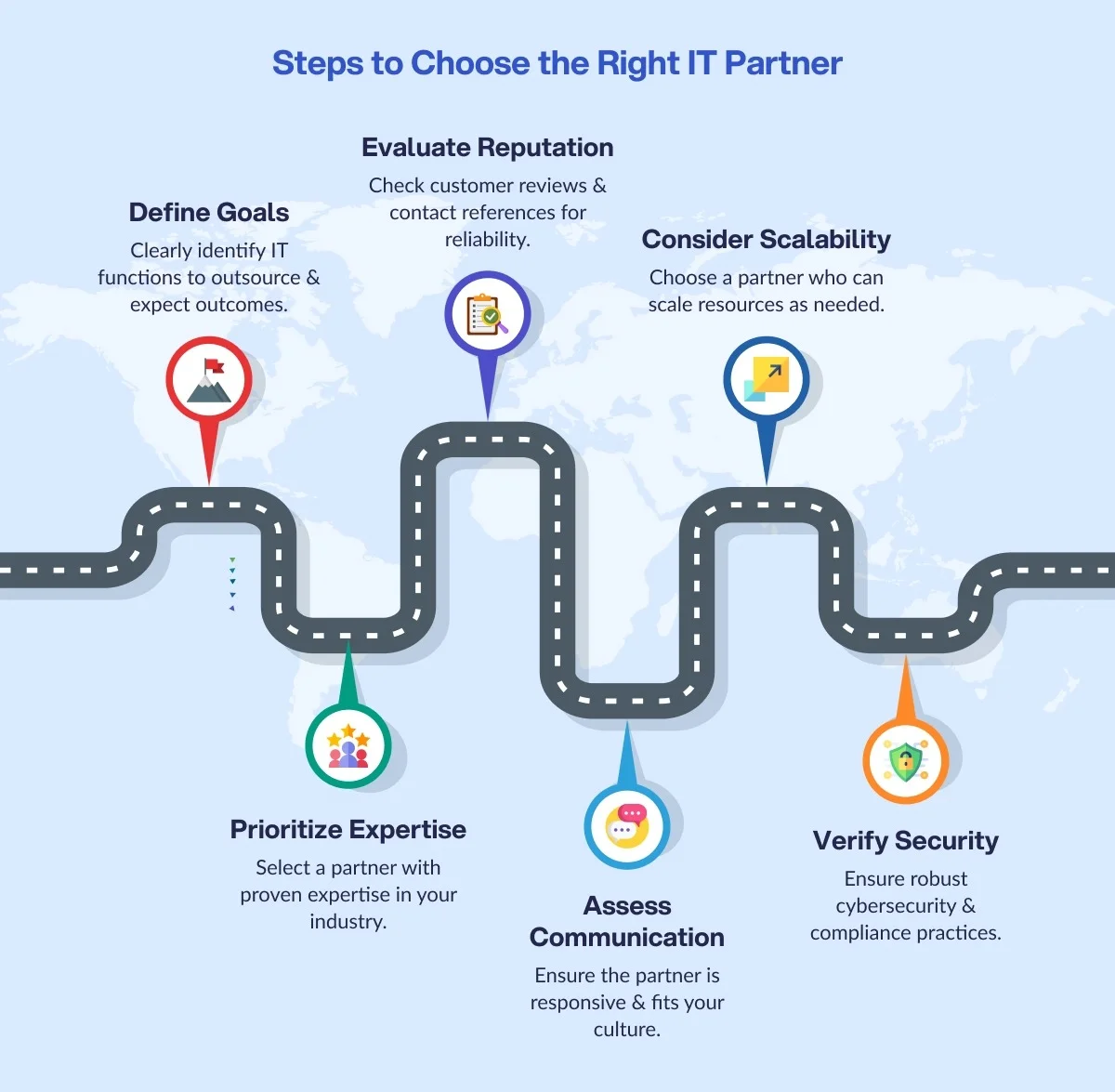
Kindly, refer to the figure below to get a better understanding and flow of how to strategically choose an outsourcing partner.
1. Define Clear Goals and Scope of Work
Before looking for an outsourcing partner, clearly identify which IT functions you want to outsource and what outcomes you expect.
2. Prioritize Domain Knowledge and Technical Expertise
Choose a partner with proven experience in your industry and the specific technologies relevant to your project.
For example, healthcare or fintech companies require providers familiar with compliance standards like HIPAA or PCI-DSS. Reviewing case studies and past projects offers insight into their capabilities.
3. Evaluate Reputation and References
Check customer reviews on platforms such as Clutch, GoodFirms, Glassdoors, or LinkedIn. Contact previous clients to verify reliability, adherence to deadlines, and quality of communication.
For further information, look at other basic information like founding year, employee size, and number of offices. They often indicate the sustainability of the business and credibility.
4. Assess Communication and Cultural Fit
Outsourced teams with strong proficiency in the client’s primary language (often English) reduce misunderstandings and enable smoother interactions.
A strong cultural fit fosters trust, engagement, and collaboration. They are essential for remote or distributed teams working on complex IT projects.
5. Consider Scalability and Flexibility
Your partner should be able to scale resources up or down based on project needs and evolving business demands. Flexible pricing models and contract terms are important to accommodate growth or pivots without excessive overhead.
6. Verify Security and Compliance Practices
Ensure the provider follows robust cybersecurity protocols and complies with relevant industry regulations. This is especially critical for businesses handling sensitive data.
Establish detailed service level agreements (SLAs) that cover data protection, access controls, incident response protocols, and compliance obligations.
Need Help Building Your Vendor Shortlist?
Tell us what you're looking for and get help identifying companies relevant to your requirements.
Get a Free ConsultationFinal Thoughts
You don’t need to build everything yourself. The most forward-thinking small business leaders are no longer trying to stretch limited internal resources or gamble on costly hires. Instead, they’re forging strategic partnerships with IT outsourcing partners. Along with technical skills, they bring speed, scalability, and security.