


 5 min read
Tech leaders face intense pressure to deliver high-quality solutions fast while optimizing costs. Choosing between staff augmentation vs project outsourcing is a pivotal decision that impacts control, scalability, and ROI. Staff augmentation integrates specialized talent into your team, while outsourcing delegates entire projects to external vendors. This article aims to assist you in aligning outsourcing models with your business goals, driving efficiency and competitive success, with insights to achieve up to 40% cost savings.
Staff Augmentation vs Project Outsourcing
When choosing between staff augmentation and project outsourcing, it's important to weigh factors like control, speed, and team structure. Each model offers distinct advantages depending on your project goals and internal capabilities. The table below highlights the key differences to help guide your decision.
Criteria | Staff Augmentation | Project Outsourcing |
|---|---|---|
Level of Control | High | Medium to Low |
Speed to Start | Fast | Moderate |
Ownership | You manage internal processes | Vendor manages the development process |
Cost Model | Hourly or monthly rates | Fixed or milestone-based |
Best Use Case | Filling skill shortages in-house | Delivering a well-defined solution |
Internal Oversight Needed | Yes | Minimal |
Talent Management | Your internal team | External personnel responsibility |
Time Zone Flexibility | Often flexible | Varies by provider |
Strategic Insights from the Field
The augmentation vs. outsourcing choice varies by industry. Both models deliver cost efficiency and agility, but their value varies by industry and scenario. Below, we discuss insights into fintech and healthcare, addressing market conditions and business processes.
Fintech: Scaling Secure Systems
Azlo partnered with BairesDev to augment its team with security-focused engineers skilled in DevOps, frontend, backend, blockchain, and PCI-DSS compliance. Consequently, over 18 months, Azlo doubled its customer base, implemented CI/CD pipelines, and strengthened UX/UI security while maintaining full IP control.
Healthcare: Operational Improvement
PHR partnered with Infinit-O (based in the Philippines) to outsource data entry, billing, and IT support, reducing internal workload. As a result, the operating costs dropped by 30–50%, IT ticket resolution time was cut in half, and the team refocused on patient care with HIPAA-compliant processes.
What to choose when
The table below discusses how to choose between staff augmentation and project outsourcing depending on six major decision criteria:
Decision Factor | Favor Staff Augmentation | Favor Project Outsourcing |
|---|---|---|
Project Scope | Evolving or unclear | Clearly defined and documented |
In-House Technical Leadership | Available and experienced | Overloaded or absent |
Control Requirements | Need direct control | Willing to delegate control |
Financial Planning | Flexible budgeting | Need cost efficiency and predictability |
Security Risks and IP | Managed in-house | Outsourced with contractual terms |
Strategic Objectives | Focus on core competencies | Free up the internal team for core business activities |
Common Scenarios and Best-Fit Models
It is helpful to look at common business scenarios where choosing the right delivery model can make all the difference. Understanding these typical challenges and matching them with the best-fit approach helps tech leaders optimize resources, control, and speed.
Scenario | Challenge | Solution | Why |
|---|---|---|---|
Scaling a Product Development Team | Limited recruitment bandwidth. | Staff augmentation. | Provides access to specialized skills without long-term commitments or additional expenses. |
Launching a Compliance-Heavy MVP | Lack of regulatory expertise and need for faster delivery. | Project outsourcing. | Enables effective collaboration with experienced professionals and reduces overhead costs. |
Balancing Core Activities and New Features | Need to maintain control over project execution while launching new features. | Hybrid approach. | Combines flexible staffing strategy with dedicated team delivery models. |
Rapid Expansion into New Markets | Tight timeline, limited in-house resources. | Project outsourcing with a third-party provider. | Enables cost-effective solution and quicker access to external expertise. |
Overcoming Common Outsourcing Challenges
Executives face potential challenges like vendor selection, communication issues, and security risks. Here’s how to address them:
Vendor Selection: Score vendors on quality control, certifications (e.g., ISO 27001), and experienced professionals. Request portfolios showing effective collaboration.
Communication Challenges: Mitigate time zone gaps and unclear communication workflow with clear communication protocols. Have daily stand-ups, shared dashboards, and agreed response times regardless of vendor location.
Security Risks & ROI: Protect intellectual property with contract negotiation for NDAs.
Strategic Tools for Outsourcing Success
To achieve cost efficiency, operational efficiency, and business growth through staff augmentation or project outsourcing, tech leaders need good tools to guide vendor selection. Below, we provide an expanded Vendor Selection Checklist and ROI Calculator, incorporating strategic insights and effective strategies to align your outsourcing partner with your business objectives. These tools address communication challenges, security risks, and financial planning, empowering you to make informed decisions that support long-term goals.
Vendor Selection Checklist
Selecting the right external service provider is critical to minimizing unexpected expenses and ensuring seamless collaboration. Use this comprehensive checklist to evaluate outsourcing providers and align their specialized expertise with your business requirements:
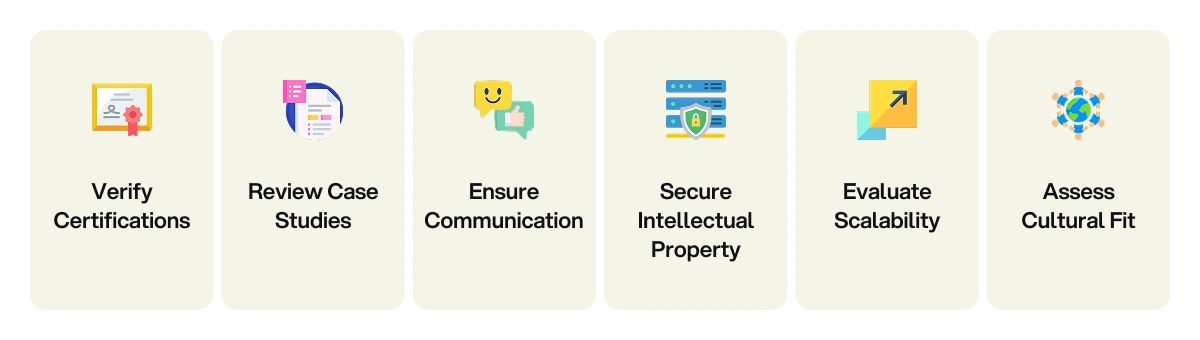
Evaluation Area | What to Look For |
|---|---|
Verify Certifications for Quality and Security | Confirm ISO 27001, CMMI, and industry-specific standards like PCI-DSS (fintech) or HIPAA (healthcare). |
Review Case Studies for Proven Expertise | Look for relevant project examples showing success in staff augmentation or outsourcing, with measurable outcomes. |
Ensure Communication Styles Align | Establish regular communication protocols (e.g., daily stand-ups, Slack updates) to bridge cultural or time zone gaps. |
Secure Intellectual Property with NDAs | Negotiate strong NDAs and security terms to protect data and IP, especially for sensitive industries. |
Evaluate Scalability and Long-Term Fit | Check the vendor'sDifferent capacity to scale with your growth and provide niche expertise when needed. |
Assess Cultural and Operational Fit | Ensure alignment in work culture, communication, and daily processes to enable smooth collaboration. |
Hybrid Model Consideration
Global Workplace Analytics reports that companies save an average of $11,000 per employee each year by adopting a remote workforce. For companies balancing core business functions and non-core tasks, a hybrid approach combining staff augmentation and project outsourcing can optimize operational costs and strategic objectives. This framework leverages external vendors for entire projects while augmenting internal resources for critical tasks.
Steps to Implement
Identify core competencies to retain in-house (e.g., intellectual property management).
Outsource non-core activities (e.g., UI/UX design) to a dedicated team.
Augment specialized skills (e.g., AI or compliance expertise) to fill talent gaps.
Establish communication protocols to align external staff with internal processes.
Benefits:
Combines complete control of staff augmentation with faster turnaround times of project outsourcing.
Reduces overhead costs by leveraging external expertise for complex projects.
Supports competitive edge by aligning team size with project requirements.
Final Thoughts
Different staffing models are available to align with your business strategy and company objectives. Whether you are filling talent gaps with temporary professionals or delegating development to an external entity, your decision hinges on current market conditions, team size, and long-term commitments.
Careful evaluation of each model, consideration of contractual terms, and awareness of potential challenges like communication issues or hidden costs will enable informed decisions. For businesses aiming to enhance core business functions while minimizing unexpected expenses, understanding the core differences in the augmentation vs. project outsourcing spectrum is critical.


