

 15 min read
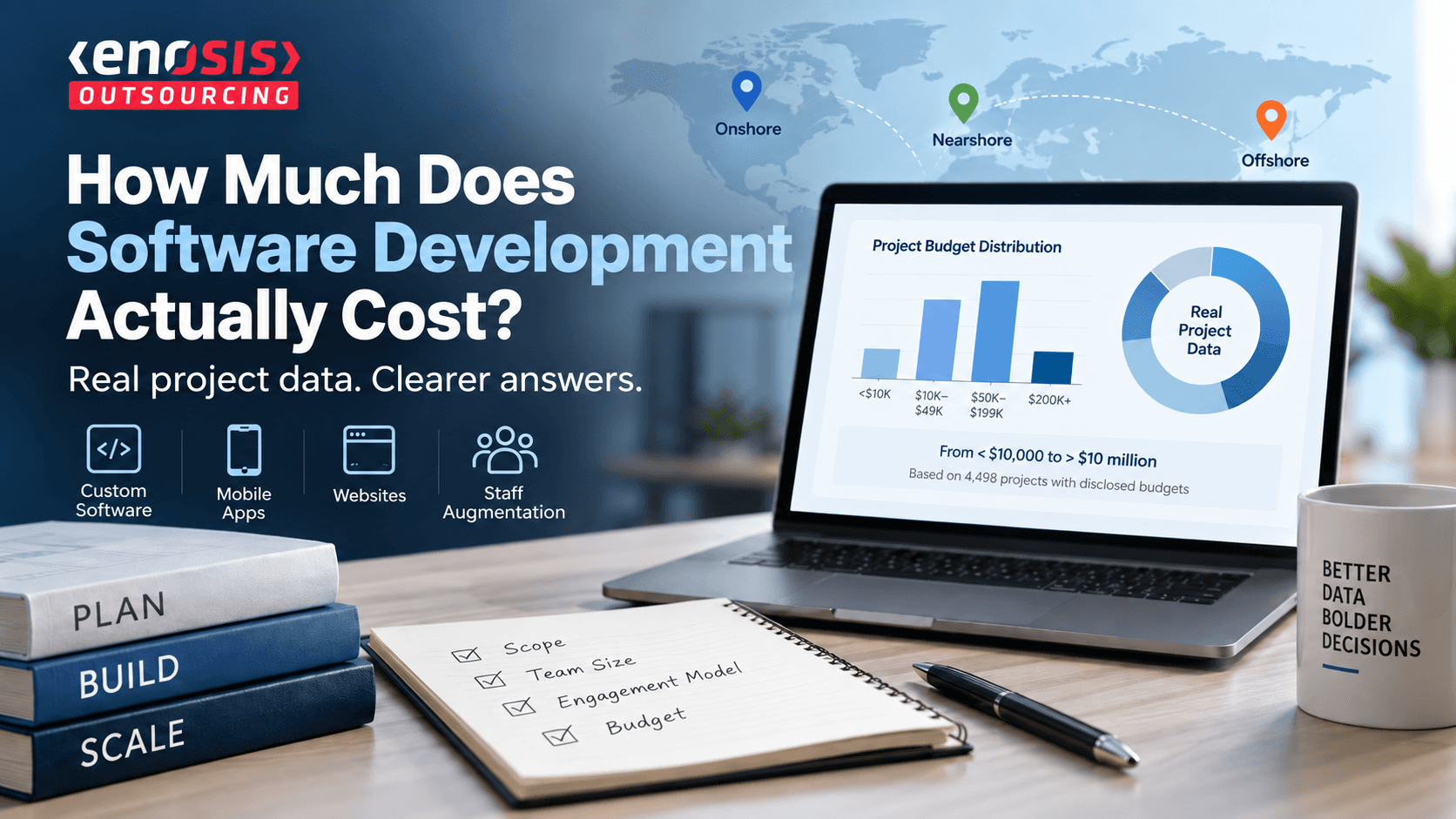
Based on 472 MVP projects with disclosed budgets in the Enosis Outsourcing dataset, the most common budget range is $10,000 to $49,000. Another 36.2% of projects fall between $50,000 and $199,000.
But historical MVP cost benchmarks now need more context.
The way software is built is changing quickly. Developers now use AI to help write routine code, create tests, find bugs, document systems, explore unfamiliar code, and speed up repetitive work. A small, experienced team may therefore be able to deliver more than a similar-sized team could several years ago.
That does not mean a $50,000 MVP should suddenly cost $25,000.
Faster coding does not remove architecture, product decisions, testing, security, integrations, deployment, or the need for experienced people to make sure the product actually works.
So the better question for buyers in 2026 is not only:
How many developers and hours am I paying for?
It is:
What can this team realistically deliver for my budget, how quickly can they deliver it, and how are they using AI to improve the outcome?
To establish a real-world benchmark, Enosis Outsourcing analyzed 559 projects explicitly identified as MVPs from a dataset of 14,075 published and endorsed outsourced software projects.
Of those 559 MVP projects:
472 have disclosed budgets
291 completed projects have confirmed start and end dates
268 projects were still ongoing at the time of analysis
The EOS data gives us a real-world benchmark for cost, timeline, and team size. Current software development research helps explain how buyers should interpret those benchmarks now that AI is becoming part of everyday development.
How Much Does an MVP Cost in 2026?
Among the 472 MVP projects with disclosed budgets in the EOS dataset, the cost distribution looks like this:
MVP Development Budget | Share of Projects |
|---|---|
Under $10,000 | 11.0% |
$10,000 to $49,000 | 39.0% |
$50,000 to $199,000 | 36.2% |
$200,000 to $999,000 | 12.1% |
$1 million or more | 1.7% |
The most common MVP development cost range is $10,000 to $49,000.
Exactly 50% of the analyzed MVP projects cost less than $50,000. Another 36.2% fall between $50,000 and $199,000.
Together, the $10,000 to $49,000 and $50,000 to $199,000 bands account for 75.2% of disclosed MVP projects.
That makes $10,000 to $199,000 a useful broad planning range for many outsourced MVP projects.
It is not a universal price.
A simple internal web tool and a financial platform with payments, multiple user roles, integrations, security requirements, and mobile applications can both be called an MVP, but their budgets will be completely different.
Need Help Building Your Vendor Shortlist?
Tell us what you're looking for and get help identifying companies relevant to your requirements.
Get a Free ConsultationHow Long Does an MVP Take to Build?
Among the 291 completed MVP projects with usable timeline data:
Median development timeline: 6 months
Mean development timeline: 7.6 months
25% completed within approximately 3 months
75% completed within approximately 10 months
MVP Development Time | Share of Completed Projects |
|---|---|
Under 3 months | 15.5% |
3 to 6 months | 34.0% |
6 to 12 months | 30.9% |
More than 12 months | 19.6% |
Six months is therefore a useful benchmark, but it should not automatically become the deadline for every MVP.
Some tightly scoped MVPs can be built in weeks or a few months. Others take a year or longer because the product itself is more complex.
This is where AI starts changing the cost and timeline discussion.
AI Is Changing the Economics of MVP Development
AI is already widely used in software development.
Stack Overflow's 2025 Developer Survey found that 84% of respondents were using or planning to use AI tools in their development process, while 51% of professional developers reported using them daily.
DORA research also found very high AI adoption among technology professionals and concluded that the results depend heavily on the quality of the engineering practices around the tools.
For an MVP buyer, the important point is simple:
The amount of work a capable development team can produce is changing.
Developers may now use AI to help with:
writing routine code
creating tests
finding bugs
explaining unfamiliar code
writing technical documentation
building early prototypes
refactoring repetitive code
exploring possible solutions
These improvements can save real time.
But this equation is too simplistic:
30% faster coding = 30% cheaper MVP
Software projects involve much more than writing code.
Why Faster Coding Does Not Mean the Whole MVP Gets 30% Cheaper
Imagine a six-month MVP project. Only part of those six months is spent writing application code.
The project may also include:
product discovery
requirement clarification
UI and UX design
architecture decisions
stakeholder review
third-party integrations
testing
security checks
deployment
user feedback
bug fixing
project management
AI can speed up several of these areas, but it does not remove all of them.
McKinsey research found large time savings for some clearly defined software development tasks:
Code documentation: 45% to 50% faster
Code generation: 35% to 45% faster
Code refactoring: 20% to 30% faster
Highly complex tasks: less than 10% faster
The final point is especially important.
AI tends to provide larger gains when the work is clearly defined and repetitive. The benefit becomes smaller when the task requires deeper judgment, complicated decisions, or detailed knowledge of a particular system.
Bain has similarly estimated that companies using AI in software development are seeing around 10% to 15% savings in total engineering time on average, even though savings on individual coding activities can be much higher.
A development company should therefore not take a traditional project estimate and apply an arbitrary "AI discount."
The impact depends on the project.
AI Can Make Some Developers Faster and Others Slower
Buyers should also be careful with bold productivity claims.
In a controlled study, METR asked experienced open-source developers to complete real tasks inside software projects they already knew well.
Before the study, the developers expected AI to help them finish faster.
Instead, developers using the early-2025 AI tools tested in the study took 19% longer on the measured tasks.
That does not mean AI makes software development slower in general.
The study covered a specific group of experienced developers, specific projects, and the tools available at that time.
What it does show is that:
AI productivity is not automatic.
The result depends on:
the developer
the type of task
the quality of the tools
the codebase
how familiar the developer is with the system
how much checking the output requires
That is why buyers should be skeptical when a software company claims:
"We use AI, so every project is 40% faster."
There is no reliable universal percentage that applies to every software project.
Looking for a Team That Can Turn AI Into a Real Product?
Explore companies with experience building AI and machine learning solutions around practical business requirements.
Find AI Development TeamsDoes AI Make MVP Development Cheaper?
It can, but a lower price is only one possible benefit.
The time saved through AI can show up in several different ways.
1. The Same MVP Can Cost Less
If a team can complete the same work with fewer engineering hours without reducing quality, some of that saving can be passed to the buyer.
For example:
Traditional estimate:
$50,000
5 months
More efficient estimate:
$42,000
5 months
The scope stays similar, but the cost falls.
2. The MVP Can Launch Faster
The vendor may keep the budget similar but deliver the product sooner.
A $50,000 MVP that previously required five months might, in the right circumstances, reach users in four months.
For a startup, launching earlier may be worth more than reducing the invoice.
The company can start learning from users sooner.
3. The Same Budget Can Produce a Better Product
Instead of reducing the price, the team can use the saved time to improve:
user experience
testing
security
performance
documentation
analytics
user feedback and iteration
The budget stays similar, but the quality of the product improves.
4. The Same Budget Can Cover More Scope
Some features that previously would have been postponed until Phase 2 may now fit inside the initial budget.
That can be useful, but it also creates a new risk. Just because a feature becomes cheaper to build does not mean it belongs in the MVP.
The Biggest AI Risk for MVPs May Be Building Too Much
Historically, software features were expensive. That forced teams to prioritize.
If an additional feature required two more weeks of development, everyone had a reason to ask:
Do we really need this?
Some features can now be created much faster.
This can lead teams to ask:
It is easy to add, so why not add it?
That can turn a focused MVP into an oversized first product.
The purpose of an MVP is not to build the maximum number of features the budget allows.
It is to test something important.
For example:
Will customers use the product?
Will users complete the main workflow?
Will they return?
Will they pay?
Does the business model work?
Is the problem important enough to solve?
AI can reduce the cost of producing software.
It cannot decide which software is worth producing.
That still requires product judgment.
MVP Development Cost by Budget
The EOS data becomes more useful when the budget ranges are translated into the type of MVP a buyer might realistically expect.
What Can You Build for an MVP Budget Under $10,000?
In the EOS dataset, 11% of disclosed MVP projects cost less than $10,000.
These projects typically used teams of 1 to 5 people and had a median completed timeline of approximately three months.
This budget is usually more realistic for:
a simple web tool
a small internal application
a basic mobile prototype
a landing experience connected to a backend
a product testing one main user flow
It is generally less realistic for:
a complex SaaS platform
a sophisticated marketplace
multiple native mobile applications
advanced administration systems
many complex integrations
products with demanding security requirements
What AI Changes Under $10,000
AI can help a small team complete routine work faster, which may make this budget more capable than it was several years ago.
The best use of that extra capacity is usually to improve the core experiment, rather than adding feature after feature.
At this budget, focus matters more than ever.
What Can You Build for $10,000 to $49,000?
This is the largest MVP budget group in the EOS dataset.
184 projects, or 39% of all disclosed MVP projects, fall into this range.
The typical team remains relatively small, and the historical median completed timeline is around five months.
Depending on complexity, this budget may support:
a focused SaaS product
a mobile application
a B2B web application
a customer portal
an internal business platform
a workflow tool
a small marketplace
a product with user accounts and a defined backend
What AI Changes Between $10,000 and $49,000
This may be the budget range where AI has one of the most visible effects.
An experienced small team may be able to handle work that previously required more people or more time.
Buyers should therefore ask: What will this team deliver?
Rather than focusing only on: How many developers will I get?
Want to See What a Vendor Has Actually Delivered?
Explore real project experience to understand a company’s capabilities before adding it to your shortlist.
Explore ProjectsWhat Can You Build for $50,000 to $199,000?
This range accounts for 36.2% of disclosed MVP projects in the EOS dataset.
The historical median completed timeline is approximately six months.
At this level, teams of 6 to 10 become more common, and projects tend to include more design, testing, backend infrastructure, and cloud work.
Possible features include:
multiple user roles
subscriptions
payments
third-party integrations
dashboards
administration systems
analytics
mobile and web applications
production infrastructure
more extensive testing
What AI Changes Between $50,000 and $199,000
At this level, the benefit of AI extends beyond simply writing code faster.
A capable team may also use it to assist with:
testing
bug investigation
documentation
routine development
code review support
log analysis
prototyping
maintenance tasks
Buyers should increasingly judge the quality of the complete delivery process, rather than the number of developers alone.
What Does a $200,000 or More MVP Look Like?
Around 13.8% of disclosed MVP projects in the EOS dataset cost $200,000 or more.
Within the $200,000 to $999,000 range, the historical median completed timeline rises to approximately 12 months, and 55% of completed projects took longer than one year.
At this point, MVP often means:
The smallest workable version of a complex product.
Examples may include:
enterprise platforms
financial software
healthcare systems
large marketplaces
multi-tenant SaaS platforms
products with complex integrations
systems handling sensitive information
applications with significant security requirements
What AI Changes Above $200,000
AI may still save substantial engineering time, but it cannot remove the underlying complexity of the product.
A payment still has to be processed correctly.
Access permissions still have to work.
Sensitive customer information still has to be protected.
Third-party integrations still need to handle failures.
Production systems still need to remain reliable.
A useful way to think about this is:
AI may make code cheaper to produce faster than it makes mistakes cheaper to fix.
The greater the cost of failure, the more important experienced human review becomes.
Does AI Mean You Need Fewer Developers?
Not automatically.
But team size is becoming a less useful way to estimate what a software company can deliver.
The EOS data already shows that MVP development is dominated by relatively small teams.
60.7% used teams of 1 to 5 people
34.2% used teams of 6 to 10 people
94.9% used ten people or fewer
AI may strengthen this trend.
But the change will not always look like:
10 developers become 5 developers.
It may instead mean that a smaller number of experienced people can handle a wider range of work.
A senior developer may be able to move faster across coding, testing, debugging, documentation, and unfamiliar parts of a system.
That makes experience more valuable, not less.
Does AI Mean You Should Pay Less Per Developer?
Not necessarily.
Consider two vendors.
Vendor A
Hourly rate: $50
Estimated effort: 1,000 hours
Total estimated cost: $50,000
Vendor B
Hourly rate: $70
Estimated effort: 650 hours
Total estimated cost: $45,500
Vendor B has the higher hourly rate.
But the estimated total project cost is lower because the team needs fewer hours.
If you compare only hourly rates, Vendor A looks cheaper.
If you compare the total cost of reaching the same result, Vendor B looks cheaper.
This is why AI and better development practices make hourly rate comparisons less useful when viewed on their own.
Fixed Price vs Hourly Pricing for MVP Development
There is no single pricing model that works for every MVP.
When Time and Materials Works Well
requirements are still changing
discovery is ongoing
priorities will move frequently
the team needs flexibility
the buyer wants ongoing control over scope
When Fixed Price Works Better
the scope is clear
requirements are stable
acceptance criteria are defined
both sides understand what will be delivered
When Milestone-Based Pricing Can Work
Milestone pricing can work well when the project can be divided into stages such as:
prototype
core product
beta launch
production launch
This can make progress easier to measure and reduce uncertainty for both parties.
The important point is not that one pricing model is always better.
Buyers should increasingly compare:
the total cost of getting a useful result
rather than focusing only on:
the price of one developer-hour.
Is Offshore MVP Development Still Cheaper?
In the EOS dataset:
62.1% of MVP projects used offshore delivery
27.5% used nearshore delivery
10.4% used onshore delivery
Offshore development is therefore the most common delivery model in this dataset.
Lower hourly rates have traditionally been one of the main advantages of offshore development.
That still matters, but AI makes the comparison more complicated.
Suppose one team charges $35 per hour but needs 1,500 hours.
Another charges $55 per hour but needs 900 hours.
The cheaper hourly rate does not automatically result in the cheaper project.
Buyers should compare:
total project cost
delivery speed
relevant experience
team quality
communication
testing standards
post-launch support
Location matters, but it should not be the only factor.
How to Tell Whether a Vendor Is Actually Using AI Well
In 2026, almost every software company can say:
"We use AI."
That statement means very little on its own.
A capable development partner should be able to explain exactly where AI helps.
For example:
routine coding
testing
documentation
debugging
prototyping
code review support
internal development tools
More importantly, the company should explain what happens after AI produces something.
Ask:
Who checks the code?
What tests are required?
What happens before code reaches production?
How are security problems identified?
How is confidential information protected?
AI should be part of a strong development process.
It should not replace one.
Looking for Companies With the Right Expertise?
Explore software development companies by service and narrow your options around what your project requires.
Find Relevant Companies9 Questions to Ask an MVP Development Company in 2026
1. How Will You Use AI on My Project?
Do not settle for:
"Our developers use AI."
Ask where it will be used, how it will be used, and where it will not be used.
2. How Does AI Change My Quote?
Ask whether the benefit appears as:
lower price
faster delivery
better quality
more scope
a smaller team
The vendor should be able to explain where the saving goes.
3. What Will Still Be Reviewed by a Human?
Human review matters especially for:
architecture
security
payments
sensitive information
permissions
complex calculations
production infrastructure
4. How Do You Check AI-Generated Code?
Look for a clear process that may include:
code review
automated testing
integration testing
security checks
staging environments
deployment checks
5. What Happens to Our Data?
Ask whether proprietary information or source code can be sent to third-party AI services.
This is particularly important when the product contains:
customer data
financial information
health information
intellectual property
confidential business information
6. Can You Show Me a Similar MVP You Have Built?
Ask for examples similar to your project in terms of:
budget
industry
platform
complexity
timeline
team size
A relevant completed project is more useful than a long general portfolio.
7. Who Will Actually Work on the Project?
Find out who is responsible for:
technical decisions
development
testing
deployment
project management
Do not judge the team only by its size.
8. What Is Not Included in the Quote?
Clarify whether the price includes:
product discovery
UI and UX design
QA
project management
hosting
third-party services
deployment
post-launch support
Two similar-looking quotes may cover very different amounts of work.
9. What Are We Trying to Achieve With This MVP?
A strong vendor should talk about more than features.
The purpose of the MVP may be to:
test demand
validate a workflow
collect user feedback
confirm willingness to pay
test an operating model
decide whether the product deserves further investment
That is ultimately what the MVP should help you learn.
A Better Way to Plan an MVP in 2026
Before requesting estimates from software development companies, answer six questions.
1. What Are We Trying to Prove?
Write the main assumption in one sentence.
For example:
Small accounting firms will pay for a tool that automatically extracts invoice data and sends it into their accounting software.
That can be tested.
"Build an AI accounting platform" is not a testable MVP hypothesis.
2. Who Will Use the First Version?
Will the MVP be used by:
your internal team
20 beta users
paying customers
thousands of public users
The answer changes the required level of quality, security, testing, and infrastructure.
3. What Absolutely Has to Work?
Identify the parts of the product that cannot fail.
A minor layout issue may be acceptable during an early test.
A payment calculation error may not be.
Spend more engineering effort where failure matters most.
4. What Can Be Built Faster With AI?
Look for repetitive or clearly defined work.
Do not assume every part of the project should be handled in the same way.
5. What Can Wait Until Later?
Ask this question for every requested feature:
Can we still test the main idea without it?
If the answer is yes, consider leaving it out of the MVP.
6. What Happens After the MVP Launches?
Decide what results will cause you to:
continue
improve the product
change direction
stop
An MVP should help make that decision.
What Should a Good MVP Budget Buy in 2026?
Two budget ranges dominate the EOS dataset:
$10,000 to $49,000: 39.0%
$50,000 to $199,000: 36.2%
Together, they represent 75.2% of disclosed MVP projects.
That makes $10,000 to $199,000 a useful broad benchmark for many outsourced MVP engagements.
But buyers should expect the amount of software delivered for that money to continue changing.
One vendor may offer:
five developers
six months
a largely traditional development process
Another may offer:
three experienced developers
better automation
stronger testing
AI-assisted development
four months
The smaller team is not automatically worse.
The team using more AI is not automatically better.
The important questions are:
What will they deliver?
How will they prove it works?
How quickly can real users test it?
What happens when something goes wrong?
What Is the Biggest MVP Cost Mistake in 2026?
Building too much.
That was true before AI.
It may be even more important now.
AI makes some development work cheaper and faster.
That can create the illusion that every feature should be included simply because it is now easier to build.
But more features do not automatically produce better evidence.
The best MVP is not the product with the greatest number of features your budget can afford.
It is the smallest credible product that gives you reliable evidence about whether the idea is worth pursuing.
The EOS timeline data also shows why scope discipline matters.
The median completed MVP took six months, while the mean was 7.6 months. This is a relatively narrow difference compared with several larger project types in the EOS dataset.
A tightly defined MVP is easier to plan.
AI does not change that principle.
The Bottom Line: How Much Should You Budget for an MVP?
Based on 472 EOS MVP projects with disclosed budgets:
11.0% cost less than $10,000
39.0% cost $10,000 to $49,000
36.2% cost $50,000 to $199,000
13.8% cost $200,000 or more
Exactly half fall below $50,000.
The historical median timeline among completed projects is six months.
The overwhelming majority of MVPs with known team sizes were built by teams of ten people or fewer.
These numbers remain useful benchmarks.
But they should be treated as reference points, not fixed rules.
AI is changing how much work a developer can handle. It is changing how quickly prototypes can be created. It is helping teams with testing, debugging, documentation, and routine coding.
But it has not removed the need for:
good product decisions
experienced developers
architecture
testing
security
domain knowledge
human review
The best question for an MVP buyer in 2026 is therefore not:
How many developers do I get for my money?
It is:
How much useful, tested product can this team deliver for my budget, and how quickly can we learn whether it is worth building further?
That is the number that matters.
Research Methodology and Data Limitations
This benchmark includes 559 projects where "MVP" appears in the project name, taken from 14,075 published and endorsed outsourced software projects in the Enosis Outsourcing dataset.
Of those 559 MVP projects:
472 had disclosed budgets
87 had confidential budgets and were excluded from cost analysis
291 completed MVPs had usable start and end dates
268 projects were still ongoing
the data cutoff was September 8, 2026
There are several limitations.
Projects that were effectively MVPs but did not include "MVP" in their project names may not appear in the sample.
Ongoing projects are excluded from completed-project timeline analysis.
The dataset contains published and client-endorsed projects, which may create selection bias.
EOS also records project budgets as ranges rather than exact prices, so an exact average MVP development cost cannot be calculated responsibly from this dataset.
The AI-related findings in this article come from independent research and should be treated separately from the EOS project data.
The EOS dataset does not identify how much AI was used on each individual project.
External research referenced in this article includes findings from Stack Overflow, DORA, Bain, McKinsey, and METR. These studies collectively show that AI can improve productivity substantially in some tasks, but the actual benefit varies according to the project, developer, complexity, codebase, and development process.